












Electrogenerated chemiluminescence resonance energy transfer between luminol and MnO2 nanosheets decorated with Cu2O nanoparticles for sensitive detection of RNase H
文献情報
出版日
2023-02-11
DOI
10.1039/D3AN00002H
インパクトファクター
4.616
著者
Yahao Shi, Chunting Chen, Yahui Zhang, Yongping Dong, Shangbing Wang
原文を見る
要旨
In the present work, a novel approach was developed for the preparation of Cu2O nanoparticle decorated MnO2 nanosheets (Cu2O@MnO2). Uniformly dispersed Cu2O nanocrystals were produced on the surface of MnO2 nanosheets by in situ reduction under refluxing conditions. The unique structure of the used MnO2 nanosheet support played a vital role in the preparation of such Cu2O@MnO2 nanocomposites. The electrogenerated chemiluminescence (ECL) resonance energy transfer can occur between the luminol/H2O2 system and Cu2O@MnO2 nanocomposites, resulting in a decrease of the ECL intensity, which can be used to fabricate an ECL sensor. Cu2O@MnO2 nanocomposite modified heterologous DNA/RNA duplexes were modified on the GCE to construct an ECL-RET system, leading to the decrease of ECL intensity. As a highly conserved damage repair protein, RNase H can specifically hydrolyze RNA in DNA/RNA strands to release Cu2O@MnO2 nanocomposites and recover the ECL signal. As a result, an “off–on” mode ECL sensor for sensitive RNase H assay was fabricated. Under the optimal conditions, the detection limit of RNase H is 0.0005 U mL−1, which is superior to other approaches. The proposed method provides a universal platform for monitoring RNase H, and exhibits great potential in bioanalysis.
関連文献
Investigating carbohydrate isomers by IMS-CID-IMS-MS: precursor and fragment ion cross-sections
M. M. Gaye, R. Kurulugama, D. E. Clemmer
2015-08-07
Paper
DOI: 10.1039/C5AN00840A
Rapid detection of cocaine, benzoylecgonine and methylecgonine in fingerprints using surface mass spectrometry
Melanie J. Bailey, Robert Bradshaw, Simona Francese, Tara L. Salter, Catia Costa, Roger P. Webb, Ingrid Bosman, Kim Wolff, Marcel de Puit
2015-05-01
Paper
DOI: 10.1039/C5AN00112A
Preparation and evaluation of nanocellulose–gold nanoparticle nanocomposites for SERS applications
2015-06-09
Paper
DOI: 10.1039/C5AN00606F
Chemical contrast observed in thermal images of blood-stained fabrics exposed to steam
Wayne L. O'Brien, Nicholas D. Boltin, Zhenyu Lu, Brianna M. Cassidy, Raymond G. Belliveau, Emory J. Straub, Stephanie A. DeJong, Stephen L. Morgan, M. L. Myrick
2015-07-24
Communication
DOI: 10.1039/C5AN01413A
Multi-component analysis of bile acids in natural Calculus bovis and its substitutes by ultrasound-assisted solid–liquid extraction and UPLC-ELSD
Xiao-He Xiao, Jia-Bo Wang, Yan-Ling Zhao, Mei-Hua Yang
2012-10-01
Paper
DOI: 10.1039/C2AN36084E
MALDI mass spectrometric imaging meets “omics”: recent advances in the fruitful marriage
2015-06-29
Minireview
DOI: 10.1039/C5AN00990A
Fluorescent polymer-based post-translational differentiation and subtyping of breast cancer cells
Michael D. Scott, Rinku Dutta, Manas K. Haldar, Anil Wagh, Thomas R. Gustad, Benedict Law, Daniel L. Friesner, Sanku Mallik
2012-10-04
Communication
DOI: 10.1039/C2AN35877H
Mercury-induced fragmentation of n-decane and n-undecane in positive mode ion mobility spectrometry
2015-07-22
Paper
DOI: 10.1039/C5AN00876J
Detection of low concentrations of ampicillin in milk
Chrysafis Andreou, Rustin Mirsafavi
2015-06-09
Communication
DOI: 10.1039/C5AN00864F
Colorimetric detection of biological hydrogen sulfide using fluorosurfactant functionalized gold nanorods
Xuan Zhang, Wenjuan Zhou, Zhiqin Yuan, Chao Lu
2015-09-17
Paper
DOI: 10.1039/C5AN01665G
こちらもおすすめ
28770-01-62-(2-Isopropyl-1,3-o...
化合物よくある質問
「邻羟基阿托伐他汀内酯标准品」に適用される法規ガイドelinesは何ですか?
CAS番号163217-74-1の「邻羟基阿托伐他汀内酯标准品」は、GHS分類では危険物に分類されず、主にREACH規則とFDA/EPAの管理対象となります。R...
163217-74-1ortho-Hydroxy Atorva...
化合物よくある質問
メチル(3R)-3-アミノ-2,3-ジヒドロ-1-ベンゾファンラニン-5-カルボイル酸塩塩酸塩の主な用途は何ですか?
メチル(3R)-3-アミノ-2,3-ジヒドロ-1-ベンゾファンラニン-5-カルボイル酸塩塩酸塩は、医薬品や合成化学の研究に広く用いられます。また、特定の薬物の前...
2241594-15-8Methyl (3R)-3-amino-...
化合物よくある質問
トランス-4-メチルピロリジン-3-オール塩酸塩はどのように合成されますか?
トランス-4-メチルピロリジン-3-オール塩酸塩は、4-メチルピロリジンの塩酸塩化によって合成されます。一般的な合成方法では、4-メチルピロリジンを塩酸に加えて...
265108-42-7trans-4-Methylpyrrol...
化合物よくある質問
硫雜環丁烷-1,1-二氧化物は安全ですか?
硫雜環丁烷-1,1-二氧化物は安全ではありません。毒性は報告されていませんが、高温下で分解し、可燃性があるため、高圧ガスは注意が必要です。密閉した容器で保管し、...
5687-92-3Thietane 1,1-dioxide
6054-10-02H, 8H-Benzo[1,2-b
化合物よくある質問
9-ヒドロキシエリプチシネ塩酸塩はどのように合成されますか?
9-ヒドロキシエリプチシネ塩酸塩は、エリプチシネから塩酸を添加することで合成されます。選択性は高いですが、収率は約70%です。
52238-35-49-Hydroxyellipticine...
化合物よくある質問
5-塩素-2-(メチルアミノ)フェニル-(2-塩素フェニル)メタン酮の物理化学的性質は何ですか?
5-塩素-2-(メチルアミノ)フェニル-(2-塩素フェニル)メタン酮のCAS番号は5621-86-3です。この化合物は白色の結晶性粉末で、分子量は415.03で...
5621-86-3[5-Chloro-2-(methyla...
化合物よくある質問
1-[2-(4-甲氧基-苯氧基)-乙基]-哌嗪はどのように保存すればよいですか?
1-[2-(4-甲氧基-苯氧基)-乙基]-哌嗪は、直射日光を避けて暗所に、室温(15-25℃)で保管し、密閉容器に入れることで安定性を保つことができます。
117132-44-21-[2-(4-Methoxy-phen...
化合物よくある質問
2-[3-(4-甲氧基フェニル)プロピル]-4,4,5,5-四メチル-1,3,2-ドイボロロールアンの主な用途は何ですか?
2-[3-(4-甲氧基フェニル)プロピル]-4,4,5,5-四メチル-1,3,2-ドイボロロールアンは、医薬品の合成、有機合成化学、および新材料の研究で使用され...
1073371-72-82-[3-(4-Methoxypheny...
掲載誌
Analyst

CiteScore:
7.8
自己引用率:
5.6%
年間論文数:
653
Analyst publishes analytical and bioanalytical research that reports premier fundamental discoveries and inventions, and the applications of those discoveries, unconfined by traditional discipline barriers.
おすすめ化合物
![1-[(4-Methylphenyl)sulfonyl]-3-(4,4,5,5-tetramethyl-1,3,2-dioxaborolan-2-yl)-1H-pyrrolo[2,3-b]pyridine-5-carbonitrile structure](https://static.chemtradehub.com/structs/143/1434747-57-5-fc0d.webp "1-[(4-Methylphenyl)sulfonyl]-3-(4,4,5,5-tetramethyl-1,3,2-dioxaborolan-2-yl)-1H-pyrrolo[2,3-b]pyridine-5-carbonitrile structure")
![N-[2-(4-Hydroxyphenoxy)-4-nitrophenyl]methanesulfonamide structure](https://static.chemtradehub.com/structs/109/109032-22-6-7c88.webp "N-[2-(4-Hydroxyphenoxy)-4-nitrophenyl]methanesulfonamide structure")
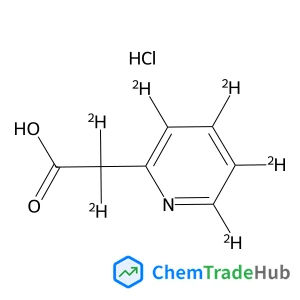
2,2-dideuterio-2-(3,4,5,6-tetradeuterio-2-pyridyl)acetic acid;hydrochloride
CAS番号:
1329799-67-8
分子式:
C7H2ClD6NO2
おすすめサプライヤー





免責事項
このページに表示される学術雑誌情報は、参考および研究目的のみを目的としています。当社は雑誌出版社とは提携しておらず、投稿の取り扱いも行っておりません。出版に関するお問い合わせは、各雑誌出版社に直接ご連絡ください。
表示されている情報に誤りがある場合は、support@chemtradehub.com までご連絡ください。迅速に確認し、対応いたします。