












Hydrophobic cargo loading at the core–corona interface of uniform, length-tunable aqueous diblock copolymer nanofibers with a crystalline polycarbonate core
文献情報
出版日
2022-06-02
DOI
10.1039/D2PY00395C
インパクトファクター
5.582
著者
Yangyang Ren
原文を見る
要旨
1D core–shell nanoparticles are considered to be among the most promising for biomedical applications such as drug delivery. The versatile living crystallization-driven self-assembly (CDSA) seeded growth method allows access to uniform, length-tunable, and water-dispersible nanofibers from block copolymer (BCP) amphiphiles. A problem with respect to their use for drug delivery is that encapsulation of cargo within the crystalline core is expected to be difficult. Herein, we demonstrate that non-covalent hydrophobic cargo uptake by diBCP nanofibers with a crystalline poly(fluorenetrimethylenecarbonate) (PFTMC) core and a corona of either poly(N–isopropylacrylamide, PNIPAM) or poly(ethylene glycol, PEG) can be achieved at the core–corona interface. The length of the nanofibers was precisely controlled over a wide range of lengths (ca. 50–1700 nm, Đ < 1.07), however we focused on low dispersity nanofibers with lengths relevant for drug delivery (100–130 nm, Đ < 1.06) for cargo loading experiments. After loading via a solvent switch to water, the nanofibers remained colloidally stable for at least 6 months and for up to 48 h under enzymatic conditions, as observed by the absence of aggregation by TEM and DLS analysis. Our findings indicate that uptake of the hydrophobic fluorescent dye Nile Red, used as a proxy for a therapeutic cargo, is independent of the nature and length of the corona-forming blocks of the nanofibers. Localization of the cargo at the core–corona interface was evidenced by fluorescence spectroscopy and fluorescence lifetime measurements were also consistent with this assertion.
関連文献
π-Stacking between Casiopeinas® and DNA bases
Rodrigo Galindo-Murillo, Joseelyne Hernandez-Lima, Mayra González-Rendón, Lena Ruíz-Azuara, Rafael Moreno-Esparza
2011-07-12
Paper
DOI: 10.1039/C1CP20183B
Modus operandi of controlled release from mesoporous matrices: a theoretical perspective
Tina Ukmar, Miran Gaberšček, Franci Merzel, Aljaž Godec
2011-07-26
Paper
DOI: 10.1039/C1CP20636B
Stabilization of organic field-effect transistors by tert-butyl groups in dibenzotetrathiafulvalene derivatives
Junki Nagakubo, Minoru Ashizawa, Tadashi Kawamoto, Akihiko Tanioka
2011-06-15
Paper
DOI: 10.1039/C1CP21507H
Testing variations of the GW approximation on strongly correlated transition metal oxides: hematite (α-Fe2O3) as a benchmark
Peilin Liao, Emily A. Carter
2011-07-14
Paper
DOI: 10.1039/C1CP20829B
Assessment of an effective quasirelativistic methodology designed to study astatine chemistry in aqueous solution
Andrea Sabatié-Gogova, Eric Renault, Gilles Montavon, Nicolas Galland
2011-07-18
Paper
DOI: 10.1039/C1CP20512A
Interaction between NO and Na, O, S, Cl on Au and Pd(111) surfaces
Ren-Yu Tian, Xiao-Bao Yang, Song-Lin Peng
2011-07-07
Paper
DOI: 10.1039/C1CP20974D
こちらもおすすめ
化合物よくある質問
2-ヒドロキシ-5-ニトロベンジンブロモイドの代替品はありますか?
2-ヒドロキシ-5-ニトロベンジンブロモイドは特定の化学反応に適しているため、代替品は限られています。しかし、同様の構造を持つ2-ヒドロキシ-4-ニトロベンジン...
772-33-82-(Bromomethyl)-4-ni...
化合物よくある質問
N-(2-ブロモフェニル)-1-チロール-3-オキソ-3-(ピペリジニル)プロペン-2-イル)ベンゼンアミドを取り扱う際の実験室安全事項は何ですか?
N-(2-ブロモフェニル)-1-チロール-3-オキソ-3-(ピペリジニル)プロペン-2-イル)ベンゼンアミドは有毒で、皮膚や粘膜に刺激を与える可能性があります。...
1800044-77-2N-[(1Z)-1-(2-Bromoph...
化合物よくある質問
1,3プロパンジオール,2-[2-(2アミノ-6クロロ-9Hピリミジン-9-イル)エチル-1,1,2,2-D4]-2,3-ジアセタートの市場動向や研究トレンドはどうですか?
この化合物は、新規治療薬の開発に注目されています。市場では、その有効性と安全性が評価され、研究分野では、分子生物学と医薬化学の新たな発見が期待されています。
1020718-81-31,3-Propanediol, 2-[...
579-44-2Ethanone, 2-hydroxy-...
化合物よくある質問
Succinimidyl-alanyl-phenylalanyl-prolyl-phenylalanine 4-nitroanilide はどの業界で使用されていますか?
Succinimidyl-alanyl-phenylalanyl-prolyl-phenylalanine 4-nitroanilide は主に医薬品開発やポ...
128802-73-3succinimidyl-alanyl-...
化合物よくある質問
メチル6-アミノ-5-クロロピリジン-2-カーボイル酸について、適用される法規ガイドラインは何ですか?
メチル6-アミノ-5-クロロピリジン-2-カーボイル酸(CAS番号: 1256794-05-4)の使用には、GHS( Globally Harmonized S...
1256794-05-4Methyl 6-amino-5-chl...
化合物よくある質問
エチル4-(シクロ Pentagonyl)アミノ-2-メチル硫化基ピリミジン-5-カルボキシレートを取り扱う際の実験室安全事項は何ですか?
取り扱いには、耐薬品性の容器を使用し、通気性の良い場所で操作することを推奨します。漏れ時は、SDS(安全データシート)を参照して適切な措置を取ること。手洗いと洗...
211245-62-4ethyl 4-(cyclopentyl...
化合物よくある質問
(S)-3-ベンZYルピペリジン塩酸塩とは何ですか?
(S)-3-ベンZYルピペリジン塩酸塩は、CAS番号1258940-00-9で表される化合物です。これは、(S)-3-苯基哌啶的盐酸盐であり、主に医薬品の原料と...
1258940-00-9(S)-3-Phenylpiperidi...
化合物よくある質問
3,5-二甲基金剛胺の主な用途は何ですか?
3,5-二甲基金剛胺は、主に医薬品の原料として使用され、また抗うつ薬や抗アルツハイマー薬の開発に利用されます。さらに、化粧品や食品添加物の製造でも重要な役割を果...
19988-45-52-(2,3-Dihydroxyphen...
化合物よくある質問
ビス(4-メチル-2-ペンチル)フェニルカルボン酸エステルの代替品はありますか?
ビス(4-メチル-2-ペンチル)フェニルカルボン酸エステル (CAS番号: 1398066-13-1) の代替品には、ビス(2-エチルヘキシル)フェノールカルボ...
1398066-13-1Bis(4-methyl-2-penty...
掲載誌
Polymer Chemistry

CiteScore:
8.6
自己引用率:
7.3%
年間論文数:
457
Polymer Chemistry welcomes submissions in all areas of polymer science that have a strong focus on macromolecular chemistry. Manuscripts may cover a broad range of fields, yet no direct application focus is required.
おすすめ化合物
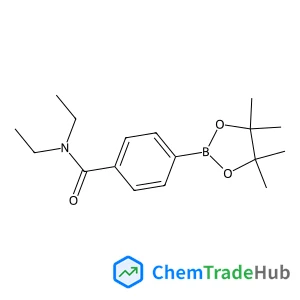
N,N-Diethyl-4-(4,4,5,5-tetramethyl-1,3,2-dioxaborolan-2-yl)benzamide
CAS番号:
325142-99-2
分子式:
C17H26BNO3

おすすめサプライヤー





免責事項
このページに表示される学術雑誌情報は、参考および研究目的のみを目的としています。当社は雑誌出版社とは提携しておらず、投稿の取り扱いも行っておりません。出版に関するお問い合わせは、各雑誌出版社に直接ご連絡ください。
表示されている情報に誤りがある場合は、support@chemtradehub.com までご連絡ください。迅速に確認し、対応いたします。