












An abiotic analogue of the diiron(iv)oxo “diamond core” of soluble methane monooxygenase generated by direct activation of O2 in aqueous Fe(ii)/EDTA solutions: thermodynamics and electronic structure
文献情報
出版日
2011-07-21
DOI
10.1039/C1CP21244C
インパクトファクター
3.676
著者
原文を見る
要旨
We study the generation of a dinuclear Fe(IV)oxo species, [EDTAH·FeO·OFe·EDTAH]2−, in aqueous solution at room temperature using Density Functional Theory (DFT) and Ab Initio Molecular Dynamics (AIMD). This species has been postulated as an intermediate in the multi-step mechanism of autoxidation of Fe(II) to Fe(III) in the presence of atmospheric O2 and EDTA ligand in water. We examine the formation of [EDTAH·FeO·OFe·EDTAH]2− by direct cleavage of O2, and the effects of solvation on the spin state and O–O cleavage barrier. We also study the reactivity of the resulting dinuclear Fe(IV)oxo system in CH4 hydroxylation, and its tendency to decompose to mononuclear Fe(IV)oxo species. The presence of the solvent is shown to play a crucial role, determining important changes in all these processes compared to the gas phase. We show that, in water solution, [EDTAH·FeO·OFe·EDTAH]2− (as well as its precursor [EDTAH·Fe·O2·Fe·EDTAH]2−) exists as stable species in a S = 4 ground spin state when hydrogen-bonded to a single water molecule. Its structure comprises two facing Fe(IV)oxo groups, in an arrangement similar to the one evinced for the active centre of intermediate Q of soluble Methane Monooxygenase (sMMO). The inclusion of the water molecule in the complex decreases the overall symmetry of the system, and brings about important changes in the energy and spatial distribution of orbitals of the Fe(IV)oxo groups relative to the gas phase. In particular, the virtual 3σ* orbital of one of the Fe(IV)oxo groups experiences much reduced repulsive orbital interactions from ligand orbitals, and its consequent stabilisation dramatically enhances the electrophilic character of the complex, compared to the symmetrical non-hydrated species, and its ability to act as an acceptor of a H atom from the CH4 substrate. The computed free energy barrier for H abstraction is 28.2 kJ mol−1 (at the BLYP level of DFT), considerably below the gas phase value for monomeric [FeO·EDTAH]−, and much below the solution value for the prototype hydrated ferryl ion [FeO(H2O)5]2+.
関連文献
Haemoglobin(βK120C)–albumin trimer as an artificial O2 carrier with sufficient haemoglobin allostery
Yoshitsugu Morita, Asuka Saito, Jun Yamaguchi, Teruyuki Komatsu
2020-07-13
Paper
DOI: 10.1039/D0CB00056F
Shifting the paradigm in treating multi-factorial diseases: polypharmacological co-inhibitors of HDAC6
Alexandria M. Chan
2020-12-11
Review Article
DOI: 10.1039/D0MD00286K
Drug combinations as effective anti-leishmanials against drug resistant Leishmania mexicana
Humera Ahmed, Charlotte R. Curtis, Sara Tur-Gracia, Toluwanimi O. Olatunji, Katharine C. Carter, Roderick A. M. Williams
2020-07-02
Research Article
DOI: 10.1039/D0MD00101E
Glycosylated cyclophellitol-derived activity-based probes and inhibitors for cellulases
Casper de Boer, Nicholas G. S. McGregor, Evert Peterse, Sybrin P. Schröder, Bogdan I. Florea, Jianbing Jiang, Jos Reijngoud, Arthur F. J. Ram, Gilles P. van Wezel, Gijsbert A. van der Marel, Jeroen D. C. Codée, Herman S. Overkleeft, Gideon J. Davies
2020-07-28
Paper
DOI: 10.1039/D0CB00045K
Computer-aided discovery of phenylpyrazole based amides as potent S6K1 inhibitors
Yan Yin, Yuxing Sun, Lianhua Zhao, Jinpeng Pan
2020-04-30
Research Article
DOI: 10.1039/C9MD00537D
Estimating the cooperativity of PROTAC-induced ternary complexes using 19F NMR displacement assay
Guilherme Vieira de Castro, Alessio Ciulli
2021-08-24
Research Article
DOI: 10.1039/D1MD00215E
Fenretinide binding to the lysosomal protein saposin D alters ceramide solubilization and hydrolysis
Brandon T. Milliken, Lindy Melegari, Gideon L. Smith, Kris Grohn, Fadi Bou-Abdallah
2020-07-14
Research Article
DOI: 10.1039/D0MD00182A
On the intrinsic reactivity of highly potent trypanocidal cruzain inhibitors
Vinicius Bonatto, Pedro Henrique Jatai Batista, Lorenzo Cianni, Daniela De Vita, Daniel G. Silva, Rodrigo Cedron, Sérgio de Albuquerque, Carolina Borsoi Moraes, Caio Haddad Franco, Andrei Leitão, Carlos A. Montanari
2020-09-09
Research Article
DOI: 10.1039/D0MD00097C
Assessment of the rules related to gaining activity against Gram-negative bacteria
Eleonora Diamanti, Alexandra Siemens, Boris Illarionov, Jörg Haupenthal, Markus Fischer, Matthias Witschel
2021-03-03
Research Article
DOI: 10.1039/D0MD00409J
こちらもおすすめ
化合物よくある質問
2-ヒドロキシ-5-ニトロベンジンブロモイドの代替品はありますか?
2-ヒドロキシ-5-ニトロベンジンブロモイドは特定の化学反応に適しているため、代替品は限られています。しかし、同様の構造を持つ2-ヒドロキシ-4-ニトロベンジン...
772-33-82-(Bromomethyl)-4-ni...
化合物よくある質問
N-(2-ブロモフェニル)-1-チロール-3-オキソ-3-(ピペリジニル)プロペン-2-イル)ベンゼンアミドを取り扱う際の実験室安全事項は何ですか?
N-(2-ブロモフェニル)-1-チロール-3-オキソ-3-(ピペリジニル)プロペン-2-イル)ベンゼンアミドは有毒で、皮膚や粘膜に刺激を与える可能性があります。...
1800044-77-2N-[(1Z)-1-(2-Bromoph...
化合物よくある質問
1,3プロパンジオール,2-[2-(2アミノ-6クロロ-9Hピリミジン-9-イル)エチル-1,1,2,2-D4]-2,3-ジアセタートの市場動向や研究トレンドはどうですか?
この化合物は、新規治療薬の開発に注目されています。市場では、その有効性と安全性が評価され、研究分野では、分子生物学と医薬化学の新たな発見が期待されています。
1020718-81-31,3-Propanediol, 2-[...
579-44-2Ethanone, 2-hydroxy-...
化合物よくある質問
Succinimidyl-alanyl-phenylalanyl-prolyl-phenylalanine 4-nitroanilide はどの業界で使用されていますか?
Succinimidyl-alanyl-phenylalanyl-prolyl-phenylalanine 4-nitroanilide は主に医薬品開発やポ...
128802-73-3succinimidyl-alanyl-...
化合物よくある質問
メチル6-アミノ-5-クロロピリジン-2-カーボイル酸について、適用される法規ガイドラインは何ですか?
メチル6-アミノ-5-クロロピリジン-2-カーボイル酸(CAS番号: 1256794-05-4)の使用には、GHS( Globally Harmonized S...
1256794-05-4Methyl 6-amino-5-chl...
化合物よくある質問
エチル4-(シクロ Pentagonyl)アミノ-2-メチル硫化基ピリミジン-5-カルボキシレートを取り扱う際の実験室安全事項は何ですか?
取り扱いには、耐薬品性の容器を使用し、通気性の良い場所で操作することを推奨します。漏れ時は、SDS(安全データシート)を参照して適切な措置を取ること。手洗いと洗...
211245-62-4ethyl 4-(cyclopentyl...
化合物よくある質問
(S)-3-ベンZYルピペリジン塩酸塩とは何ですか?
(S)-3-ベンZYルピペリジン塩酸塩は、CAS番号1258940-00-9で表される化合物です。これは、(S)-3-苯基哌啶的盐酸盐であり、主に医薬品の原料と...
1258940-00-9(S)-3-Phenylpiperidi...
化合物よくある質問
3,5-二甲基金剛胺の主な用途は何ですか?
3,5-二甲基金剛胺は、主に医薬品の原料として使用され、また抗うつ薬や抗アルツハイマー薬の開発に利用されます。さらに、化粧品や食品添加物の製造でも重要な役割を果...
19988-45-52-(2,3-Dihydroxyphen...
化合物よくある質問
ビス(4-メチル-2-ペンチル)フェニルカルボン酸エステルの代替品はありますか?
ビス(4-メチル-2-ペンチル)フェニルカルボン酸エステル (CAS番号: 1398066-13-1) の代替品には、ビス(2-エチルヘキシル)フェノールカルボ...
1398066-13-1Bis(4-methyl-2-penty...
掲載誌
Physical Chemistry Chemical Physics

CiteScore:
5.5
自己引用率:
10.3%
年間論文数:
3036
Physical Chemistry Chemical Physics (PCCP) is an international journal co-owned by 19 physical chemistry and physics societies from around the world. This journal publishes original, cutting-edge research in physical chemistry, chemical physics and biophysical chemistry. To be suitable for publication in PCCP, articles must include significant innovation and/or insight into physical chemistry; this is the most important criterion that reviewers and Editors will judge against when evaluating submissions. The journal has a broad scope and welcomes contributions spanning experiment, theory, computation and data science. Topical coverage includes spectroscopy, dynamics, kinetics, statistical mechanics, thermodynamics, electrochemistry, catalysis, surface science, quantum mechanics, quantum computing and machine learning. Interdisciplinary research areas such as polymers and soft matter, materials, nanoscience, energy, surfaces/interfaces, and biophysical chemistry are welcomed if they demonstrate significant innovation and/or insight into physical chemistry. Joined experimental/theoretical studies are particularly appreciated when complementary and based on up-to-date approaches.
おすすめ化合物
![Methyl 4-({[(2-methyl-2-propanyl)oxy]carbonyl}amino)bicyclo[2.2.2]octane-1-carboxylate structure](https://static.chemtradehub.com/structs/943/943845-74-7-b7e5.webp "Methyl 4-({[(2-methyl-2-propanyl)oxy]carbonyl}amino)bicyclo[2.2.2]octane-1-carboxylate structure")
![Pyrazolo[1,5-a]pyridine-3-carbothioamide structure](https://static.chemtradehub.com/structs/885/885275-44-5-aae0.webp "Pyrazolo[1,5-a]pyridine-3-carbothioamide structure")
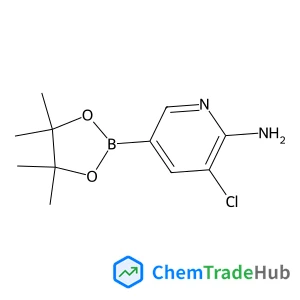
3-Chloro-5-(4,4,5,5-tetramethyl-1,3,2-dioxaborolan-2-yl)-2-pyridinamine
CAS番号:
1032758-99-8
分子式:
C11H16BClN2O2
おすすめサプライヤー




免責事項
このページに表示される学術雑誌情報は、参考および研究目的のみを目的としています。当社は雑誌出版社とは提携しておらず、投稿の取り扱いも行っておりません。出版に関するお問い合わせは、各雑誌出版社に直接ご連絡ください。
表示されている情報に誤りがある場合は、support@chemtradehub.com までご連絡ください。迅速に確認し、対応いたします。