


Association between ageing, brain chemistry and white matter volume revealed with complementary MRI and FTIR brain imaging
文献情報
出版日
2022-11-02
DOI
10.1039/D2AN01271E
インパクトファクター
4.616
著者
Juliette Phillips, Elizabeth Harrild, Rebecca J. Tidy, Lincoln Codd, Kirsty Richardson, Liesl Celliers
原文を見る
要旨
Magnetic resonance imaging (MRI) is the gold standard method to study brain anatomy in vivo. Using MRI, subtle alterations to white matter structures in the brain are observed prior to cognitive decline associated with the ageing process, and neurodegenerative diseases such as Alzheimer's disease. Detection of such alterations provides hope for early clinical diagnosis. While MRI is essential to detect subtle alterations to brain structure in vivo, the technique is less suited to study and image the distribution of biochemical markers within specific brain structures. Consequently, the chemical changes that drive, or are associated with MRI-detectable alterations to white matter are not well understood. Herein, we describe (to the best of our knowledge) the first application of a complementary imaging approach that incorporates in vivo MRI with ex vivo Fourier transform infrared (FTIR) spectroscopic imaging on the same brain tissue. The combined workflow is used to detect and associate markers of altered biochemistry (FTIR) with anatomical changes to brain white matter (MRI). We have applied this combination of techniques to the senescence accelerated murine prone strain 8 (SAMP8) mouse model (n = 6 animals in each group, analysed across two ageing time points, 6 and 12 months). The results have demonstrated alterations to lipid composition and markers of disturbed metabolism during ageing are associated with loss of white matter volume.
おすすめジャーナル

Chinese Journal of Chemistry

Cellulose

Polycyclic Aromatic Compounds

Biocatalysis and Biotransformation

Topics in Catalysis

Herald of the Russian Academy of Sciences

Journal of Asian Natural Products Research

Medicinal Chemistry Research

Critical Reviews in Solid State and Materials Sciences

NDT & E International
関連文献
Stereochemistry of hydrogen removal from the ‘unactivated’ C-3 position of 4-hydroxybutyryl-CoA catalysed by 4-hydroxybutyryl-CoA dehydratase
Richard Scott, Ulrike Näser, Peter Friedrich, Thorsten Selmer, Wolfgang Buckel, Bernard T. Golding
2004-04-23
Communication
DOI: 10.1039/B402322F
Olefincopolymerizationvia reversible addition–fragmentation chain transfer
Rajan Venkatesh, Bastiaan B P Staal, Bert Klumperman
2004-05-20
Communication
DOI: 10.1039/B403342F
The rediscovery of Alfred Werner's second hexol
W. Gregory Jackson, Josephine A. McKeon, Margareta Zehnder, Markus Neuberger, Silvio Fallab
2004-09-06
Communication
DOI: 10.1039/B408277J
H2–O2 atmosphere increases the activity of Pt/TiO2 for benzene photocatalytic oxidation by two orders of magnitude
Yilin Chen, Danzhen Li, Xinchen Wang, Xuxu Wang, Xianzhi Fu
2004-09-02
Communication
DOI: 10.1039/B408187K
Desymmetrization of meso-dienyne by asymmetric Pauson–Khand type reaction catalysts
Nakcheol Jeong, Dong Hoon Kim, Jun Hun Choi
2004-04-08
Communication
DOI: 10.1039/B401288G
A bidentate borane as colorimetric fluoride ion sensor
Stéphane Solé, François P. Gabbaï
2004-04-28
Communication
DOI: 10.1039/B403596H
An enantioselective imprinted receptor for Z-glutamate exhibiting a binding induced color change
Panagiotis Manesiotis, Andrew J. Hall, Marco Emgenbroich, Milena Quaglia, Ersilia De Lorenzi, Börje Sellergren
2004-09-09
Communication
DOI: 10.1039/B407870E
A novel, stereoselective and convergent synthesis of aryltetralins
Steven M. Miles, Stephen P. Marsden, Robin J. Leatherbarrow, William J. Coates
2004-09-01
Communication
DOI: 10.1039/B409528F
A new series of sodium cobalt oxyhydrates
Donna C. Arnold, Chris J. Nuttall, Alexandros Lappas
2004-09-21
Communication
DOI: 10.1039/B405907G
A novel supramolecular assembly in an iron(iii) compound exhibiting magnetic ordering at 70 K
Donatella Armentano, Giovanni De Munno, Teresa F. Mastropietro, Miguel Julve, Francesc Lloret
2004-04-21
Communication
DOI: 10.1039/B402055C
こちらもおすすめ
化合物よくある質問
2,3-スチオエポキシマドルを取り扱う際の実験室安全事項は何ですか?
取り扱いにはPPE(プロテクティブ・パーソナル・エイド)が必要で、防ぐ手袋と保護眼鏡を着用してください。ドラフトチャンバーの使用を推奨します。漏洩した場合は、適...
4267-80-52,3-Thioepoxy Madol
53981-25-22-Amino-6-fluorophen...
化合物よくある質問
BOC-S-3-アミニ-4-(4-メチオキシベンチル)-ブタン酸の代替品はありますか?
この化合物の代替品としては、BOC保護基を有さないアミノ酸やその他の保護基化合物が考えられます。また、メチオキシ基を有しない他の芳香族アミノ酸も代替品として挙げ...
126800-59-7(3S)-4-(4-Methoxyphe...
化合物よくある質問
Methyl 2-(chloromethyl)-3-nitrobenzoate(1218910-61-2)の代替品はありますか?
Methyl 2-(chloromethyl)-3-nitrobenzoate(1218910-61-2)の代替品としては、化学組成を変えることで効果を達成する...
1218910-61-2Methyl 2-(chlorometh...
化合物よくある質問
(2R)-2-アミノ-N-ベンジル-3-ヒドロキシプロパナミドを含む廃棄物はどのように処理すべきですか?
(2R)-2-アミノ-N-ベンジル-3-ヒドロキシプロパナミドを含む廃棄物は、適切な廃棄物管理ガイドラインに基づき処理する必要があります。まず、廃棄物を適切に収...
175481-39-7(2R)-2-amino-N-benzy...
化合物よくある質問
6,7-二氢-咪唑並[1,2-a]ピリドイン-8(5h)-酮はどのように合成されますか?
6,7-二氢-咪唑並[1,2-a]ピリドイン-8(5h)-酮は、2-ブロモフェニルアセトインとリン酸ハロゲン化物を反応させることで合成できます。この反応は高温で...
457949-09-66,7-Dihydroimidazo[1...
化合物よくある質問
エチル(3R)-3-ピロリジニル酢酸水和塩とは何ですか?
エチル(3R)-3-ピロリジニル酢酸水和塩は、CAS番号1332459-32-1の化合物で、(R)-乙基2-(ピロリジン-3-基)酢酸塩水和塩と呼ばれます。この...
1332459-32-1Ethyl (3R)-3-pyrroli...
化合物よくある質問
(2S)-{[(2-メチルエチルオキシ]カルボニル}アミノ)[2-(トリアフルオロメチルフェニル]エチカシック酸の物理化学的性質は何ですか?
(2S)-{[(2-メチルエチルオキシ]カルボニル}アミノ)[2-(トリアフルオロメチルフェニル]エチカシック酸のCAS番号は1203454-45-8です。この...
1203454-45-8(2S)-({[(2-Methyl-2-...
化合物よくある質問
2-ブロモ-1-(2-メチル-2-プロパニル)-4-ニトロベンゼンはどのように保存すればよいですか?
2-ブロモ-1-(2-メチル-2-プロパニル)-4-ニトロベンゼンは、直射日光を避けて暗所で、室温(約15℃〜25℃)、乾燥した場所に保存する必要があります。ま...
6310-17-42-Bromo-1-(2-methyl-...
化合物よくある質問
1-[(4-硝基フェニル)スルホニル]-1H-1,2,4-三唑の市場動向や研究トレンドはどうですか?
市場動向としては、1-[(4-硝基フェニル)スルホニル]-1H-1,2,4-三唑は主に農業用除草剤や合成化学製品の原料として利用されています。研究トレンドとして...
57777-84-11-[(4-Nitrophenyl)su...
掲載誌
Analyst

CiteScore:
7.8
自己引用率:
5.6%
年間論文数:
653
Analyst publishes analytical and bioanalytical research that reports premier fundamental discoveries and inventions, and the applications of those discoveries, unconfined by traditional discipline barriers.
おすすめ化合物
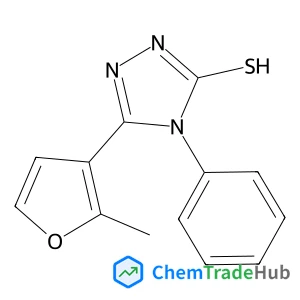
5-(2-Methyl-3-furyl)-4-phenyl-2,4-dihydro-3H-1,2,4-triazole-3-thione
CAS番号:
346464-59-3
分子式:
C13H11N3OS
おすすめサプライヤー




免責事項
このページに表示される学術雑誌情報は、参考および研究目的のみを目的としています。当社は雑誌出版社とは提携しておらず、投稿の取り扱いも行っておりません。出版に関するお問い合わせは、各雑誌出版社に直接ご連絡ください。
表示されている情報に誤りがある場合は、support@chemtradehub.com までご連絡ください。迅速に確認し、対応いたします。