












ω-Unsaturated methacrylate macromonomers as reactive polymeric stabilizers in mini-emulsion polymerization
文献情報
出版日
2022-01-31
DOI
10.1039/D1PY01664D
インパクトファクター
5.582
著者
Joshua R. Booth, Joshua D. Davies, Stefan A. F. Bon
原文を見る
要旨
Polymer latexes of poly(benzyl methacrylate) P(BzMA) were synthesized by mini-emulsion polymerization, using hexadecane as the hydrophobe and ω-unsaturated methacrylate-based macromonomers as a reactive stabilizer. The amphiphilic macromonomers were synthesized by catalytic chain transfer emulsion polymerization (CCTP) and subsequent chain extension via sulfur-free reversible addition–fragmentation chain transfer (SF-RAFT). Their critical micelle concentration (CMC) was determined by dynamic light scattering (DLS), and micelle size was measured using DLS and small angle X-ray scattering (SAXS). The surface activity of the stabilizers was measured by pendant drop tensiometry and compared to modelled behaviour. For the mini-emulsion polymerizations, macromonomer stabilizers were added at a range of concentrations, with respect to the dispersed phase. Using less than 5 wt% stabilizer, SEM micrographs showed many of the particles were bowl-shaped. This morphology was studied in depth and we propose that monomer transport occurs between particles during polymerization towards the smaller particles as a direct result of compartmentalization. At concentrations of 5 wt% and higher, bimodal droplet and particle distributions were observed by DLS and SEM. We propose shear-dependent depletion flocculation as the explanation. Lastly, the effectiveness of the reactive stabilizers was tested in terms of latex stability and molecular weight control. Resistance to coagulation during freeze–thaw cycles and prolonged dialysis were tested. Examination of P(BzMA) reaction kinetics and molecular weight indicated that the incorporation of macromonomer is gradual and less than quantitative at the end of the polymerization process, in agreement with the mechanistic understanding.
関連文献
Reduction of the thermal conductivity of a graphene/hBN heterobilayer via interlayer sp3 bonds
T. Iwata, K. Shintani
2018-01-23
Paper
DOI: 10.1039/C7CP07345C
Understanding interface (odd–even) effects in charge tunneling using a polished EGaIn electrode
Jiahao Chen, Thomas J. Giroux, Yen Nguyen, Atte A. Kadoma, Boyce S. Chang, Brett VanVeller, Martin M. Thuo
2018-01-12
Paper
DOI: 10.1039/C7CP07531F
Hexagonal SiC with spatially separated active sites on polar and nonpolar facets achieving enhanced hydrogen production from photocatalytic water reduction
Ning Liu, Zhongnan Guo, Wenjun Wang, Liwei Guo, Wenxia Yuan
2018-01-17
Paper
DOI: 10.1039/C7CP08363G
First-principles database driven computational neural network approach to the discovery of active ternary nanocatalysts for oxygen reduction reaction
Joonhee Kang, Seung Hyo Noh, Jeemin Hwang, Hoje Chun, Hansung Kim, Byungchan Han
2018-07-30
Paper
DOI: 10.1039/C8CP03801E
Photoprotection or photodamage: a direct observation of nonradiative dynamics from 2-ethylhexyl 4-dimethylaminobenzoate sunscreen agent
Chensheng Ma, Chris Tsz-Leung Chan, Ruth Chau-Ting Chan, Allen Ka-Wa Wong, Bowie Po-Yee Chung, Wai-Ming Kwok
2018-09-05
Paper
DOI: 10.1039/C8CP04447C
Bound and continuum-embedded states of cyanopolyyne anions
Wojciech Skomorowski, Sahil Gulania, Anna I. Krylov
2018-01-15
Paper
DOI: 10.1039/C7CP08227D
Zn-Porphyrin propped with hydantoin anchor: synthesis, photophysics and electron injection/recombination dynamics
Poomani Ram Kumar, Ebrahim M. Mothi, Mohan Ramesh, Arunkumar Kathiravan
2018-01-18
Paper
DOI: 10.1039/C7CP07326G
Benchmarking triplet–triplet annihilation photon upconversion schemes
Anders S. Gertsen, Mads Koerstz, Kurt V. Mikkelsen
2018-04-06
Paper
DOI: 10.1039/C8CP00588E
Superconductivity and phase stability of potassium-doped biphenyl
Guo-Hua Zhong, Dong-Yu Yang, Kai Zhang, Ren-Shu Wang, Chao Zhang, Hai-Qing Lin, Xiao-Jia Chen
2018-09-07
Paper
DOI: 10.1039/C8CP05184D
Modelling the kinetics and structural property evolution of a versatile reaction: aqueous HCN polymerization
Amparo Fernández, Marta Ruiz-Bermejo, José L. de la Fuente
2018-05-29
Paper
DOI: 10.1039/C8CP01662C
こちらもおすすめ
化合物よくある質問
2-ヒドロキシ-5-ニトロベンジンブロモイドの代替品はありますか?
2-ヒドロキシ-5-ニトロベンジンブロモイドは特定の化学反応に適しているため、代替品は限られています。しかし、同様の構造を持つ2-ヒドロキシ-4-ニトロベンジン...
772-33-82-(Bromomethyl)-4-ni...
化合物よくある質問
N-(2-ブロモフェニル)-1-チロール-3-オキソ-3-(ピペリジニル)プロペン-2-イル)ベンゼンアミドを取り扱う際の実験室安全事項は何ですか?
N-(2-ブロモフェニル)-1-チロール-3-オキソ-3-(ピペリジニル)プロペン-2-イル)ベンゼンアミドは有毒で、皮膚や粘膜に刺激を与える可能性があります。...
1800044-77-2N-[(1Z)-1-(2-Bromoph...
化合物よくある質問
1,3プロパンジオール,2-[2-(2アミノ-6クロロ-9Hピリミジン-9-イル)エチル-1,1,2,2-D4]-2,3-ジアセタートの市場動向や研究トレンドはどうですか?
この化合物は、新規治療薬の開発に注目されています。市場では、その有効性と安全性が評価され、研究分野では、分子生物学と医薬化学の新たな発見が期待されています。
1020718-81-31,3-Propanediol, 2-[...
579-44-2Ethanone, 2-hydroxy-...
化合物よくある質問
Succinimidyl-alanyl-phenylalanyl-prolyl-phenylalanine 4-nitroanilide はどの業界で使用されていますか?
Succinimidyl-alanyl-phenylalanyl-prolyl-phenylalanine 4-nitroanilide は主に医薬品開発やポ...
128802-73-3succinimidyl-alanyl-...
化合物よくある質問
メチル6-アミノ-5-クロロピリジン-2-カーボイル酸について、適用される法規ガイドラインは何ですか?
メチル6-アミノ-5-クロロピリジン-2-カーボイル酸(CAS番号: 1256794-05-4)の使用には、GHS( Globally Harmonized S...
1256794-05-4Methyl 6-amino-5-chl...
化合物よくある質問
エチル4-(シクロ Pentagonyl)アミノ-2-メチル硫化基ピリミジン-5-カルボキシレートを取り扱う際の実験室安全事項は何ですか?
取り扱いには、耐薬品性の容器を使用し、通気性の良い場所で操作することを推奨します。漏れ時は、SDS(安全データシート)を参照して適切な措置を取ること。手洗いと洗...
211245-62-4ethyl 4-(cyclopentyl...
化合物よくある質問
(S)-3-ベンZYルピペリジン塩酸塩とは何ですか?
(S)-3-ベンZYルピペリジン塩酸塩は、CAS番号1258940-00-9で表される化合物です。これは、(S)-3-苯基哌啶的盐酸盐であり、主に医薬品の原料と...
1258940-00-9(S)-3-Phenylpiperidi...
化合物よくある質問
3,5-二甲基金剛胺の主な用途は何ですか?
3,5-二甲基金剛胺は、主に医薬品の原料として使用され、また抗うつ薬や抗アルツハイマー薬の開発に利用されます。さらに、化粧品や食品添加物の製造でも重要な役割を果...
19988-45-52-(2,3-Dihydroxyphen...
化合物よくある質問
ビス(4-メチル-2-ペンチル)フェニルカルボン酸エステルの代替品はありますか?
ビス(4-メチル-2-ペンチル)フェニルカルボン酸エステル (CAS番号: 1398066-13-1) の代替品には、ビス(2-エチルヘキシル)フェノールカルボ...
1398066-13-1Bis(4-methyl-2-penty...
掲載誌
Polymer Chemistry

CiteScore:
8.6
自己引用率:
7.3%
年間論文数:
457
Polymer Chemistry welcomes submissions in all areas of polymer science that have a strong focus on macromolecular chemistry. Manuscripts may cover a broad range of fields, yet no direct application focus is required.
おすすめ化合物
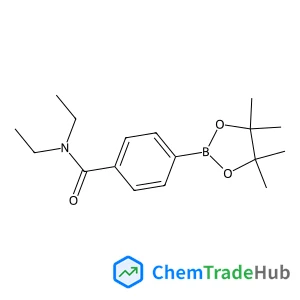
N,N-Diethyl-4-(4,4,5,5-tetramethyl-1,3,2-dioxaborolan-2-yl)benzamide
CAS番号:
325142-99-2
分子式:
C17H26BNO3
![5-Methyl-4,5,6,7-tetrahydropyrazolo[1,5-a]pyrazin-2-amine structure](https://static.chemtradehub.com/structs/122/1227210-33-4-8d64.webp "5-Methyl-4,5,6,7-tetrahydropyrazolo[1,5-a]pyrazin-2-amine structure")
![6-Benzyl-4,5,6,7-tetrahydro-1H-pyrazolo[3,4-c]pyridin-3(2H)-one structure](https://static.chemtradehub.com/structs/909/909187-64-0-f54f.webp "6-Benzyl-4,5,6,7-tetrahydro-1H-pyrazolo[3,4-c]pyridin-3(2H)-one structure")
おすすめサプライヤー







免責事項
このページに表示される学術雑誌情報は、参考および研究目的のみを目的としています。当社は雑誌出版社とは提携しておらず、投稿の取り扱いも行っておりません。出版に関するお問い合わせは、各雑誌出版社に直接ご連絡ください。
表示されている情報に誤りがある場合は、support@chemtradehub.com までご連絡ください。迅速に確認し、対応いたします。