


Photoprotection or photodamage: a direct observation of nonradiative dynamics from 2-ethylhexyl 4-dimethylaminobenzoate sunscreen agent
文献情報
出版日
2018-09-05
DOI
10.1039/C8CP04447C
インパクトファクター
3.676
著者
Chensheng Ma, Chris Tsz-Leung Chan, Ruth Chau-Ting Chan, Allen Ka-Wa Wong, Bowie Po-Yee Chung, Wai-Ming Kwok
原文を見る
要旨
Apart from being an analogue of the prototype for photoinduced intramolecular charge transfer (ICT), 2-ethylhexyl 4-dimethylaminobenzoate (EHDMABA) is also one of the earliest patented and most commonly used sunscreen components. There is, however, little documented information about the photophysics and factors affecting the photophysics of this molecule. Such information is of importance for both the understanding of the ICT reaction and assessing the underlying process of photoprotection, especially in view of the “sunscreen controversy” that has arisen from the contrasting in vivo vs. in vitro photobiological results on this and related UV filters. We report herein a femtosecond broadband time-resolved fluorescence (fs-TRF), complemented by transient absorption (fs-TA) to allow a full probe of the excited state cascades for EHDMABA and two of its derivatives in solvents of varied properties. The results provide direct evidence for a nearly solvent independent inner sphere ICT reaction occurring on the sub-picosecond time scale, and an ensuing solvent dictated deactivation of the ICT state. The ICT state in the aprotic solvent acetonitrile decayed solely through the intrinsic intersystem crossing (ISC) to produce a potentially harmful triplet excited state. In the protic solvent, the solvation and formation of ICT-induced solute–solvent hydrogen (H)-bonding opened the originally inaccessible internal conversion (IC) channel of the ICT state, leading to the rapid reformation of the ground state molecule with a unitary efficiency in the aqueous solution. This H-bonding-mediated IC restrained or eliminated the intrinsic ISC, providing a mechanism at the molecular level for the benign dissipation of the electronic excitation. The precise rate of IC was observed to vary with the alkoxy substituent and its efficiency was affected by the H-bonding capacity of the solvent. The findings of this work demonstrate the pivotal role of the microenvironment and the direct participation of solvent molecules through H-bonding in drastically altering the nonradiative dynamics and promoting or inhibiting photostability and photoprotection. This may assist in developing next-generation UV filters and help in improving formulation design for the optimal efficacy of sunscreen products. The pronounced H-bonding-induced fluorescence quenching and variation in the fluorescence wavelength imply that these molecules may also serve as a sensitive fluorescence probe for the H-bonding properties of the microenvironment.
おすすめジャーナル

Proceedings of the National Academy of Sciences of the United States of America

Planta Medica

Molecular Pharmacology

Helvetica Chimica Acta

Pharmacological Reviews

Science

Journal of Medicinal Chemistry

Journal of Heterocyclic Chemistry

Kinetics and Catalysis

Organic Preparations and Procedures International
関連文献
μ-XAFS of a single particle of a practical NiOx/Ce2Zr2Oy catalyst
Tomoya Uruga, Hajime Tanida, Yasuko Terada, Yasuhiro Iwasawa, Shin-ichi Ohkoshi
2011-06-08
Communication
DOI: 10.1039/C1CP20895K
Double layer capacitance of anode/solid-electrolyte interfaces
2011-07-25
Paper
DOI: 10.1039/C1CP20508K
Interaction between NO and Na, O, S, Cl on Au and Pd(111) surfaces
Ren-Yu Tian, Xiao-Bao Yang, Song-Lin Peng
2011-07-07
Paper
DOI: 10.1039/C1CP20974D
Nonequilibrium transport in quantum impurity models: exact path integral simulations
Dvira Segal, Andrew J. Millis, David R. Reichman
2011-06-15
Paper
DOI: 10.1039/C1CP20702D
Self-doping of molecular quantum-dot cellular automata: mixed valence zwitterions
Yuhui Lu, Craig Lent
2011-07-14
Paper
DOI: 10.1039/C1CP21332F
Understanding microsolvation of Li+: structural and energetical analyses
Jonathan Romero, Andres Reyes, Jorge David, Albeiro Restrepo
2011-07-27
Paper
DOI: 10.1039/C1CP20903E
A study of the ethene-ozone reaction with photoelectron spectroscopy: measurement of product branching ratios and atmospheric implications
Grant Copeland, Mariana V. Ghosh, Dudley E. Shallcross, Carl J. Percival, John M. Dyke
2011-06-23
Paper
DOI: 10.1039/C0CP03004J
Graphical prediction of quantum interference-induced transmission nodes in functionalized organic molecules
Troels Markussen, Robert Stadler, Kristian S. Thygesen
2011-06-28
Paper
DOI: 10.1039/C1CP20924H
Covalent networks through on-surface chemistry in ultra-high vacuum: state-of-the-art and recent developments
2011-05-09
Perspective
DOI: 10.1039/C1CP20700H
こちらもおすすめ
化合物よくある質問
2-ヒドロキシ-5-ニトロベンジンブロモイドの代替品はありますか?
2-ヒドロキシ-5-ニトロベンジンブロモイドは特定の化学反応に適しているため、代替品は限られています。しかし、同様の構造を持つ2-ヒドロキシ-4-ニトロベンジン...
772-33-82-(Bromomethyl)-4-ni...
化合物よくある質問
N-(2-ブロモフェニル)-1-チロール-3-オキソ-3-(ピペリジニル)プロペン-2-イル)ベンゼンアミドを取り扱う際の実験室安全事項は何ですか?
N-(2-ブロモフェニル)-1-チロール-3-オキソ-3-(ピペリジニル)プロペン-2-イル)ベンゼンアミドは有毒で、皮膚や粘膜に刺激を与える可能性があります。...
1800044-77-2N-[(1Z)-1-(2-Bromoph...
化合物よくある質問
1,3プロパンジオール,2-[2-(2アミノ-6クロロ-9Hピリミジン-9-イル)エチル-1,1,2,2-D4]-2,3-ジアセタートの市場動向や研究トレンドはどうですか?
この化合物は、新規治療薬の開発に注目されています。市場では、その有効性と安全性が評価され、研究分野では、分子生物学と医薬化学の新たな発見が期待されています。
1020718-81-31,3-Propanediol, 2-[...
579-44-2Ethanone, 2-hydroxy-...
化合物よくある質問
Succinimidyl-alanyl-phenylalanyl-prolyl-phenylalanine 4-nitroanilide はどの業界で使用されていますか?
Succinimidyl-alanyl-phenylalanyl-prolyl-phenylalanine 4-nitroanilide は主に医薬品開発やポ...
128802-73-3succinimidyl-alanyl-...
化合物よくある質問
メチル6-アミノ-5-クロロピリジン-2-カーボイル酸について、適用される法規ガイドラインは何ですか?
メチル6-アミノ-5-クロロピリジン-2-カーボイル酸(CAS番号: 1256794-05-4)の使用には、GHS( Globally Harmonized S...
1256794-05-4Methyl 6-amino-5-chl...
化合物よくある質問
エチル4-(シクロ Pentagonyl)アミノ-2-メチル硫化基ピリミジン-5-カルボキシレートを取り扱う際の実験室安全事項は何ですか?
取り扱いには、耐薬品性の容器を使用し、通気性の良い場所で操作することを推奨します。漏れ時は、SDS(安全データシート)を参照して適切な措置を取ること。手洗いと洗...
211245-62-4ethyl 4-(cyclopentyl...
化合物よくある質問
(S)-3-ベンZYルピペリジン塩酸塩とは何ですか?
(S)-3-ベンZYルピペリジン塩酸塩は、CAS番号1258940-00-9で表される化合物です。これは、(S)-3-苯基哌啶的盐酸盐であり、主に医薬品の原料と...
1258940-00-9(S)-3-Phenylpiperidi...
化合物よくある質問
3,5-二甲基金剛胺の主な用途は何ですか?
3,5-二甲基金剛胺は、主に医薬品の原料として使用され、また抗うつ薬や抗アルツハイマー薬の開発に利用されます。さらに、化粧品や食品添加物の製造でも重要な役割を果...
19988-45-52-(2,3-Dihydroxyphen...
化合物よくある質問
ビス(4-メチル-2-ペンチル)フェニルカルボン酸エステルの代替品はありますか?
ビス(4-メチル-2-ペンチル)フェニルカルボン酸エステル (CAS番号: 1398066-13-1) の代替品には、ビス(2-エチルヘキシル)フェノールカルボ...
1398066-13-1Bis(4-methyl-2-penty...
掲載誌
Physical Chemistry Chemical Physics

CiteScore:
5.5
自己引用率:
10.3%
年間論文数:
3036
Physical Chemistry Chemical Physics (PCCP) is an international journal co-owned by 19 physical chemistry and physics societies from around the world. This journal publishes original, cutting-edge research in physical chemistry, chemical physics and biophysical chemistry. To be suitable for publication in PCCP, articles must include significant innovation and/or insight into physical chemistry; this is the most important criterion that reviewers and Editors will judge against when evaluating submissions. The journal has a broad scope and welcomes contributions spanning experiment, theory, computation and data science. Topical coverage includes spectroscopy, dynamics, kinetics, statistical mechanics, thermodynamics, electrochemistry, catalysis, surface science, quantum mechanics, quantum computing and machine learning. Interdisciplinary research areas such as polymers and soft matter, materials, nanoscience, energy, surfaces/interfaces, and biophysical chemistry are welcomed if they demonstrate significant innovation and/or insight into physical chemistry. Joined experimental/theoretical studies are particularly appreciated when complementary and based on up-to-date approaches.
おすすめ化合物
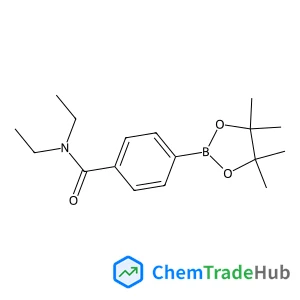
N,N-Diethyl-4-(4,4,5,5-tetramethyl-1,3,2-dioxaborolan-2-yl)benzamide
CAS番号:
325142-99-2
分子式:
C17H26BNO3
![tert-Butyl N-[(2-chloropyridin-4-yl)methyl]carbamate structure](https://static.chemtradehub.com/structs/916/916210-27-0-9f95.webp "tert-Butyl N-[(2-chloropyridin-4-yl)methyl]carbamate structure")
おすすめサプライヤー






免責事項
このページに表示される学術雑誌情報は、参考および研究目的のみを目的としています。当社は雑誌出版社とは提携しておらず、投稿の取り扱いも行っておりません。出版に関するお問い合わせは、各雑誌出版社に直接ご連絡ください。
表示されている情報に誤りがある場合は、support@chemtradehub.com までご連絡ください。迅速に確認し、対応いたします。