












![Methyl 4-({[(2-methyl-2-propanyl)oxy]carbonyl}amino)bicyclo[2.2.2]octane-1-carboxylate structure](https://static.chemtradehub.com/structs/943/943845-74-7-b7e5.webp "Methyl 4-({[(2-methyl-2-propanyl)oxy]carbonyl}amino)bicyclo[2.2.2]octane-1-carboxylate structure")
Fragmentation and rearrangement of Breslow intermediates: branches to both radical and ionic pathways
文献情報
出版日
2021-11-17
DOI
10.1039/D1CP03118J
インパクトファクター
3.676
著者
Ming-Hsiu Hsieh, Jen-Shiang K. Yu
原文を見る
要旨
Breslow intermediates are the key species in N-heterocyclic carbene-catalyzed reactions to promote the C–C bond formation. As the fragmentation and rearrangement of Breslow intermediates terminate the catalytic cycle of N-heterocyclic carbene, two mechanisms under debate have been proposed in terms of the radical channel and the ionic route. Theoretical calculations demonstrate herein that ionic and radical characteristics can coexist, depending on the protonation state of the hydroxyl group in Breslow intermediates: radicals are merely generated in the enol system, while both ionic and radical species exist in the enolate system with a lower barrier. Complete pathways for thiamin analogue and N-allyl benzothiazole Breslow intermediates are exclusively constructed considering experimental conditions. The growing population of the enolate under higher pH values rationalizes the increased rate of the fragmentation of thiamin. The fragmentation products of thiamin, namely pyrimidine and ketone, are the thermodynamic products, while the tertiary alcohol is both the kinetic and thermodynamic product for N-allyl benzothiazole Breslow intermediate via a Claisen-like rearrangement. Other NHCs used to synthesize tertiary alcohols could form the enolate due to the base, followed by the production of stable radicals and recombination to form tertiary alcohols. It is concluded that specific protonation states and chemical structures of NHCs account for the distinct mechanisms.
関連文献
The influence of hydrogen bonds on NIAD-4 for use in the optical imaging of amyloid fibrils
Donglin Li, Yonggang Yang, Chaozheng Li, Yufang Liu
2017-05-18
Paper
DOI: 10.1039/C7CP02268A
Methane adsorption in ADOR zeolites: a combined experimental and DFT/CC study
M. Rubeš, M. Trachta, E. Koudelková, R. Bulánek, V. Kasneryk, O. Bludský
2017-06-05
Paper
DOI: 10.1039/C7CP02315D
Ionic hydration-induced evolution of decane–water interfacial tension
Boyao Wen, Chengzhen Sun, Bofeng Bai
2017-05-08
Paper
DOI: 10.1039/C7CP01826F
Correction: Dynamic nuclear polarization in a magnetic resonance force microscope experiment
Corinne E. Isaac, Christine M. Gleave, Paméla T. Nasr, Hoang L. Nguyen, Elizabeth A. Curley, Jonilyn L. Yoder, Eric W. Moore, Lei Chen, John A. Marohn
2017-06-09
Correction
DOI: 10.1039/C7CP90126G
Gate-controlled heat generation in ZnO nanowire FETs
Andrea Pescaglini, Davide Cammi, Carsten Ronning, Daniela Iacopino
2017-05-02
Paper
DOI: 10.1039/C7CP01356F
Strain engineering of electronic structures and photocatalytic responses of MXenes functionalized by oxygen
S. A. Khan, B. Amin, Li-Yong Gan, Iftikhar Ahmad
2017-05-10
Paper
DOI: 10.1039/C7CP02513K
Cold interactions and chemical reactions of linear polyatomic anions with alkali-metal and alkaline-earth-metal atoms
2017-05-30
Paper
DOI: 10.1039/C7CP02127E
Vibrational Stark spectroscopy for assessing ligand-binding strengths in a protein
Padmabati Mondal, Markus Meuwly
2017-05-24
Paper
DOI: 10.1039/C7CP01892D
Photomultiplication type narrowband organic photodetectors working at forward and reverse bias
Jianli Miao, Fujun Zhang, Mingde Du, Wenbin Wang, Ying Fang
2017-05-08
Paper
DOI: 10.1039/C7CP01969F
Surface-induced assembly of sophorolipids
Jessie Peyre, Marco Faustini, Vincent Humblot, Niki Baccile
2017-06-01
Paper
DOI: 10.1039/C7CP01339F
こちらもおすすめ
化合物よくある質問
2-ヒドロキシ-5-ニトロベンジンブロモイドの代替品はありますか?
2-ヒドロキシ-5-ニトロベンジンブロモイドは特定の化学反応に適しているため、代替品は限られています。しかし、同様の構造を持つ2-ヒドロキシ-4-ニトロベンジン...
772-33-82-(Bromomethyl)-4-ni...
化合物よくある質問
N-(2-ブロモフェニル)-1-チロール-3-オキソ-3-(ピペリジニル)プロペン-2-イル)ベンゼンアミドを取り扱う際の実験室安全事項は何ですか?
N-(2-ブロモフェニル)-1-チロール-3-オキソ-3-(ピペリジニル)プロペン-2-イル)ベンゼンアミドは有毒で、皮膚や粘膜に刺激を与える可能性があります。...
1800044-77-2N-[(1Z)-1-(2-Bromoph...
化合物よくある質問
1,3プロパンジオール,2-[2-(2アミノ-6クロロ-9Hピリミジン-9-イル)エチル-1,1,2,2-D4]-2,3-ジアセタートの市場動向や研究トレンドはどうですか?
この化合物は、新規治療薬の開発に注目されています。市場では、その有効性と安全性が評価され、研究分野では、分子生物学と医薬化学の新たな発見が期待されています。
1020718-81-31,3-Propanediol, 2-[...
579-44-2Ethanone, 2-hydroxy-...
化合物よくある質問
Succinimidyl-alanyl-phenylalanyl-prolyl-phenylalanine 4-nitroanilide はどの業界で使用されていますか?
Succinimidyl-alanyl-phenylalanyl-prolyl-phenylalanine 4-nitroanilide は主に医薬品開発やポ...
128802-73-3succinimidyl-alanyl-...
化合物よくある質問
メチル6-アミノ-5-クロロピリジン-2-カーボイル酸について、適用される法規ガイドラインは何ですか?
メチル6-アミノ-5-クロロピリジン-2-カーボイル酸(CAS番号: 1256794-05-4)の使用には、GHS( Globally Harmonized S...
1256794-05-4Methyl 6-amino-5-chl...
化合物よくある質問
エチル4-(シクロ Pentagonyl)アミノ-2-メチル硫化基ピリミジン-5-カルボキシレートを取り扱う際の実験室安全事項は何ですか?
取り扱いには、耐薬品性の容器を使用し、通気性の良い場所で操作することを推奨します。漏れ時は、SDS(安全データシート)を参照して適切な措置を取ること。手洗いと洗...
211245-62-4ethyl 4-(cyclopentyl...
化合物よくある質問
(S)-3-ベンZYルピペリジン塩酸塩とは何ですか?
(S)-3-ベンZYルピペリジン塩酸塩は、CAS番号1258940-00-9で表される化合物です。これは、(S)-3-苯基哌啶的盐酸盐であり、主に医薬品の原料と...
1258940-00-9(S)-3-Phenylpiperidi...
化合物よくある質問
3,5-二甲基金剛胺の主な用途は何ですか?
3,5-二甲基金剛胺は、主に医薬品の原料として使用され、また抗うつ薬や抗アルツハイマー薬の開発に利用されます。さらに、化粧品や食品添加物の製造でも重要な役割を果...
19988-45-52-(2,3-Dihydroxyphen...
化合物よくある質問
ビス(4-メチル-2-ペンチル)フェニルカルボン酸エステルの代替品はありますか?
ビス(4-メチル-2-ペンチル)フェニルカルボン酸エステル (CAS番号: 1398066-13-1) の代替品には、ビス(2-エチルヘキシル)フェノールカルボ...
1398066-13-1Bis(4-methyl-2-penty...
掲載誌
Physical Chemistry Chemical Physics

CiteScore:
5.5
自己引用率:
10.3%
年間論文数:
3036
Physical Chemistry Chemical Physics (PCCP) is an international journal co-owned by 19 physical chemistry and physics societies from around the world. This journal publishes original, cutting-edge research in physical chemistry, chemical physics and biophysical chemistry. To be suitable for publication in PCCP, articles must include significant innovation and/or insight into physical chemistry; this is the most important criterion that reviewers and Editors will judge against when evaluating submissions. The journal has a broad scope and welcomes contributions spanning experiment, theory, computation and data science. Topical coverage includes spectroscopy, dynamics, kinetics, statistical mechanics, thermodynamics, electrochemistry, catalysis, surface science, quantum mechanics, quantum computing and machine learning. Interdisciplinary research areas such as polymers and soft matter, materials, nanoscience, energy, surfaces/interfaces, and biophysical chemistry are welcomed if they demonstrate significant innovation and/or insight into physical chemistry. Joined experimental/theoretical studies are particularly appreciated when complementary and based on up-to-date approaches.
おすすめ化合物

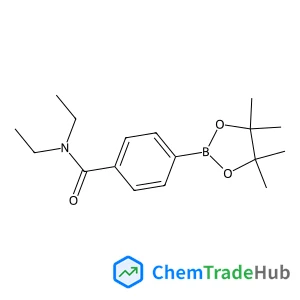
N,N-Diethyl-4-(4,4,5,5-tetramethyl-1,3,2-dioxaborolan-2-yl)benzamide
CAS番号:
325142-99-2
分子式:
C17H26BNO3
おすすめサプライヤー






免責事項
このページに表示される学術雑誌情報は、参考および研究目的のみを目的としています。当社は雑誌出版社とは提携しておらず、投稿の取り扱いも行っておりません。出版に関するお問い合わせは、各雑誌出版社に直接ご連絡ください。
表示されている情報に誤りがある場合は、support@chemtradehub.com までご連絡ください。迅速に確認し、対応いたします。