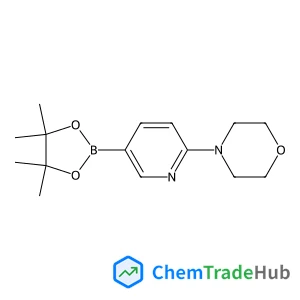
4-(5-(4,4,5,5-tetramethyl-1,3,2-dioxaborolan-2-yl)pyridin-2-yl)morpholine
CAS番号:
485799-04-0
分子式:
C15H23BN2O3
Jianli Miao, Fujun Zhang, Mingde Du, Wenbin Wang, Ying Fang
It is a great challenge to obtain narrowband and photomultiplication (PM) type organic photodetectors (OPDs) without optical filters due to the broad absorption range and large exciton binding energy of organic materials. Narrowband OPDs with the special structure of ITO/PFN-OX/P3HT : PC61BM (100 : 1,wt/wt)/Al were successfully fabricated with different active layer thicknesses, exhibiting a tunable response window and PM phenomenon under bi-directional bias. The OPDs exhibit U-shaped EQE spectra with two narrowband response windows under forward bias and a single narrowband response window under reverse bias. The best EQE of the optimized OPDs with a 4.0 μm thick active layer approaches 7160% or 8180% for 340 nm or 650 nm light illumination at 60 V and 1640% for 665 nm light illumination at −60 V, respectively. The most important features of the optimized OPDs is that the full width at half-maximum (FWHM) of their response windows is less than 30 nm under bi-directional biases, which can be well maintained at large bias. The PM type narrowband OPDs working at bi-directional bias are the first to be reported with a tunable response range, further indicating that the density of the electrons trapped in PC61BM near the hole injection electrode plays the key role in determining the interfacial band bending for hole tunneling injection from the external circuit.
Dominik Göbel, Nils Clamor, Boris J. Nachtsheim
DOI: 10.1039/C8OB01072B
Xiaoyu Xing, Yan Zhao
DOI: 10.1039/C8OB00786A
Shaista Tahir, Jonas F. Wunsch, Matthias Rudolph, Frank Rominger
DOI: 10.1039/D1QO01214B
DeGuang Liu, ZheYuan Xu, MingQiang Liu, Yao Fu
DOI: 10.1039/D1QO01560E
Takuya Sakai, Takuma Kumoi, Tatsuro Ishikawa, Takahiro Nitta, Hiroki Iida
DOI: 10.1039/C8OB00856F
Jian Huang, Wei Chen, Jiazhi Liang, Qin Yang, Zhihong Deng, Zhibin Song, Yiyuan Peng
DOI: 10.1039/D1QO01186C
Kiran Bajaj, Devesh S. Agarwal, Rajeev Sakhuja, Girinath G. Pillai
DOI: 10.1039/C8OB00676H
Debashruti Bandyopadhyay, Annaram Thirupathi, Nagsen Munjaji Dhage, Nirmala Mohanta, S. Peruncheralathan
DOI: 10.1039/C8OB01712C
Zhipeng Zheng, Shanshan Shi, Qianru Ma, Yufei Yang, Yan Liu, Guo Tang
DOI: 10.1039/D1QO01178B
Yuan Chen, Xiaoyu Ren, Yumeng Guo, Bing Yi, Hongkui Zhang, Guowei Gao, Tianli Wang
DOI: 10.1039/D1QO01501J
環戊烷-1,3-二甲酸甲酯は、環戊烷と塩酸によるヒンデンブルク反応を経由して合成されます。この反応では、環戊烷が塩酸と作用し、1,3-ジカルボキシ基が導入されま...
4-メトキシ-1,2,3-スチアゼ-3,5-ジオンは、CAS番号107843-77-6の化合物で、(E)-ベンジル3-(3,4-ジヒドロキシフェニル) acry...
プロスタグランジンA2 (CAS番号: 41691-92-3) は、化学物質の安全管理に関する規制として、GHS (危険物質の国際的ハザード分類・ラベル付けシス...
4-アミノ-1-ナフタレン sulfonic 酸のCAS番号は84-86-6です。この化合物は結晶性で、分子量は212.15 g/molです。アルコールや水など...
N-GlcNAc-生物素は吸収性があり、皮膚や目への接触を避けることが重要です。PPE(個体保護具)は使用し、ドラフトチャンバーは必要に応じて使用します。漏洩時...
CAS番号1209781-11-2の3-アミノメチルフローラノピペリジン-1-カルボニル酸テルブチルエステルは、有機化合物の一種で、化学式はC10H17FNO3...
6- bromo-1-methyl-1H-benzotriazoleは、ブロモフリオリンと1-メチル-1H-ベンゾ[d][1,2,3]三氮唑の反応により合成され...
4-硫代尿苷は、尿素とD-リボシルヒドロキシアルデヒドを用いてスルホン化反応を経て合成されます。通常は塩酸ヒドロキシチオニルスルホン酸などの触媒を使用し、選択性...
ブレインナトリユリックペプチド32ラット(CAS番号: 133448-20-1)は、心臓で作られるホルモンの一つで、心不全の診断や予後評価に使用されます。
CAS番号810680-60-5の1-(3-氮杂啶)-4-羟基哌啶双盐酸盐は、白色の結晶性粉末である。分子量は360.84 g/molで、水に溶けやすい。反応活...

Physical Chemistry Chemical Physics (PCCP) is an international journal co-owned by 19 physical chemistry and physics societies from around the world. This journal publishes original, cutting-edge research in physical chemistry, chemical physics and biophysical chemistry. To be suitable for publication in PCCP, articles must include significant innovation and/or insight into physical chemistry; this is the most important criterion that reviewers and Editors will judge against when evaluating submissions. The journal has a broad scope and welcomes contributions spanning experiment, theory, computation and data science. Topical coverage includes spectroscopy, dynamics, kinetics, statistical mechanics, thermodynamics, electrochemistry, catalysis, surface science, quantum mechanics, quantum computing and machine learning. Interdisciplinary research areas such as polymers and soft matter, materials, nanoscience, energy, surfaces/interfaces, and biophysical chemistry are welcomed if they demonstrate significant innovation and/or insight into physical chemistry. Joined experimental/theoretical studies are particularly appreciated when complementary and based on up-to-date approaches.
![N-[(9H-Fluoren-9-ylmethoxy)carbonyl]-beta-phenyl-L-phenylalanine structure](https://static.chemtradehub.com/structs/201/201484-50-6-c2fc.webp "N-[(9H-Fluoren-9-ylmethoxy)carbonyl]-beta-phenyl-L-phenylalanine structure")
![Ethyl 3-((6-(4,5-dihydro-1H-benzo[d]azepin-3(2H)-yl)-2-(pyridin-2-yl)pyrimidin-4-yl)amino)propanoate structure](https://static.chemtradehub.com/structs/137/1373423-53-0-496a.webp "Ethyl 3-((6-(4,5-dihydro-1H-benzo[d]azepin-3(2H)-yl)-2-(pyridin-2-yl)pyrimidin-4-yl)amino)propanoate structure")