












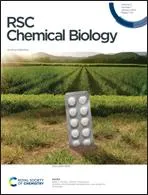

Interfacing non-enzymatic catalysis with living microorganisms
文献情報
出版日
2021-06-04
DOI
10.1039/D1CB00072A
インパクトファクター
0
著者
Joanna C. Sadler, Nick W. Johnson, Stephen Wallace
原文を見る
要旨
Interfacing non-enzymatic catalysis with cellular metabolism is emerging as a powerful approach to produce a range of high value small molecules and polymers. In this review, we highlight recent examples from this promising young field. Specifically, we discuss demonstrations of living cells mediating redox processes for biopolymer production, interfacing solar-light driven chemistry with microbial metabolism, and intra- and extracellular non-enzymatic catalysis to generate high value molecules. This review highlights the vast potential of this nascent field to bridge the two disciplines of synthetic chemistry and synthetic biology for a sustainable chemical industry.
関連文献
The atomic level structure of the TiO2–NiTi interface
M. Nolan, S. A. M. Tofail
2010-06-15
Paper
DOI: 10.1039/C002562C
Franck–Condon simulation of the photoelectron spectrum of AsF2 and the photodetachment spectrum of AsF2− using ab initio calculations: Ionization energy and electron affinity of AsF2
Daniel K. W. Mok, Foo-tim Chau, John M. Dyke
2010-06-08
Paper
DOI: 10.1039/C003688A
The origin of the large bending enhancement of the reaction of C2H2+ with methane: the effects of bending momentum, ruling out the precursor mechanism, and steps toward “Polanyi rules” for polyatomic reactions
Jianbo Liu, Scott L. Anderson
2009-07-28
Paper
DOI: 10.1039/B908328F
Determination of the charge profile in the KcsA selectivity filter using ab initio calculations and molecular dynamics simulations
Sebastian Kraszewski, Céline Boiteux, Christophe Ramseyer, Claude Girardet
2009-07-24
Paper
DOI: 10.1039/B905991A
Understanding underlying processes in formic acidfuelcells
Sunghyun Uhm, Hye Jin Lee
2009-08-04
Perspective
DOI: 10.1039/B909525J
Acceleration of the Z to Ephotoisomerization of penta-2,4-dieniminium by hydrogen out-of-plane motion: theoretical study on a model system of retinal protonated Schiff base
Masato Sumita, Mikhail N. Ryazantsev, Kazuya Saito
2009-06-09
Paper
DOI: 10.1039/B900882A
Cyanide leaching of Au/CeO2: highly active gold clusters for 1,3-butadiene hydrogenation
Y. Guan, E. J. M. Hensen
2009-08-19
Paper
DOI: 10.1039/B909487C
こちらもおすすめ
化合物よくある質問
2-メトキシ-4-(メチルスルフィニル)アミンの主な用途は何ですか?
2-メトキシ-4-(メチルスルフィニル)アミンは、主に医薬品および農薬の製造に使用されます。また、合成化学の一部として研究用材料としても利用されます。
41608-73-52-Methoxy-4-(methyls...
118684-13-24-(Bromomethyl)-3-me...
化合物よくある質問
4,6-二氯-N-甲基ピラミジンアミンの代替品はありますか?
代替品としては、4,6-二クロロピラミジンアミンや他のピラミジン系化合物が考えられます。ただし、目的と用途によって最適な代替品は異なります。
10397-15-64,6-Dichloro-N-methy...
化合物よくある質問
6-氯-4-甲基-1H-吲哚を含む廃棄物はどのように処理すべきですか?
6-氯-4-甲基-1H-吲哚の廃棄物は、適切な容器に収集し、密閉して保管します。温度は常温、湿度は低く、直射日光を避けて保管することを推奨します。廃棄処理は専門...
885520-84-36-chloro-4-methyl-1H...
化合物よくある質問
2-フローユロ-4-(トリフルオロメチル)ベンゾイドについて「に適用される法規ガイドラインは何ですか」
2-フローユロ-4-(トリフルオロメチル)ベンゾイドのCAS番号は207974-08-1です。この化合物はGHS分類で毒性物質と有害な反応物質として分類されます...
207974-08-1[2-Fluoro-4-(trifluo...
化合物よくある質問
4-ニトロフェニルN-[(ベンゼルオキシルカーボンイル]グリシングリシングリシン酸はどのように保存すればよいですか?
4-ニトロフェニルN-[(ベンゼルオキシルカーボンイル]グリシングリシングリシン酸は、室温で暗所に保管し、乾燥した環境で保存することを推奨します。容器は密閉性の...
19811-64-44-Nitrophenyl N-[(be...
化合物よくある質問
イソデスロラタドリンの代替品はありますか?
イソデスロラタドリンの代替品としては、デスロラタドリンや他の抗ヒスタミン薬が挙げられます。具体的には、デスロラタドリン、ラセカミド、フェルタドリンなどが、症状や...
183198-49-4Iso Desloratadine
化合物よくある質問
5-甲氧基-1,2,3,4-四氢异喹啉盐酸盐はどのように合成されますか?
5-甲氧基-1,2,3,4-四氢异喹啉盐酸盐の一般的な合成方法は、メタノール中で5-メトキシ-1,2,3,4-四ヒュドロイソキシンを塩酸で塩化します。この反応で...
103030-69-95-Methoxy-1,2,3,4-te...
化合物よくある質問
4-アミノ-5-メトキシ-2-トルエンサルホニック酸についての法規ガイドラインは何ですか?
CAS番号6471-78-9の4-アミノ-5-メトキシ-2-トルエンサルホニック酸は、GHS分類では corrosive(腐食性)と識別されます。EUのREAC...
6471-78-94-Amino-5-Methoxy-2-...
化合物よくある質問
甲基孕酮を取り扱う際の実験室安全事項は何ですか?
甲基孕酮の取り扱いは、PPE(個人保護具)の使用が必要な重要な安全事項を伴います。防塵マスク、ゴーグル、手袋を着用することが推奨されます。ドラフトチャンバーを使...
204063-33-22-[(Diphenylmethyl)a...
掲載誌
おすすめ化合物
![1-Naphthalenesulfonic acid, 2-[(2-hydroxy-1-naphthalenyl)azo]-, bariumsalt (2:1) structure](https://static.chemtradehub.com/structs/110/1103-38-4-0b33.webp "1-Naphthalenesulfonic acid, 2-[(2-hydroxy-1-naphthalenyl)azo]-, bariumsalt (2:1) structure")
1-Naphthalenesulfonic acid, 2-[(2-hydroxy-1-naphthalenyl)azo]-, bariumsalt (2:1)
CAS番号:
1103-38-4
分子式:
C20H14BaN2O4S
おすすめサプライヤー





免責事項
このページに表示される学術雑誌情報は、参考および研究目的のみを目的としています。当社は雑誌出版社とは提携しておらず、投稿の取り扱いも行っておりません。出版に関するお問い合わせは、各雑誌出版社に直接ご連絡ください。
表示されている情報に誤りがある場合は、support@chemtradehub.com までご連絡ください。迅速に確認し、対応いたします。