












Franck–Condon simulation of the photoelectron spectrum of AsF2 and the photodetachment spectrum of AsF2− using ab initio calculations: Ionization energy and electron affinity of AsF2
文献情報
出版日
2010-06-08
DOI
10.1039/C003688A
インパクトファクター
3.676
著者
Daniel K. W. Mok, Foo-tim Chau, John M. Dyke
原文を見る
要旨
RCCSD(T) and/or CASSCF/MRCI calculations were carried out on the 2B1 state of AsF2, the 1A1, ã3B1 and Ã1B1 states of AsF2+, and the 1A1 state of AsF2− employing the fully-relativistic small-core effective core potential (ECP10MDF) for As and basis sets of up to augmented correlation-consistent polarized valence quintuple-zeta (aug-cc-pV5Z) quality. Minimum-energy geometrical parameters and relative electronic energies were evaluated, including contributions from extrapolation to the complete basis set limit and from outer core correlation of the As 3d10 electrons. In addition, simplified, explicitly correlated RHF/UCCSD(T)-F12x calculations were also performed employing different atomic orbital basis sets, and associated complementary auxiliary and density-fitting basis sets. The best theoretical estimates of the adiabatic ionization energies (AIE0) of AsF2(2B1) to the 1A1 and ã3B1 states of AsF2+, including corrections for zero-point vibrational energy (ΔZPE), are 9.099(8) and 13.290(22) eV respectively. The best estimated electron affinity (EA0) of AsF2 is 1.182(16) eV, also including Δ(ZPE). These are currently the most reliable AIE0 and EA0 values for AsF2. Potential energy functions (PEFs) of the 2B1 state of AsF2, the 1A1 and ã3B1 states of AsF2+ and 1A1 state of AsF2− were computed at RCCSD(T)/aug-cc-pV5Z, RCCSD(T)/aug-cc-pCV5Z and RHF/UCCSD(T)-F12a/aug-cc-pCVTZ levels. These PEFs were employed in variational calculations of anharmonic vibrational wavefunctions, which were then utilised to calculate Franck–Condon factors (FCFs), using a method which includes allowance for anharmonicity and Duschinsky rotation. The computed FCFs were used to simulate the first two bands in the photoelectron spectrum of AsF2 and the first band in the photodetachment spectrum of AsF2−, both yet to be recorded. The simulated spectra obtained using different sets of PEFs were found to be almost identical, suggesting that the simplified explicitly correlated UCCSD(T)-F12x method with a relatively small basis set can be a reliable alternative to the conventional RCCSD(T) correlation methods with a relatively large basis set, but at a significantly lower cost.
関連文献
Effect of the state of distribution of supported Pt nanoparticles on effective Pt utilization in polymer electrolyte fuel cells
Makoto Uchida, Young-Chul Park, Katsuyoshi Kakinuma, Hiroshi Yano, Donald A. Tryk, Takeo Kamino, Hiroyuki Uchida, Masahiro Watanabe
2013-05-29
Paper
DOI: 10.1039/C3CP51801A
The mechanistic exploration of porous activated graphene sheets-anchored SnO2nanocrystals for application in high-performance Li-ion battery anodes
Yingchang Yang, Xiaobo Ji, Fang Lu, Qiyuan Chen, Craig E. Banks
2013-08-07
Paper
DOI: 10.1039/C3CP52808A
Conformational preferences of furan- and thiophene-based arylamides: a combined computational and experimental study
Jhenny F. Galan, Chi Ngong Tang, Shubhashis Chakrabarty, Zhiwei Liu, Vojislava Pophristic
2013-05-08
Paper
DOI: 10.1039/C3CP50353D
Superior power density solid oxidefuel cells by enlarging the three-phase boundary region of a NiO–Ce0.8Gd0.2O1.9 composite anode through optimized surface structure
Daeil Yoon, Qing Su, Haiyan Wang, Arumugam Manthiram
2013-07-09
Paper
DOI: 10.1039/C3CP52679H
Stability of Si epoxide defects in Si nanowires: a mixed reactive force field/DFT study
Erik C. Neyts, Umedjon Khalilov, Bart Partoens
2013-07-16
Paper
DOI: 10.1039/C3CP51621K
Interactions of platinum clusters with a graphite substrate
G. Ramos-Sanchez, P. B. Balbuena
2013-05-31
Paper
DOI: 10.1039/C3CP51791H
Thermal unfolding and refolding of lysozyme in deep eutectic solvents and their aqueous dilutions
Rocio Esquembre, Jesus M. Sanz, J. Gerard Wall, Francisco del Monte, C. Reyes Mateo, M. Luisa Ferrer
2013-05-08
Paper
DOI: 10.1039/C3CP44299C
Dye-sensitized solar cells based on hydroquinone/benzoquinone as bio-inspired redox couple with different counter electrodes
Ming Cheng, Xichuan Yang, Cheng Chen, Jianghua Zhao, Fuguo Zhang
2013-06-24
Paper
DOI: 10.1039/C3CP51980E
Highly soluble energy relay dyes for dye-sensitized solar cells
George Y. Margulis, Bogyu Lim, Brian E. Hardin, Eva L. Unger, Jun-Ho Yum, Johann M. Feckl, Dina Fattakhova-Rohlfing, Thomas Bein, Michael Grätzel, Alan Sellinger, Michael D. McGehee
2013-05-28
Paper
DOI: 10.1039/C3CP51018B
こちらもおすすめ
化合物よくある質問
2-メトキシ-4-(メチルスルフィニル)アミンの主な用途は何ですか?
2-メトキシ-4-(メチルスルフィニル)アミンは、主に医薬品および農薬の製造に使用されます。また、合成化学の一部として研究用材料としても利用されます。
41608-73-52-Methoxy-4-(methyls...
118684-13-24-(Bromomethyl)-3-me...
化合物よくある質問
4,6-二氯-N-甲基ピラミジンアミンの代替品はありますか?
代替品としては、4,6-二クロロピラミジンアミンや他のピラミジン系化合物が考えられます。ただし、目的と用途によって最適な代替品は異なります。
10397-15-64,6-Dichloro-N-methy...
化合物よくある質問
6-氯-4-甲基-1H-吲哚を含む廃棄物はどのように処理すべきですか?
6-氯-4-甲基-1H-吲哚の廃棄物は、適切な容器に収集し、密閉して保管します。温度は常温、湿度は低く、直射日光を避けて保管することを推奨します。廃棄処理は専門...
885520-84-36-chloro-4-methyl-1H...
化合物よくある質問
2-フローユロ-4-(トリフルオロメチル)ベンゾイドについて「に適用される法規ガイドラインは何ですか」
2-フローユロ-4-(トリフルオロメチル)ベンゾイドのCAS番号は207974-08-1です。この化合物はGHS分類で毒性物質と有害な反応物質として分類されます...
207974-08-1[2-Fluoro-4-(trifluo...
化合物よくある質問
4-ニトロフェニルN-[(ベンゼルオキシルカーボンイル]グリシングリシングリシン酸はどのように保存すればよいですか?
4-ニトロフェニルN-[(ベンゼルオキシルカーボンイル]グリシングリシングリシン酸は、室温で暗所に保管し、乾燥した環境で保存することを推奨します。容器は密閉性の...
19811-64-44-Nitrophenyl N-[(be...
化合物よくある質問
イソデスロラタドリンの代替品はありますか?
イソデスロラタドリンの代替品としては、デスロラタドリンや他の抗ヒスタミン薬が挙げられます。具体的には、デスロラタドリン、ラセカミド、フェルタドリンなどが、症状や...
183198-49-4Iso Desloratadine
化合物よくある質問
5-甲氧基-1,2,3,4-四氢异喹啉盐酸盐はどのように合成されますか?
5-甲氧基-1,2,3,4-四氢异喹啉盐酸盐の一般的な合成方法は、メタノール中で5-メトキシ-1,2,3,4-四ヒュドロイソキシンを塩酸で塩化します。この反応で...
103030-69-95-Methoxy-1,2,3,4-te...
化合物よくある質問
4-アミノ-5-メトキシ-2-トルエンサルホニック酸についての法規ガイドラインは何ですか?
CAS番号6471-78-9の4-アミノ-5-メトキシ-2-トルエンサルホニック酸は、GHS分類では corrosive(腐食性)と識別されます。EUのREAC...
6471-78-94-Amino-5-Methoxy-2-...
化合物よくある質問
甲基孕酮を取り扱う際の実験室安全事項は何ですか?
甲基孕酮の取り扱いは、PPE(個人保護具)の使用が必要な重要な安全事項を伴います。防塵マスク、ゴーグル、手袋を着用することが推奨されます。ドラフトチャンバーを使...
204063-33-22-[(Diphenylmethyl)a...
掲載誌
Physical Chemistry Chemical Physics

CiteScore:
5.5
自己引用率:
10.3%
年間論文数:
3036
Physical Chemistry Chemical Physics (PCCP) is an international journal co-owned by 19 physical chemistry and physics societies from around the world. This journal publishes original, cutting-edge research in physical chemistry, chemical physics and biophysical chemistry. To be suitable for publication in PCCP, articles must include significant innovation and/or insight into physical chemistry; this is the most important criterion that reviewers and Editors will judge against when evaluating submissions. The journal has a broad scope and welcomes contributions spanning experiment, theory, computation and data science. Topical coverage includes spectroscopy, dynamics, kinetics, statistical mechanics, thermodynamics, electrochemistry, catalysis, surface science, quantum mechanics, quantum computing and machine learning. Interdisciplinary research areas such as polymers and soft matter, materials, nanoscience, energy, surfaces/interfaces, and biophysical chemistry are welcomed if they demonstrate significant innovation and/or insight into physical chemistry. Joined experimental/theoretical studies are particularly appreciated when complementary and based on up-to-date approaches.
おすすめ化合物
![1,2-Diphenyl-4-[2-(phenylsulfinyl)ethyl]-3,5-pyrazolidinedione structure](https://static.chemtradehub.com/structs/57-/57-96-5-efcc.webp "1,2-Diphenyl-4-[2-(phenylsulfinyl)ethyl]-3,5-pyrazolidinedione structure")
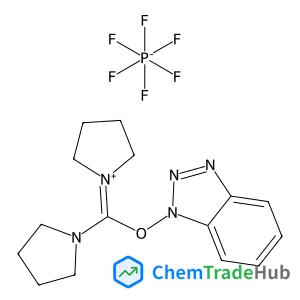
(1H-Benzotriazol-1-yloxy)(di-1-pyrrolidinyl)methylium hexafluorophosphate
CAS番号:
105379-24-6
分子式:
C15H21F6N5OP
おすすめサプライヤー



免責事項
このページに表示される学術雑誌情報は、参考および研究目的のみを目的としています。当社は雑誌出版社とは提携しておらず、投稿の取り扱いも行っておりません。出版に関するお問い合わせは、各雑誌出版社に直接ご連絡ください。
表示されている情報に誤りがある場合は、support@chemtradehub.com までご連絡ください。迅速に確認し、対応いたします。