


![[4-(Isobutyrylamino)phenyl]boronic acid structure](https://static.chemtradehub.com/structs/874/874219-50-8-6ab5.webp "[4-(Isobutyrylamino)phenyl]boronic acid structure")
A Ni-doping-induced phase transition and electron evolution in cobalt hexacyanoferrate as a stable cathode for sodium-ion batteries
文献情報
出版日
2020-12-28
DOI
10.1039/D0CP05665K
インパクトファクター
3.676
著者
Junjie Quan, Enze Xu, Hanwen Zhu, Yajing Chang, Yi Zhu, Pengcheng Li, Zhenjie Sun, Dabin Yu, Yang Jiang
原文を見る
要旨
Prussian blue analogues are potential competitive energy storage materials due to their diverse metal combinations and wide three-dimensional ion channels. Here, we prepared a new highly crystalline monoclinic nickel-doped cobalt hexacyanoferrate via a feasible and simple one-step co-precipitation method. In the process of sodium-ion de-intercalation, three stable charge and discharge platforms, which are consistent with the cyclic voltammetry performance, are seen for the first time, showing the function of nickel ions in Prussian blue. Furthermore, the charge transfer and structural evolution caused by the transmission of sodium ions were well revealed via ex situ XRD, ex situ XPS, and in situ EIS studies. Simulation calculations are performed relating to the energy band structure and the highest-occupied bonding orbitals of the system in different charge states, revealing the charge and discharge mechanism of the nickel-doped material and the reason for the emergence of the new platform at low voltages. In addition, NaNi0.17Co0.83Fe(CN)6 also delivers a striking capacity of 146 mA h g−1 and superior cyclability, with 93% capacity retention over 100 cycles; it can be considered as a promising alternative cathode material for use in sodium-ion batteries.
おすすめジャーナル

New Journal of Chemistry

Russian Journal of Coordination Chemistry

Current Opinion in Colloid & Interface Science

Acta Materialia

Journal of Saudi Chemical Society

Crystallography Reports

Chemistry Education Research and Practice

Russian Journal of Bioorganic Chemistry

Journal of Natural Medicines

Saudi Pharmaceutical Journal
関連文献
Synthesis and characterization of a novel hydrogel: salecan/polyacrylamide semi-IPN hydrogel with a desirable pore structure
Xinyu Hu, Liandong Feng, Aming Xie, Wei Wei, Shiming Wang, Jianfa Zhang, Wei Dong
2014-04-03
Paper
DOI: 10.1039/C3TB21711F
Encapsulating nanoscale zero-valent iron with a soluble Mg(OH)2 shell for improved mobility and controlled reactivity release
Yi-bo Hu, Xiao-yan Li
2017-11-30
Paper
DOI: 10.1039/C7TA08605A
Influence of a polyelectrolyte based-fluorene interfacial layer on the performance of a polymer solar cell
Shiyu Yao, Pengfei Li, Ji Bian, Qingfeng Dong, Chan Im, Wenjing Tian
2013-08-15
Paper
DOI: 10.1039/C3TA11972F
Evaluation and development of novel photoinitiator complexes for photoinitiating the copper-catalyzed azide–alkyne cycloaddition reaction
Abeer A. Alzahrani, Annette H. Erbse, Christopher N. Bowman
2013-12-13
Paper
DOI: 10.1039/C3PY01064C
An assessment of nanosponges for intravenous and oral drug delivery of BCS class IV drugs: Drug delivery kinetics and solubilization
Kelly A. Gilmore
2014-04-01
Communication
DOI: 10.1039/C4PY00207E
Light-induced reactivity of gold and hybrid perovskite as a new possible degradation mechanism in perovskite solar cells
Natalia N. Shlenskaya, Nikolai A. Belich, Michael Grätzel
2017-12-20
Paper
DOI: 10.1039/C7TA10217H
Self-assembled hybrid tinphosphonate nanoparticles with bimodal porosity: an insight towards the efficient and selective catalytic process for the synthesis of bioactive 1,4-dihydropyridines under solvent-free conditions
Malay Pramanik, Asim Bhaumik
2013-07-12
Paper
DOI: 10.1039/C3TA12476B
Triplet depletion forces from density functional optimization
2000-06-30
Paper
DOI: 10.1039/B001801P
How the number of fitting points for the slope of the mean-square displacement influences the experimentally determined particle size distribution from single-particle tracking
Dominique Ernst, Jürgen Köhler
2013-02-04
Communication
DOI: 10.1039/C3CP44391D
Solar light assisted green synthesis of palladium nanoparticle decorated nitrogen doped graphene for hydrogen storage application
B. P. Vinayan, Rupali Nagar, S. Ramaprabhu
2013-07-12
Paper
DOI: 10.1039/C3TA12016C
こちらもおすすめ
化合物よくある質問
6- bromo-1-cyclopropyl-1H-benzimidazoleの市場動向や研究トレンドはどうですか?
6- bromo-1-cyclopropyl-1H-benzimidazoleは、抗炎症、抗ウイルス作用を持つことが報告されており、新薬開発の研究対象として注目...
1416713-53-56-Bromo-1-cyclopropy...
化合物よくある質問
環氧プロpanol-d5を取り扱う際の実験室安全事項は何ですか?
取り扱う際には、防護眼鏡と手袋を使用し、ドラフトチャンバー内で操作することを推奨します。漏洩時には適切な手順で処理し、安全データシートを常に参照してください。
1246819-20-4Glycidol-d5
化合物よくある質問
2,2’-ジメチル-3,3’-ビピリジンはどのように合成されますか?
2,2’-ジメチル-3,3’-ビピリジンは、ピリジンと2-メチルアクリルアミドを有機合成反応で合成します。この反応では、ピリジンと2-メチルアクリルアミドを含有...
86156-55-02,2’-Dimethyl-3,3’-b...
化合物よくある質問
6-甲基ピリジン-2-ボリック酸の主な用途は何ですか?
6-甲基ピリジン-2-ボリック酸は、合成化学、医薬品合成、以及研究用途などに広く使用され、特に組換えDNA技術や分子生物学の研究において重要な役割を果たします。
372963-50-3(6-Methyl-2-pyridiny...
化合物よくある質問
(R)-3-(1-甲基-2-氧環己基)プロpano酸メチルは安全ですか?
(R)-3-(1-甲基-2-氧環己基)プロpano酸メチルは一定の安全性がありますが、直接的な皮膚接触や吸入は避けるべきです。使用する際は適切な個々の安全データ...
94089-47-1methyl 3-[(1R)-1-met...
化合物よくある質問
ketorolacはどのように保存すればよいですか?
ketorolacは、密封して遮光容器に保管し、直射日光や高温を避けて保存してください。温度は常温で保存し、湿度をなるべく低く保つことが推奨されます。
74103-06-3rac Ketorolac
化合物よくある質問
L-2,3-二氨基丙酸二盐酸盐を取り扱う際の実験室安全事項は何ですか?
L-2,3-二氨基丙酸二盐酸盐は腐食性が強く、皮膚や粘膜に刺激を与える可能性があります。取り扱う際は、防塵マスク、ゴーグル、手袋を使用し、適切な排気設備を使用し...
19777-68-5(S)-2,3-Diaminopropa...
化合物よくある質問
2-(4-溴ピリジン-2-基)乙腈の物理化学的性質は何ですか?
2-(4-溴ピリジン-2-基)乙腈のCAS番号は312325-73-8です。主に結晶形態で存在し、分子量は159.01 g/molです。この化合物は水に溶けやす...
312325-73-8(4-Bromo-2-pyridinyl...
化合物よくある質問
3-フローロ-[1,1-ベンジレン]-3,4-ジカルボン酸を取り扱う際の実験室安全事項は何ですか?
この化合物は毒性は低いですが、直接的な接触や吸入に注意が必要です。PPE(個人防護具)を着用し、ドラフトチャンバーを使用して操作することを推奨します。また、漏洩...
1261915-32-53'-Fluoro-[1,1'-biph...
化合物よくある質問
3-(1-氧代-1,3-二氢-2H-2-异吲哚)丙酸の主な用途は何ですか?
3-(1-氧代-1,3-二氢-2H-2-异吲哚)丙酸は、薬理学研究や医薬品製造において広く用いられる化合物です。また、工業的な用途でも一部の化学反応の触媒や助剤...
83747-30-23-(1-Oxo-1,3-dihydro...
掲載誌
Physical Chemistry Chemical Physics

CiteScore:
5.5
自己引用率:
10.3%
年間論文数:
3036
Physical Chemistry Chemical Physics (PCCP) is an international journal co-owned by 19 physical chemistry and physics societies from around the world. This journal publishes original, cutting-edge research in physical chemistry, chemical physics and biophysical chemistry. To be suitable for publication in PCCP, articles must include significant innovation and/or insight into physical chemistry; this is the most important criterion that reviewers and Editors will judge against when evaluating submissions. The journal has a broad scope and welcomes contributions spanning experiment, theory, computation and data science. Topical coverage includes spectroscopy, dynamics, kinetics, statistical mechanics, thermodynamics, electrochemistry, catalysis, surface science, quantum mechanics, quantum computing and machine learning. Interdisciplinary research areas such as polymers and soft matter, materials, nanoscience, energy, surfaces/interfaces, and biophysical chemistry are welcomed if they demonstrate significant innovation and/or insight into physical chemistry. Joined experimental/theoretical studies are particularly appreciated when complementary and based on up-to-date approaches.
おすすめ化合物
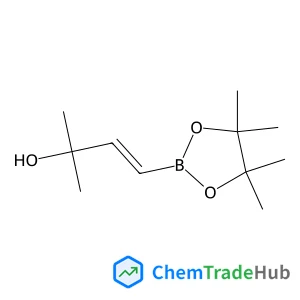
(E)-2-methyl-4-(4,4,5,5-tetramethyl-1,3,2-dioxaborolan-2-yl)but-3-en-2-ol
CAS番号:
581802-26-8
分子式:
C11H21BO3
おすすめサプライヤー






免責事項
このページに表示される学術雑誌情報は、参考および研究目的のみを目的としています。当社は雑誌出版社とは提携しておらず、投稿の取り扱いも行っておりません。出版に関するお問い合わせは、各雑誌出版社に直接ご連絡ください。
表示されている情報に誤りがある場合は、support@chemtradehub.com までご連絡ください。迅速に確認し、対応いたします。