












Temperature-controlled helical inversion of asymmetric triphenylamine-based supramolecular polymers; difference of handedness at the micro- and macroscopic levels
文献情報
出版日
2019-02-19
DOI
10.1039/C9QO00051H
インパクトファクター
5.281
著者
Misun Go, Heekyoung Choi, Ka Young Kim, Cheol Joo Moon, Yeonweon Choi, Hiroyuki Miyake, Shim Sung Lee, Sung Ho Jung, Myong Yong Choi, Jong Hwa Jung
原文を見る
要旨
This study describes the temperature-controlled helicity inversion of supramolecular polymers based on N-triphenylamines (TPAs) bearing different numbers of D-alanine and/or glycine moieties. Despite chiral branching differences, the three investigated TPAs form helical supramolecular polymers via a typical nucleation–elongation model, characteristic of a cooperative assembly. The supramolecular polymer TPA-3, composed of symmetric tri-alanine segments, was more thermodynamically stable compared with TPA-1 and TPA-2, which had one or two alanine segments. More interestingly, at the microscopic level, temperature-dependent circular dichroism (CD) measurements revealed that the left-handed (M-type) helicity of supramolecular polymers TPA-1 and TPA-2 was inverted to the right-handed (P-type) helicity during heating. The (+/−) pattern of the vibrational circular dichroism (VCD) signal in the region of amide groups of self-assembled TPA-1 was also converted to the (−/+) pattern of the VCD signal. This indicates that the conformation of achiral gycine groups with the left-handed orientation was changed to the conformation of the glycine groups with the right-handed orientation. However, at the macroscopic level, the left- and the right-handed helical fibers were observed to coexist in self-assembled TPA-1 and TPA-2 at lower and higher temperatures. In contrast, no helicity conversion with the increase in temperature was observed for self-assembled TPA-3, which exhibited an ambiguous left-handed helical structure with a long helical pitch. Furthermore, the origin of the helical inversion at the microscopic level was supported via computational simulations. The helical inversion was possibly due to a molecular conformational change of flexible glycine moieties during the formation of supramolecular polymers. Based on AFM observations and DFT calculations, we conclude that even though either the positive or the negative signal of supramolecular polymers TPAs was obtained in CD spectra, the right- and the left-handed supramolecular polymer TPAs co-existed at the microscopic and macroscopic levels. Thus, the handedness of supramolecular polymers TPAs was determined by relative distribution of the right- and left-handed helical fibers.
関連文献
Unexpected protonation state of Glu197 discovered from simulations of tacrine in butyrylcholinesterase
Xiao Wan, Yuan Yao, Lei Fang, Junjun Liu
2018-05-08
Paper
DOI: 10.1039/C8CP01566J
A “turn-off” red-emitting fluorophore for nanomolar detection of heparin
Palash Jana, Mithun Radhakrishna, Saumyakanti Khatua, Sriram Kanvah
2018-01-24
Paper
DOI: 10.1039/C7CP06300H
A potential material for hydrogen storage: a Li decorated graphitic-CN monolayer
Yong-Dao Chen, Song Yu, Wen-Hui Zhao, Shun-Fang Li, Xiang-Mei Duan
2018-04-25
Paper
DOI: 10.1039/C8CP01145A
Eliminating common biases in modelling the electrical conductivity of carbon nanotube–polymer nanocomposites
Linh Trong Hoang, Siu Ning Leung, Zheng Hong Zhu
2018-04-12
Communication
DOI: 10.1039/C8CP01715H
Radiation-induced disorder in compressed lanthanide zirconates
Sulgiye Park, Cameron L. Tracy, Fuxiang Zhang, Changyong Park, Sergey N. Tkachev, Maik Lang, Rodney C. Ewing
2018-02-12
Paper
DOI: 10.1039/C7CP08664D
Ternary CBe4Au4 cluster: a 16-electron system with quasi-planar tetracoordinate carbon
Lin-Yan Feng, Hua-Jin Zhai
2018-02-13
Paper
DOI: 10.1039/C7CP08420J
“On demand” triggered crystallization of CaCO3 from solute precursor species stabilized by the water-in-oil microemulsion
Teresa Roncal-Herrero, Alejandro Fernandez-Martinez, Adriana Matamoros-Veloza, Roland Kröger
2018-05-10
Paper
DOI: 10.1039/C8CP00540K
Influence of the anion on the properties of ionic liquid mixtures: a molecular dynamics study
Renata Costa, Carlos M. Pereira, M. Natália D. S. Cordeiro
2018-05-17
Paper
DOI: 10.1039/C8CP01541D
Small stoichiometric (MoS2)n clusters with the 1T phase
Ya-Ya Wang, Jia-Jun Deng, Xin Wang, Jian-Tao Che, Xun-Lei Ding
2018-01-30
Paper
DOI: 10.1039/C7CP07914A
Poly(vinylidene fluoride)/poly(3-methylthiophene) core–shell nanocomposites with improved structural and electronic properties of the conducting polymer component
Nikolay A. Ogurtsov, Valery N. Bliznyuk, Andrii V. Mamykin, Oleksandr L. Kukla, Yuri P. Piryatinski, Alexander A. Pud
2018-02-05
Paper
DOI: 10.1039/C7CP07604E
こちらもおすすめ
化合物よくある質問
4-アミノフェノール酸ナトリウム水和物とは何ですか?
4-アミノフェノール酸ナトリウム水和物は、CAS番号206557-08-6の化合物で、4-アミノフェノールとナトリウムが結合した塩と水和物です。この化合物は、白...
206557-08-64-Aminobenzoic acid ...
化合物よくある質問
Methyl 3-methyl-N-{[(2-methyl-2-propanyl)oxy]carbonyl}-L-histidinateの代替品はありますか?
この化合物は特定の合成プロセスに使用される可能性がありますが、代替品として、他の类似的な化合物、例えばMethyl 3-methyl-N-{[(2-methyl...
72212-51-2Methyl 3-methyl-N-{[...
化合物よくある質問
4-Boc-2-哌嗪甲酸の市場動向や研究トレンドはどうですか?
4-Boc-2-哌嗪甲酸は、薬品開発や合成化学分野で広く使用されており、その需要は継続的に推移しています。特に、新薬開発における合成化学分野での需要が高まってい...
192330-11-3(2R)-4-[(tert-butoxy...
化合物よくある質問
4,4'-二羟甲基联苯の物理化学的性質は何ですか?
4,4'-二羟甲基联苯のCAS番号は1667-12-5です。この化合物は白色の結晶粉末で、分子量は154.20です。水にわずかに溶けますが、アルコールや有機溶媒...
1667-12-54,4'-Biphenyldiyldim...
化合物よくある質問
5-甲硫基戊腈はどの業界で使用されていますか?
5-甲硫基戊腈は医薬品産業で使用される可能性があります。また、ポリマー合成の触媒として、センサー製造の一部として、半導体製造のプロセス改善に使用される可能性があ...
59121-25-45-(Methylsulfanyl)pe...
化合物よくある質問
CAS番号1311961-50-8の化合物はどのように合成されますか?
この化合物は、1-abieta-8,11,13-trien-19-イルと6'-メトキシシンコナナン-9-基を含有する窒素含有化合物から合成されます。一般的な合成...
1311961-50-81-Abieta-8,11,13-tri...
化合物よくある質問
6-ブロモベンジジミダゾール-2-カルビルデオキシドはどのように保存すればよいですか?
6-ブロモベンジジミダゾール-2-カルビルデオキシドは、避光・乾燥した容器(密閉容器)で-20℃~4℃の低温で保存してください。高温や直射日光、湿気は避けてくだ...
885280-26-25-Bromo-1H-benzimida...
化合物よくある質問
Boc-N-甲基氨甲环酸とは何ですか?
621-65-8のCAS番号を持つBoc-N-甲基氨甲环酸は、化学式C7H13NO5を有する化合物です。この化合物は白色の結晶性粉末で、吸湿性があります。
621-65-83-Hydroxy-1,2-propan...
化合物よくある質問
乙基三氟硼酸钾はどのように合成されますか?
乙基三氟硼酸钾は、トリフLUオール酸カリウムとエチルブロミドを反応させて合成されます。この反応は高い選択性と収率を持ち、触媒を用いることで効率的に進行します。
882871-21-8Potassium ethyltrifl...
化合物よくある質問
2-フロウロ-5-クロロ-4-アミノフェノールはどのように保存すればよいですか?
2-フロウロ-5-クロロ-4-アミノフェノールは、直射日光を避けて冷却された暗所で保存し、密閉容器に保管してください。温度は常温か低温が適しています。
847872-10-04-Amino-5-chloro-2-f...
掲載誌
Organic Chemistry Frontiers

CiteScore:
7.8
自己引用率:
8.7%
年間論文数:
724
Organic Chemistry Frontiers publishes high-quality research from across organic chemistry. Emphases are placed on studies that make significant contributions to the field of organic chemistry by reporting either new or significantly improved protocols or methodologies. Topics include, but are not limited to the following: Organic synthesis Development of synthetic methodologies Catalysis Natural products Functional organic materials Supramolecular and macromolecular chemistry Physical and computational organic chemistry
おすすめ化合物
![Methyl 3-({2'-[(E)-(hydroxyhydrazono)methyl]-4-biphenylyl}methyl)-2-oxo-2,3-dihydro-1H-benzimidazole-4-carboxylate structure](https://static.chemtradehub.com/structs/149/1499167-72-4-034a.webp "Methyl 3-({2'-[(E)-(hydroxyhydrazono)methyl]-4-biphenylyl}methyl)-2-oxo-2,3-dihydro-1H-benzimidazole-4-carboxylate structure")
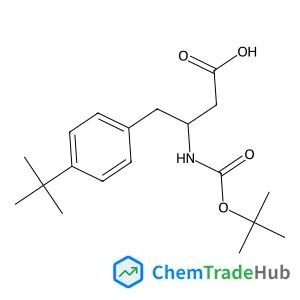
(S)-3-((tert-Butoxycarbonyl)amino)-4-(4-(tert-butyl)phenyl)butanoic acid
CAS番号:
403661-85-8
分子式:
C19H29NO4
おすすめサプライヤー





免責事項
このページに表示される学術雑誌情報は、参考および研究目的のみを目的としています。当社は雑誌出版社とは提携しておらず、投稿の取り扱いも行っておりません。出版に関するお問い合わせは、各雑誌出版社に直接ご連絡ください。
表示されている情報に誤りがある場合は、support@chemtradehub.com までご連絡ください。迅速に確認し、対応いたします。