












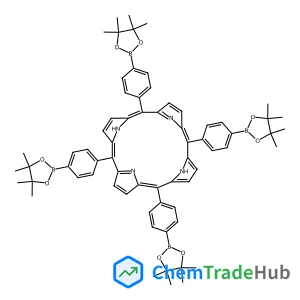
5,10,15,20-tetrakis(4-boronic acid pinacol ester phenyl) porphyrin
CAS番号:
1332748-00-1
分子式:
C68H74B4N4O8
Nikolay A. Ogurtsov, Valery N. Bliznyuk, Andrii V. Mamykin, Oleksandr L. Kukla, Yuri P. Piryatinski, Alexander A. Pud
We report significant improvements in the structure and electronic properties of a poly(3-alkylthiophene) representative, namely poly(3-methylthiophene) (P3MT), when it is synthesized in the presence of submicron electroactive poly(vinylidene fluoride) (PVDF) particles. The applied template oxidative synthesis leads to the formation of the PVDF/P3MT composite consisting of core–shell particles. The shells are constituted with a monolayer of 20–40 nm nanoparticles of the doped P3MT (P3MT-Cl) precipitated at the surface of the spherical PVDF cores. This morphology differs strongly from the hierarchical one of the neat P3MT synthesized without PVDF particles. In the latter case, 20–60 nm P3MT nanoparticles form ∼200 nm aggregates, which, in turn, are arranged in a few micrometer agglomerates. Furthermore, we demonstrate that compared to the neat polymer, doped P3MT in the shells of the composite is characterized with higher effective conjugation length, regioregularity of the molecular structure, improved intrachain packing order and lower bipolaron/polaron ratio. These features of the PVDF/P3MT composite strongly suggest applicability of this material in various electronic devices. As a proof of concept, we report on an improved sensing performance of the PVDF/P3MT-Cl composite compared with the neat P3MT-Cl in detection of several volatile organic compounds known as markers for some diseases and toxic substances. We have discovered that the maximal improvement in the sensor response magnitude corresponds to the case when the values of the analyte electronegativity and polythiophene work function are close. We associate this behavior with a higher surface dipole component of the work function of the PVDF/P3MT-Cl composite compared to that of the neat conducting polymer.
Justyna Łuczak, Christian Jungnickel, Izabela Łącka, Stefan Stolte, Jan Hupka
DOI: 10.1039/B921805J
DOI: 10.1039/B713875J
Ana C. Fernandes, Moisés L. Pinto, Fernando Antunes, João Pires
DOI: 10.1039/C3TB20535E
Jennifer Neumann, Olav Grundmann, Jorg Thöming, Michael Schulte, Stefan Stolte
DOI: 10.1039/B918453H
Shujuan Bian, Kui Gao, Huijie Shen, Xuheng Jiang, Yafeng Long, Yong Chen
DOI: 10.1039/C3TB20169D
D. V. Ravi Kumar, Manasi Kasture, A. A. Prabhune, C. V. Ramana, B. L. V. Prasad, A. A. Kulkarni
DOI: 10.1039/B919550E
Qiankun Zhong, Wensheng Liu, Yong Yang, Wenkang Pan, Mingzai Wu, Fangcai Zheng, Xiao Lian, Helin Niu
DOI: 10.1039/D1MA00390A
Sergio Gámez-Valenzuela, David Neusser, Belén Villacampa, Rocío Ponce Ortiz, Sabine Ludwigs, Raquel Andreu, M. Carmen Ruiz Delgado
DOI: 10.1039/D1MA00415H
4-アミノフェノール酸ナトリウム水和物は、CAS番号206557-08-6の化合物で、4-アミノフェノールとナトリウムが結合した塩と水和物です。この化合物は、白...
この化合物は特定の合成プロセスに使用される可能性がありますが、代替品として、他の类似的な化合物、例えばMethyl 3-methyl-N-{[(2-methyl...
4-Boc-2-哌嗪甲酸は、薬品開発や合成化学分野で広く使用されており、その需要は継続的に推移しています。特に、新薬開発における合成化学分野での需要が高まってい...
4,4'-二羟甲基联苯のCAS番号は1667-12-5です。この化合物は白色の結晶粉末で、分子量は154.20です。水にわずかに溶けますが、アルコールや有機溶媒...
5-甲硫基戊腈は医薬品産業で使用される可能性があります。また、ポリマー合成の触媒として、センサー製造の一部として、半導体製造のプロセス改善に使用される可能性があ...
この化合物は、1-abieta-8,11,13-trien-19-イルと6'-メトキシシンコナナン-9-基を含有する窒素含有化合物から合成されます。一般的な合成...
6-ブロモベンジジミダゾール-2-カルビルデオキシドは、避光・乾燥した容器(密閉容器)で-20℃~4℃の低温で保存してください。高温や直射日光、湿気は避けてくだ...
621-65-8のCAS番号を持つBoc-N-甲基氨甲环酸は、化学式C7H13NO5を有する化合物です。この化合物は白色の結晶性粉末で、吸湿性があります。
乙基三氟硼酸钾は、トリフLUオール酸カリウムとエチルブロミドを反応させて合成されます。この反応は高い選択性と収率を持ち、触媒を用いることで効率的に進行します。
2-フロウロ-5-クロロ-4-アミノフェノールは、直射日光を避けて冷却された暗所で保存し、密閉容器に保管してください。温度は常温か低温が適しています。

Physical Chemistry Chemical Physics (PCCP) is an international journal co-owned by 19 physical chemistry and physics societies from around the world. This journal publishes original, cutting-edge research in physical chemistry, chemical physics and biophysical chemistry. To be suitable for publication in PCCP, articles must include significant innovation and/or insight into physical chemistry; this is the most important criterion that reviewers and Editors will judge against when evaluating submissions. The journal has a broad scope and welcomes contributions spanning experiment, theory, computation and data science. Topical coverage includes spectroscopy, dynamics, kinetics, statistical mechanics, thermodynamics, electrochemistry, catalysis, surface science, quantum mechanics, quantum computing and machine learning. Interdisciplinary research areas such as polymers and soft matter, materials, nanoscience, energy, surfaces/interfaces, and biophysical chemistry are welcomed if they demonstrate significant innovation and/or insight into physical chemistry. Joined experimental/theoretical studies are particularly appreciated when complementary and based on up-to-date approaches.
![6,7-Dihydro-5H-pyrrolo[1,2-a]imidazole-6-carboxylic acid structure](https://static.chemtradehub.com/structs/136/1369160-12-2-6524.webp "6,7-Dihydro-5H-pyrrolo[1,2-a]imidazole-6-carboxylic acid structure")


