












![8-Bromo-6-fluoro[1,2,4]triazolo[1,5-a]pyridin-2-amine structure](https://static.chemtradehub.com/structs/125/1257705-51-3-9f4a.webp "8-Bromo-6-fluoro[1,2,4]triazolo[1,5-a]pyridin-2-amine structure")
Pressure-induced non-innocence in bis(1,2-dionedioximato)Pt(ii) complexes: an experimental and theoretical study of their insulator–metal transitions
文献情報
出版日
2020-03-05
DOI
10.1039/C9CP06749C
インパクトファクター
3.676
著者
Helen Benjamin, Jonathan G. Richardson, Stephen A. Moggach, Sergejs Afanasjevs, Lisette Warren, Mark R. Warren, David R. Allan, Carole A. Morrison, Konstantin V. Kamenev, Neil Robertson
原文を見る
要旨
Bis(1,2-dionedioximato) complexes of Pt(II) are known for their propensity to form linear chains of metal complexes in the solid state, and under the application of pressure members of the family display interesting optical and conductive properties. Two examples, Pt(bqd)2 and Pt(dmg)2, are known to undergo insulator-to-metal-to-insulator transitions, with the metallic state reached at 0.8–1.4 GPa and 5 GPa, respectively. Previous interpretations of these materials’ behaviour focused on the role of the filled dz2 and vacant p orbitals on platinum, with little consideration to the role of the ligand. Here, the pressure-structural behaviour of Pt(bqd)2 is investigated through single crystal X-ray diffraction, the first such study on this material. The difference in conductive behaviour under pressure between Pt(bqd)2 and Pt(dmg)2 is then interpreted through a combination of experimental and computational methods, including conductivity measurements under high pressure and electronic structure calculations. Our computational work reveals the significant contribution from ligand low-lying vacant π-orbitals to the frontier orbitals and bands in these complexes, and provides an explanation for the experimentally observed re-entrant insulator-to-metal-to-insulator transitions, and the differences in behaviour between the two compounds.
関連文献
Well-defined PCL-graft-PDMAEMA prepared by ring-opening polymerisation and click chemistry
Vincent Darcos, Sarah El Habnouni, Benjamin Nottelet, Abdeslam El Ghzaoui, Jean Coudane
2010-01-25
Communication
DOI: 10.1039/C0PY00004C
Performance polymers from renewable monomers: high molecular weight poly(pentadecalactone) for fiber applications
Matthijs de Geus, Inge van der Meulen, Bart Goderis, Kristof van Hecke, Marko Dorschu, Harm van der Werff, Cor E. Koning
2010-01-20
Paper
DOI: 10.1039/B9PY00360F
Sequential removal and recovery of cadmium ions (Cd2+) using photocatalysis and reduction crystallization from the aqueous phase
Vivek Kumar, Ravinder Kumar Wanchoo, Amrit Pal Toor
2021-06-28
Paper
DOI: 10.1039/D1RE00149C
Highly permeable polymers for gas separation membranes
Peter M. Budd, Neil B. McKeown
2010-01-04
Review Article
DOI: 10.1039/B9PY00319C
Flow synthesis kinetics for lomustine, an anti-cancer active pharmaceutical ingredient
Samir Diab, Mateen Raiyat, Dimitrios I. Gerogiorgis
2021-07-19
Paper
DOI: 10.1039/D1RE00184A
Understanding the origin of structure sensitivity in hydrodechlorination of trichloroethylene on a palladium catalyst
Chaitra S. Shenoy, Tuhin S. Khan, Kirti Verma, Mesfin Tsige, M. Ali Haider, Shelaka Gupta
2021-09-17
Paper
DOI: 10.1039/D1RE00252J
Extracting kinetic information in catalysis: an automated tool for the exploration of small data
Pedro S. F. Mendes, Sébastien Siradze, Laura Pirro, Joris W. Thybaut
2021-10-06
Paper
DOI: 10.1039/D1RE00215E
An intensified chlorination process of 4-nitroaniline in a liquid–liquid microflow system
Zhou Lan, Yangcheng Lu
2021-10-14
Communication
DOI: 10.1039/D1RE00379H
Hyperbranched 5,6-glucan as reducing sugar ball
Masaki Tamaki, Tsukasa Taguchi, Soichi Nakabayashi, Kota Mori, Yoshikazu Kitajyo, Ryosuke Sakai, Toyoji Kakuchi, Toshifumi Satoh
2009-12-21
Paper
DOI: 10.1039/B9PY00223E
こちらもおすすめ
化合物よくある質問
2,3-スチオエポキシマドルを取り扱う際の実験室安全事項は何ですか?
取り扱いにはPPE(プロテクティブ・パーソナル・エイド)が必要で、防ぐ手袋と保護眼鏡を着用してください。ドラフトチャンバーの使用を推奨します。漏洩した場合は、適...
4267-80-52,3-Thioepoxy Madol
53981-25-22-Amino-6-fluorophen...
化合物よくある質問
BOC-S-3-アミニ-4-(4-メチオキシベンチル)-ブタン酸の代替品はありますか?
この化合物の代替品としては、BOC保護基を有さないアミノ酸やその他の保護基化合物が考えられます。また、メチオキシ基を有しない他の芳香族アミノ酸も代替品として挙げ...
126800-59-7(3S)-4-(4-Methoxyphe...
化合物よくある質問
Methyl 2-(chloromethyl)-3-nitrobenzoate(1218910-61-2)の代替品はありますか?
Methyl 2-(chloromethyl)-3-nitrobenzoate(1218910-61-2)の代替品としては、化学組成を変えることで効果を達成する...
1218910-61-2Methyl 2-(chlorometh...
化合物よくある質問
(2R)-2-アミノ-N-ベンジル-3-ヒドロキシプロパナミドを含む廃棄物はどのように処理すべきですか?
(2R)-2-アミノ-N-ベンジル-3-ヒドロキシプロパナミドを含む廃棄物は、適切な廃棄物管理ガイドラインに基づき処理する必要があります。まず、廃棄物を適切に収...
175481-39-7(2R)-2-amino-N-benzy...
化合物よくある質問
6,7-二氢-咪唑並[1,2-a]ピリドイン-8(5h)-酮はどのように合成されますか?
6,7-二氢-咪唑並[1,2-a]ピリドイン-8(5h)-酮は、2-ブロモフェニルアセトインとリン酸ハロゲン化物を反応させることで合成できます。この反応は高温で...
457949-09-66,7-Dihydroimidazo[1...
化合物よくある質問
エチル(3R)-3-ピロリジニル酢酸水和塩とは何ですか?
エチル(3R)-3-ピロリジニル酢酸水和塩は、CAS番号1332459-32-1の化合物で、(R)-乙基2-(ピロリジン-3-基)酢酸塩水和塩と呼ばれます。この...
1332459-32-1Ethyl (3R)-3-pyrroli...
化合物よくある質問
(2S)-{[(2-メチルエチルオキシ]カルボニル}アミノ)[2-(トリアフルオロメチルフェニル]エチカシック酸の物理化学的性質は何ですか?
(2S)-{[(2-メチルエチルオキシ]カルボニル}アミノ)[2-(トリアフルオロメチルフェニル]エチカシック酸のCAS番号は1203454-45-8です。この...
1203454-45-8(2S)-({[(2-Methyl-2-...
化合物よくある質問
2-ブロモ-1-(2-メチル-2-プロパニル)-4-ニトロベンゼンはどのように保存すればよいですか?
2-ブロモ-1-(2-メチル-2-プロパニル)-4-ニトロベンゼンは、直射日光を避けて暗所で、室温(約15℃〜25℃)、乾燥した場所に保存する必要があります。ま...
6310-17-42-Bromo-1-(2-methyl-...
化合物よくある質問
1-[(4-硝基フェニル)スルホニル]-1H-1,2,4-三唑の市場動向や研究トレンドはどうですか?
市場動向としては、1-[(4-硝基フェニル)スルホニル]-1H-1,2,4-三唑は主に農業用除草剤や合成化学製品の原料として利用されています。研究トレンドとして...
57777-84-11-[(4-Nitrophenyl)su...
掲載誌
Physical Chemistry Chemical Physics

CiteScore:
5.5
自己引用率:
10.3%
年間論文数:
3036
Physical Chemistry Chemical Physics (PCCP) is an international journal co-owned by 19 physical chemistry and physics societies from around the world. This journal publishes original, cutting-edge research in physical chemistry, chemical physics and biophysical chemistry. To be suitable for publication in PCCP, articles must include significant innovation and/or insight into physical chemistry; this is the most important criterion that reviewers and Editors will judge against when evaluating submissions. The journal has a broad scope and welcomes contributions spanning experiment, theory, computation and data science. Topical coverage includes spectroscopy, dynamics, kinetics, statistical mechanics, thermodynamics, electrochemistry, catalysis, surface science, quantum mechanics, quantum computing and machine learning. Interdisciplinary research areas such as polymers and soft matter, materials, nanoscience, energy, surfaces/interfaces, and biophysical chemistry are welcomed if they demonstrate significant innovation and/or insight into physical chemistry. Joined experimental/theoretical studies are particularly appreciated when complementary and based on up-to-date approaches.
おすすめ化合物
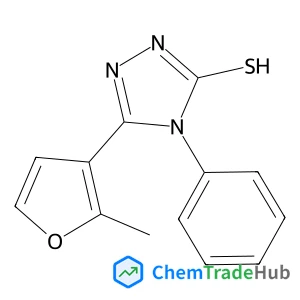
5-(2-Methyl-3-furyl)-4-phenyl-2,4-dihydro-3H-1,2,4-triazole-3-thione
CAS番号:
346464-59-3
分子式:
C13H11N3OS
おすすめサプライヤー






免責事項
このページに表示される学術雑誌情報は、参考および研究目的のみを目的としています。当社は雑誌出版社とは提携しておらず、投稿の取り扱いも行っておりません。出版に関するお問い合わせは、各雑誌出版社に直接ご連絡ください。
表示されている情報に誤りがある場合は、support@chemtradehub.com までご連絡ください。迅速に確認し、対応いたします。