












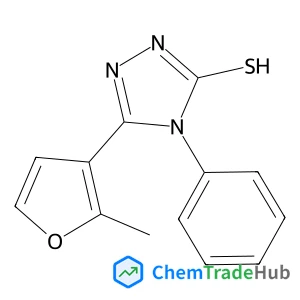
5-(2-Methyl-3-furyl)-4-phenyl-2,4-dihydro-3H-1,2,4-triazole-3-thione
CAS番号:
346464-59-3
分子式:
C13H11N3OS
Samir Diab, Mateen Raiyat, Dimitrios I. Gerogiorgis
Continuous flow synthesis of active pharmaceutical ingredients (APIs) can offer access to process conditions that are otherwise hazardous when operated in batch mode, resulting in improved mixing and heat transfer, which enables higher yields and greater reaction selectivity. Reaction kinetic parameter estimation from flow synthesis data is an essential activity for the development of process models for drug substance manufacturing unit operations and systems, facilitating a reduction of experimental effort and accelerating development. The flow synthesis of lomustine, an anti-cancer API, in two flow reactors (carbamylation + nitrosation stages) was recently demonstrated by Jaman et al. (Org. Process Res. Dev., 2019, 23, 334). In this study, we postulate kinetic rate laws based on hereby proposed reaction mechanisms presented for the first time in the literature for this API synthesis. We then perform kinetic parameter regression for the proposed rate laws, on the basis of published data, towards establishing reactor models. For the carbamylation (irreversible reaction), we compare two candidate reaction rate laws, an overall third-order rate law (first-order in each reagent) deriving best fit. For the nitrosation, we propose two substitution reactions on the basis of published mechanisms (a rate-limiting equilibrium step, followed by a fast irreversible reaction) with very good model fit.
Le-Le Li, Wen-Tao Duan, Quan Yuan, Zhen-Xing Li, Hao-Hong Duan, Chun-Hua Yan
DOI: 10.1039/B912495K
Ruchi Shukla, Sergey V. Lindeman, Rajendra Rathore
DOI: 10.1039/B912796H
Philippe Saint-Cricq, Thierry Pigot, Lionel Nicole, Clément Sanchez, Sylvie Lacombe
DOI: 10.1039/B911742C
Chika Takai, Tadashi Hotta, Shuji Shiozaki, Yaowalak Boonsongrit, Hiroya Abe
DOI: 10.1039/B907786C
Albert Dato, Zonghoon Lee, Ki-Joon Jeon, Rolf Erni, Velimir Radmilovic, Thomas J. Richardson, Michael Frenklach
DOI: 10.1039/B911395A
Xiaoru Zhang, Huanran Zhou, Caifeng Ding, Shusheng Zhang
DOI: 10.1039/B907844D
Tibor Hianik, Igor Grman, Ivana Karpisova
DOI: 10.1039/B910981A
M. Arunachalam, Pradyut Ghosh
DOI: 10.1039/B910014H
取り扱いにはPPE(プロテクティブ・パーソナル・エイド)が必要で、防ぐ手袋と保護眼鏡を着用してください。ドラフトチャンバーの使用を推奨します。漏洩した場合は、適...
この化合物の代替品としては、BOC保護基を有さないアミノ酸やその他の保護基化合物が考えられます。また、メチオキシ基を有しない他の芳香族アミノ酸も代替品として挙げ...
Methyl 2-(chloromethyl)-3-nitrobenzoate(1218910-61-2)の代替品としては、化学組成を変えることで効果を達成する...
(2R)-2-アミノ-N-ベンジル-3-ヒドロキシプロパナミドを含む廃棄物は、適切な廃棄物管理ガイドラインに基づき処理する必要があります。まず、廃棄物を適切に収...
6,7-二氢-咪唑並[1,2-a]ピリドイン-8(5h)-酮は、2-ブロモフェニルアセトインとリン酸ハロゲン化物を反応させることで合成できます。この反応は高温で...
エチル(3R)-3-ピロリジニル酢酸水和塩は、CAS番号1332459-32-1の化合物で、(R)-乙基2-(ピロリジン-3-基)酢酸塩水和塩と呼ばれます。この...
(2S)-{[(2-メチルエチルオキシ]カルボニル}アミノ)[2-(トリアフルオロメチルフェニル]エチカシック酸のCAS番号は1203454-45-8です。この...
2-ブロモ-1-(2-メチル-2-プロパニル)-4-ニトロベンゼンは、直射日光を避けて暗所で、室温(約15℃〜25℃)、乾燥した場所に保存する必要があります。ま...
市場動向としては、1-[(4-硝基フェニル)スルホニル]-1H-1,2,4-三唑は主に農業用除草剤や合成化学製品の原料として利用されています。研究トレンドとして...

Reaction Chemistry & Engineering is an interdisciplinary journal reporting cutting-edge research focused on enhancing the understanding and efficiency of reactions. Reaction engineering leverages the interface where fundamental molecular chemistry meets chemical engineering and technology. Challenges in chemistry can be overcome by the application of new technologies, while engineers may find improved solutions for process development from the latest developments in reaction chemistry. Reaction Chemistry & Engineering is a unique forum for researchers whose interests span the broad areas of chemical engineering and chemical sciences to come together in solving problems of importance to wider society. All papers should be written to be approachable by readers across the engineering and chemical sciences. Papers that consider multiple scales, from the laboratory up to and including plant scale, are particularly encouraged.
![N-[2-(2-Pyridinyl)ethyl]-1-propanamine structure](https://static.chemtradehub.com/structs/554/55496-57-6-22b4.webp "N-[2-(2-Pyridinyl)ethyl]-1-propanamine structure")




