












A new way of studying chemical reactions: a hand-in-hand URVA and QTAIM approach‡
文献情報
出版日
2019-06-18
DOI
10.1039/C9CP01933B
インパクトファクター
3.676
著者
Sadisha Nanayakkara, Elfi Kraka
原文を見る
要旨
Bond formation and bond cleavage processes are central to a chemical reaction. They can be investigated by monitoring changes in the potential energy surface (PES) or changes in the electron density (ED) distribution ρ(r) taking place during the reaction. However, it is not yet clear how the corresponding changes in the PES and ED are related, although the connection between energy and density has been postulated in the famous Hohenberg–Kohn theorem. Our unified reaction valley approach (URVA) identifies the locations of bond formation/cleavage events along the reaction path via the reaction path curvature peaks and their decomposition into the internal coordinate components associated with the bond to be formed or cleaved. One can also investigate bond formation/cleavage events using the quantum theory of atoms-in-molecule (QTAIM) analysis by monitoring changes in the topological properties of ρ(r) and the associated Laplacian ∇2ρ(r). By a systematic comparison of these two approaches for a series of ten representative chemical reactions ranging from hydrogen migration to cycloaddition reactions and gold(I) catalysis, we could for the first time unravel the PES–ED relationship. In the case of a bond formation, all changes in the ED occur shortly before or at the corresponding curvature peak, and in a bond cleavage, the ED changes occur at or shortly after the curvature peak. In any case, the ED changes always occurred in the vicinity of the curvature peak in accordance with the Hohenberg–Kohn theorem. Our findings provide a comprehensive view on bond formation/cleavage processes seen through the eyes of both the PES and ED and offer valuable guidelines on where to search for significant ED changes associated with bond formation or cleavage events.
関連文献
Non-touching plasma–liquid interaction – where is aqueous nitric oxide generated?
Helena Jablonowski, Ansgar Schmidt-Bleker, Klaus-Dieter Weltmann, Thomas von Woedtke, Kristian Wende
2018-09-28
Paper
DOI: 10.1039/C8CP02412J
Base adsorption mechanism over zeolite catalysts at different Al contents probed by the tapered element oscillating microbalance (TEOM)
Pierre Bräuer, Carmine D’Agostino
2018-09-10
Paper
DOI: 10.1039/C8CP05001E
Exposing catalytic versatility of GTPases: taking reaction detours in mutants of hGBP1 enzyme without additional energetic cost
Ravi Tripathi, Jan Noetzel, Dominik Marx
2018-12-07
Paper
DOI: 10.1039/C8CP06343E
Non-nuclear attractors in small charged lithium clusters, Limq (m = 2–5, q = ±1), with QTAIM and the Ehrenfest force partitioning
Alireza Azizi, Roya Momen, Tianlv Xu, Steven R. Kirk, Samantha Jenkins
2018-09-13
Paper
DOI: 10.1039/C8CP05214J
Modeling of aromatics formation in fuel-rich methane oxy-combustion with an automatically generated pressure-dependent mechanism
Te-Chun Chu, Zachary J. Buras, Patrick Oßwald, Mengjie Liu, Mark Jacob Goldman, William H. Green
2018-12-07
Paper
DOI: 10.1039/C8CP06097E
Anomalous molecular infiltration in graphene laminates
Riccardo Checchetto, Paolo Bettotti, Gianfranco Carotenuto, Werner Egger, Christoph Hugenschmidt, Antonio Miotello
2018-08-09
Paper
DOI: 10.1039/C8CP03879A
Improved charge carrier dynamics in polymer/perovskite nanocrystal based hybrid ternary solar cells
Bianka M. D. Puscher, Ali Asghar Katbab, Ievgen Levchuk, Negar Kazerouni, Nicola Gasparini, Nadia Camaioni, Andres Osvet, Miroslaw Batentschuk, Rainer H. Fink, Dirk M. Guldi
2018-09-01
Paper
DOI: 10.1039/C8CP03743D
Influence of Mn co-doping on the magnetic properties of planar arrays of GaxFe4−xN nanocrystals in a GaN matrix
L. Del Bianco, F. Spizzo, Tian Li, R. Adhikari, A. Bonanni
2018-09-26
Paper
DOI: 10.1039/C8CP04475A
こちらもおすすめ
化合物よくある質問
四氢-3-呋喃羧酰胺を含む廃棄物はどのように処理すべきですか?
四氢-3-呋喃羧酰胺を含む廃棄物の処理は、まず安全に収集し、化学的処理または専門廃棄処理を行うことが推奨されます。高温焼却は一般的な選択肢ですが、環境保護の観点...
871677-92-8Tetrahydro-3-furanca...
化合物よくある質問
DIMETHYL 3-AMINO-2,5-THIOPHENEDICARBOXYLATEについて「に適用される法規ガイドラインは何ですか」
DIMETHYL 3-AMINO-2,5-THIOPHENEDICARBOXYLATE(CAS番号: 785803-74-9)は、GHS( Globally H...
785803-74-9Dimethyl 3-amino-2,5...
化合物よくある質問
5-フェニル-2,2'-ビピリジンはどのように合成されますか?
5-フェニル-2,2'-ビピリジンは、ピリジン環とフェニル基を有する化合物から合成されます。一般的な合成方法は、4-ブロミノ苯と2,2'-ビピリジンの窒素上的ウ...
156972-80-45-Phenyl-2,2'-bipyri...
化合物よくある質問
三溴甲基苯砜とは何ですか?
三溴甲基苯砜はCAS番号17025-47-7の化合物で、(Tribromomethyl)sulfonyl]benzeneと呼ばれています。この物質は、芳香族化合...
17025-47-7[(Tribromomethyl)sul...
化合物よくある質問
四氢吡喃-4,4-二甲酸二甲酯を含む廃棄物はどのように処理すべきですか?
四氢吡喃-4,4-二甲酸二甲酯の廃棄物は、専門の廃棄処理業者に委託して安全に処理することが推奨されます。具体的には、反応性の点から常温で保存し、容器は密閉状態で...
149777-00-4Dimethyl tetrahydro-...
化合物よくある質問
N-叔丁氧羰基-N-甲乙二胺はどのように合成されますか?
N-叔丁氧羰基-N-甲乙二胺は、N-叔丁氧羰基アミンとプロピニルアミンのジアミン反応により合成されます。反応は無機触媒なしで行え、選択性と収率は良好です。
121492-06-62-Methyl-2-propanyl ...
化合物よくある質問
1,2-プロパンジオール-D6はどのように合成されますか?
1,2-プロパンジオール-D6は、プロパン-1,2-ジオールをD6同位体と交換反応を行うことで合成されます。この反応は触媒を必要とし、選択性と収率が良好です。
52910-80-21,2-Propane-d6-diol
化合物よくある質問
4,4'-異プロピルジキレートとは何ですか?
4,4'-異プロピルジキレートは、CAS番号7418-16-8の化合物で、4,4'-(2,2-プロパネディイル)ジシクロヘキサンカーボン酸は、白色の粉末またはク...
7418-16-84,4'-(2,2-Propanediy...
化合物よくある質問
2-メチル-2-プロパンチル (2S)-4-酸化-2-(1,3-チアゾリジン-3-イルカルベニル)-1-ピロリジンカルボキシレートの主な用途は何ですか?
この化合物は主に医薬品の開発に関与しており、特に抗炎症薬や神経保護剤の研究に利用されます。また、有機合成の中間体として工業製品の製造にも応用されることがあります...
401564-36-12-Methyl-2-propanyl ...
化合物よくある質問
ナトリウム5'-O-{ヘキシロキシ[(ヘキシロキシフォスフィニルオキシ)フィロホスフィル]アデノシン}を含む廃棄物はどのように処理すべきですか?
ナトリウム5'-O-{ヘキシロキシ[(ヘキシロキシフォスフィニルオキシ)フィロホスフィル]アデノシン}を含む廃棄物は、適切な化学廃棄処理施設に引き渡す必要があり...
1172-42-5Sodium 5'-O-{hydroxy...
掲載誌
Physical Chemistry Chemical Physics

CiteScore:
5.5
自己引用率:
10.3%
年間論文数:
3036
Physical Chemistry Chemical Physics (PCCP) is an international journal co-owned by 19 physical chemistry and physics societies from around the world. This journal publishes original, cutting-edge research in physical chemistry, chemical physics and biophysical chemistry. To be suitable for publication in PCCP, articles must include significant innovation and/or insight into physical chemistry; this is the most important criterion that reviewers and Editors will judge against when evaluating submissions. The journal has a broad scope and welcomes contributions spanning experiment, theory, computation and data science. Topical coverage includes spectroscopy, dynamics, kinetics, statistical mechanics, thermodynamics, electrochemistry, catalysis, surface science, quantum mechanics, quantum computing and machine learning. Interdisciplinary research areas such as polymers and soft matter, materials, nanoscience, energy, surfaces/interfaces, and biophysical chemistry are welcomed if they demonstrate significant innovation and/or insight into physical chemistry. Joined experimental/theoretical studies are particularly appreciated when complementary and based on up-to-date approaches.
おすすめ化合物
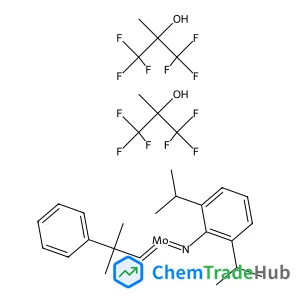
2,6-Diisopropylphenylimidoneophylidene molybdenum(VI) bis(hexafluoro-t-butoxide)
CAS番号:
139220-25-0
分子式:
C30H37F12MoNO2
![[3-Fluoro-5-(2,2,2-trifluoroethoxy)phenyl]boronic acid structure](https://static.chemtradehub.com/structs/850/850589-55-8-a8ed.webp "[3-Fluoro-5-(2,2,2-trifluoroethoxy)phenyl]boronic acid structure")
おすすめサプライヤー




免責事項
このページに表示される学術雑誌情報は、参考および研究目的のみを目的としています。当社は雑誌出版社とは提携しておらず、投稿の取り扱いも行っておりません。出版に関するお問い合わせは、各雑誌出版社に直接ご連絡ください。
表示されている情報に誤りがある場合は、support@chemtradehub.com までご連絡ください。迅速に確認し、対応いたします。