


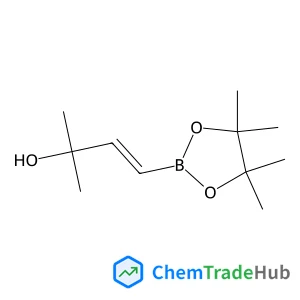
(E)-2-methyl-4-(4,4,5,5-tetramethyl-1,3,2-dioxaborolan-2-yl)but-3-en-2-ol
CAS番号:
581802-26-8
分子式:
C11H21BO3
Pierre Bräuer, Carmine D’Agostino
Acidity of zeolites is a paramount property that determines their behaviour in catalytic and adsorption applications. Various techniques have been established over the years to characterise this property qualitatively and quantitatively, using different indicators able to reveal different insights. In this work, for the first time we have used the tapered element oscillating microbalance (TEOM) to study the quantitative aspects of the internal and external acidity of zeolites by measuring the sorption dynamics of pyridine and collidine over HZSM5 zeolites with different silica-to-alumina ratios (SAR). The method is able to easily quantify, with a rapid and robust calibration procedure, maximum, physisorbed and chemisorbed uptake of probe molecules. The results show that the uptake of both pyridine and collidine measured by the TEOM increases with decreasing SAR, that is, with the increase in Al content, consistent with the increase in acid site density at increasing Al content. Most importantly, by providing a robust and easy-to-interpret set of data, the experimental protocol reveals new fundamental insights into the adsorption mechanism as a function of the Al content, showing that at high Al content chemisorption is the major adsorption mechanism, whereas at low Al content physisorption becomes the dominant mechanism.

Journal of Saudi Chemical Society

Drug Discovery Today

Russian Journal of Bioorganic Chemistry

Nature Medicine

Chemistry Education Research and Practice

Organic Process Research & Development

Russian Chemical Bulletin

Russian Journal of Coordination Chemistry

Acta Materialia

Russian Journal of Organic Chemistry
Wenhao Pan, Changjiang Yang, Lei Zhou, Xiaolan Cai, Yankun Wang, Junhao Tan, Jun Chang
DOI: 10.1039/D3CP03677D
Gisela Anahí Bocan, Hanadi Breiss, Samir Szilasi, Elena Magdalena Staicu Casagrande, María Silvia Gravielle, Hocine Khemliche
DOI: 10.1039/D3CP02486E
M. Boström, I. Brevik, O. I. Malyi
DOI: 10.1039/D3CP04157C
Liying Yang, Tingyu Liu, Jinsong Jiang, Wenqi Song
DOI: 10.1039/D3CP04600A
Yang Sun, Renhai Wang, Yimei Fang, Shunqing Wu, Qiubao Lin, Kai-Ming Ho
DOI: 10.1039/D3CP03844K
Thomas Nevolianis, Raja A. Ahmed, Arnim Hellweg, Michael Diedenhofen, Kai Leonhard
DOI: 10.1039/D3CP04077A
Davood Taherinia, C. Daniel Frisbie
DOI: 10.1039/D3CP03877G
Ganchang Lei, Sihui Qi, Haiyan Li, Yinjiang Xue, Xiaohai Zheng, Shiping Wang, Yanning Cao, Yingying Zhan
DOI: 10.1039/D3CP04495E
6- bromo-1-cyclopropyl-1H-benzimidazoleは、抗炎症、抗ウイルス作用を持つことが報告されており、新薬開発の研究対象として注目...
取り扱う際には、防護眼鏡と手袋を使用し、ドラフトチャンバー内で操作することを推奨します。漏洩時には適切な手順で処理し、安全データシートを常に参照してください。
2,2’-ジメチル-3,3’-ビピリジンは、ピリジンと2-メチルアクリルアミドを有機合成反応で合成します。この反応では、ピリジンと2-メチルアクリルアミドを含有...
6-甲基ピリジン-2-ボリック酸は、合成化学、医薬品合成、以及研究用途などに広く使用され、特に組換えDNA技術や分子生物学の研究において重要な役割を果たします。
(R)-3-(1-甲基-2-氧環己基)プロpano酸メチルは一定の安全性がありますが、直接的な皮膚接触や吸入は避けるべきです。使用する際は適切な個々の安全データ...
ketorolacは、密封して遮光容器に保管し、直射日光や高温を避けて保存してください。温度は常温で保存し、湿度をなるべく低く保つことが推奨されます。
L-2,3-二氨基丙酸二盐酸盐は腐食性が強く、皮膚や粘膜に刺激を与える可能性があります。取り扱う際は、防塵マスク、ゴーグル、手袋を使用し、適切な排気設備を使用し...
2-(4-溴ピリジン-2-基)乙腈のCAS番号は312325-73-8です。主に結晶形態で存在し、分子量は159.01 g/molです。この化合物は水に溶けやす...
この化合物は毒性は低いですが、直接的な接触や吸入に注意が必要です。PPE(個人防護具)を着用し、ドラフトチャンバーを使用して操作することを推奨します。また、漏洩...
3-(1-氧代-1,3-二氢-2H-2-异吲哚)丙酸は、薬理学研究や医薬品製造において広く用いられる化合物です。また、工業的な用途でも一部の化学反応の触媒や助剤...

Physical Chemistry Chemical Physics (PCCP) is an international journal co-owned by 19 physical chemistry and physics societies from around the world. This journal publishes original, cutting-edge research in physical chemistry, chemical physics and biophysical chemistry. To be suitable for publication in PCCP, articles must include significant innovation and/or insight into physical chemistry; this is the most important criterion that reviewers and Editors will judge against when evaluating submissions. The journal has a broad scope and welcomes contributions spanning experiment, theory, computation and data science. Topical coverage includes spectroscopy, dynamics, kinetics, statistical mechanics, thermodynamics, electrochemistry, catalysis, surface science, quantum mechanics, quantum computing and machine learning. Interdisciplinary research areas such as polymers and soft matter, materials, nanoscience, energy, surfaces/interfaces, and biophysical chemistry are welcomed if they demonstrate significant innovation and/or insight into physical chemistry. Joined experimental/theoretical studies are particularly appreciated when complementary and based on up-to-date approaches.
![(2S)-2-{[(9H-Fluoren-9-ylmethoxy)carbonyl]amino}-4-(methylselanyl)butanoic acid structure](https://static.chemtradehub.com/structs/121/1217852-49-7-f252.webp "(2S)-2-{[(9H-Fluoren-9-ylmethoxy)carbonyl]amino}-4-(methylselanyl)butanoic acid structure")




