











A highly sensitive endotoxin sensor based on redox cycling in a nanocavity
文献情報
出版日
2019-04-24
DOI
10.1039/C9AN00478E
インパクトファクター
4.616
著者
Kentaro Ito, Kumi Y. Inoue, Kosuke Ino, Tomokazu Matsue, Hitoshi Shiku
原文を見る
要旨
We report a highly sensitive and rapid electrochemical method for the detection of endotoxin, based on a Limulus amebocyte lysate (LAL) assay using redox cycling at a pair of electrodes in a nanocavity for electrochemical signal amplification. We have previously developed Boc-Leu-Gly-Arg-p-aminophenol (LGR-pAP) as a substrate for the amperometric LAL assay, and in this work, Z-Leu-Gly-Arg-aminomethylferrocene (LGR-AMF) was newly prepared. They were examined as substrates for a LAL-based endotoxin assay using a nanocavity device. During the last step of the endotoxin-induced LAL cascade reaction, pAP or AMF is generated from the substrate, which can be detected electrochemically with efficient signal amplification by redox cycling between the two electrodes in the nanocavity. A device with a 190 nm-high nanocavity was fabricated by photolithography. With the fabricated device in model assay solutions prepared by mixing LGR-pAP and pAP, we demonstrated that pAP could be quantitatively detected from the difference in oxidation potentials between LGR-pAP and pAP. For LGR-AMF and AMF, a difference in the formal potential of 0.1 V was obtained which was considered to be insufficient to distinguish AMF from LGR-AMF. However, we showed for the first time that analytes such as AMF can be detected by differences in diffusion coefficients between the analyte and coexisting molecules (such as LGR-AMF) using a device with high redox-cycling efficiency. Next, the endotoxin assay was performed using the fabricated nanocavity device. Using this method, endotoxin was detected at concentrations as low as 0.2 and 0.5 EU L−1 after LAL reaction times of 1 h and 30 min, respectively, using the LGR-pAP substrate. However, the endotoxin assay using LGR-AMF was not successful because the clotting enzyme did not react with LGR-AMF. This problem might be solved by further design of the substrate. Our nanocavity device represents an effective platform for the simple and rapid detection of endotoxin with high sensitivity.
関連文献
NHC–amine Ru complex catalyzed selective mono-N-methylation of amines with methanol: understanding the effect of amine ligands
Xiuju Cai, Xiaoyu Zhou, Ming Huang
2023-11-14
Research Article
DOI: 10.1039/D3QO01097J
Dissimilar-at-boron N-BODIPYs: from light-harvesting multichromophoric arrays to CPL-bright chiral-at-boron BODIPYs
César Ray, Edurne Avellanal-Zaballa, Jessica Colligan, Florencio Moreno, Gilles Muller, Jorge Bañuelos, Beatriz L. Maroto, Santiago de la Moya
2023-10-19
Research Article
DOI: 10.1039/D3QO01561K
A box-in-box supramolecular assembly for the highly selective recognition of natural, epigenetically and chemically modified cytosines in water
Shu-Qin Qin, Wei Xu, Qi-Qi Wang, Run-Yi Chen, De-Zhi Yang, Yang Lu
2023-11-23
Research Article
DOI: 10.1039/D3QO01649H
Iron-catalyzed asymmetric Csp3–H/Csp3–H coupling: improving the chirality induction by mechanochemical liquid-assisted grinding
Tao Ying, Hong Chen, Keyu Xiang, Weike Su, Haijiao Xie, Jingbo Yu
2023-11-10
Research Article
DOI: 10.1039/D3QO01467C
Correction: An overview of the applications of chiral phosphoric acid organocatalysts in enantioselective additions to CO and CN bonds
Xabier del Corte, Edorta Martínez de Marigorta, Francisco Palacios, Javier Vicario, Aitor Maestro
2023-11-07
Correction
DOI: 10.1039/D3QO90085A
Access to phosphorus-containing cyclopenta[b]benzofuranols via a serendipitous cascade reaction promoted by a bifunctional phosphonium salt
Hui-Lin Hu, Siqiang Fang, Yulin Chen, Wei Wan, Yuqiao Zhou, Zhipeng Xu, Tianli Wang
2023-08-07
Research Article
DOI: 10.1039/D3QO00979C
Aerobic oxidation/metal-free cyclization cascades of nitrosoarenes and allenynes with TEMPO/O2: a switch of diradical to single radical intermediates
Chandrima Maitra, Debashis Barik, Yeu-Shiuan Ho, Mu-Jeng Cheng, Rai-Shung Liu
2023-10-24
Research Article
DOI: 10.1039/D3QO01466E
Unveiling the potency of a phenalenyl-based photocatalyst for intramolecular dehydrogenative lactonization‡
Partha Pratim Sen, Vishali Pathania, Sudipta Raha Roy
2023-11-07
Research Article
DOI: 10.1039/D3QO01662E
Photo-hydroacylation: 1-tetralones from ortho-allylbenzaldehydes
Veronika Schmalz, Ulrich Koert
2023-10-10
Research Article
DOI: 10.1039/D3QO01510F
Synthesis of 3-CF3-4-acyl-substituted quinoline derivatives via a cascade reaction of nitrosoarenes and β-CF3-1,3-enynes
Wenhui Li, Shuangping Huang, Qiang Liu, Xing Li, Wenwen Chen
2023-11-02
Research Article
DOI: 10.1039/D3QO01208E
こちらもおすすめ
化合物よくある質問
3-イチチルビフェニルはどのように合成されますか?
3-イチチルビフェニルは、ビフェニルとイチプロピオニトリルを回収率約90%で反応させて合成されます。触媒は通常、亜リチウムホウ素を用います。
5668-93-93-Ethylbiphenyl
化合物よくある質問
8-溴-5-三氟甲基喹啉はどのように合成されますか?
8-溴-5-三氟甲基喹啉は、5-トリフルオロメチル-2-メチル-1,3-ベンゼンジオールをブロモエタノールと反応させて生成します。この反応は塩基性条件下で行われ...
917251-92-48-Bromo-5-(trifluoro...
化合物よくある質問
ジメチル4-(4,4,5,5-テトラメチル-1,3,2-ドioxaborolan-2-基)-2,6-ピリジンジカルボイル酸フェニルアミニドの代替品はありますか?
ジメチル4-(4,4,5,5-テトラメチル-1,3,2-ドioxaborolan-2-基)-2,6-ピリジンジカルボイル酸フェニルアミニドの代替品としては、4-...
741709-66-0Dimethyl 4-(4,4,5,5-...
化合物よくある質問
N-(3,5-ヘキサクロロ-4-ピリドインイル)-8-メチオキシ-5-キノリンカーボン酸の市場動向や研究トレンドはどのようなものでしょうか?
N-(3,5-ヘキサクロロ-4-ピリドインイル)-8-メチオキシ-5-キノリンカーボン酸の市場動向は、主に産業用途での需要により影響を受けます。研究トレンドとし...
199871-63-1N-(3,5-Dichloro-4-py...
化合物よくある質問
イソステアロイルグリセリルは安全ですか?
イソステアロイルグリセリルは一般的に安全性が高いとされていますが、過度な使用や個人差により皮�owsん炎などの反応が起こる可能性があります。使用前に医師に相談す...
222723-55-92-[(5Z,8Z,11Z,14Z)-5...
化合物よくある質問
1-(二苯甲基)-3,3-二氟-氮杂环丁烷の市場動向や研究トレンドはどうですか?
1-(二苯甲基)-3,3-二氟-氮杂环丁烷の市場動向は、医薬品や合成化学の研究分野で注目を集めています。新興研究は、該当化合物の合成改良と生体内での作用メカニズ...
288315-02-61-Benzhydryl-3,3-dif...
化合物よくある質問
3-チオフェンスチオールの物理化学的性質は何ですか?
3-チオフェンスチオールのCAS番号は7774-73-4です。結晶性の白色粉末で、分子量は122.17です。この化合物は水に微溶解し、エタノールやジクロロメタン...
7774-73-43-Thiophenethiol
化合物よくある質問
2-Methyl-2-propanyl (2S)-2-(aminomethyl)-1-piperidinecarboxylateは安全ですか?
2-Methyl-2-propanyl (2S)-2-(aminomethyl)-1-piperidinecarboxylateは一定の安全性基準を満たしていま...
475105-35-22-Methyl-2-propanyl ...
化合物よくある質問
CAS番号1316822-90-8の化合物は安全ですか?
CAS番号1316822-90-8の化合物は安全性に関しては評価が不足していますが、一般的には生物学的に活性な物質であり、取り扱いには適切な安全防護措置が必要で...
1316822-90-8Gal beta(1-3)[Neu5Ac...
化合物よくある質問
Tert-butyl 2-(2-羟基乙基)哌嗪-1-羧酸はどのように保存すればよいですか?
Tert-butyl 2-(2-羟基乙基)哌嗪-1-羧酸は、冷暗所で保存し、直射日光から遠ざけてください。容器は密閉し、高湿度や高温を避けて保管してください。
517866-79-4Tert-butyl 2-(2-hydr...
掲載誌
Analyst

CiteScore:
7.8
自己引用率:
5.6%
年間論文数:
653
Analyst publishes analytical and bioanalytical research that reports premier fundamental discoveries and inventions, and the applications of those discoveries, unconfined by traditional discipline barriers.
おすすめ化合物
![Methyl 3-({2'-[(E)-(hydroxyhydrazono)methyl]-4-biphenylyl}methyl)-2-oxo-2,3-dihydro-1H-benzimidazole-4-carboxylate structure](https://static.chemtradehub.com/structs/149/1499167-72-4-034a.webp "Methyl 3-({2'-[(E)-(hydroxyhydrazono)methyl]-4-biphenylyl}methyl)-2-oxo-2,3-dihydro-1H-benzimidazole-4-carboxylate structure")
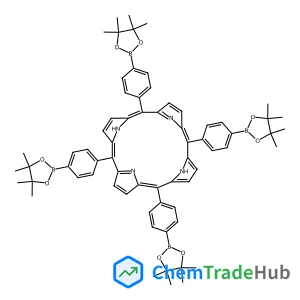
5,10,15,20-tetrakis(4-boronic acid pinacol ester phenyl) porphyrin
CAS番号:
1332748-00-1
分子式:
C68H74B4N4O8
![(4aR,5S,6R,8aS)-5-[2-(3-Furyl)ethyl]-8a-(hydroxymethyl)-5,6-dimethyl-3,4,4a,5,6,7,8,8a-octahydro-1-naphthalenecarboxylic acid structure](https://static.chemtradehub.com/structs/184/18411-75-1-d4cd.webp "(4aR,5S,6R,8aS)-5-[2-(3-Furyl)ethyl]-8a-(hydroxymethyl)-5,6-dimethyl-3,4,4a,5,6,7,8,8a-octahydro-1-naphthalenecarboxylic acid structure")
おすすめサプライヤー





免責事項
このページに表示される学術雑誌情報は、参考および研究目的のみを目的としています。当社は雑誌出版社とは提携しておらず、投稿の取り扱いも行っておりません。出版に関するお問い合わせは、各雑誌出版社に直接ご連絡ください。
表示されている情報に誤りがある場合は、support@chemtradehub.com までご連絡ください。迅速に確認し、対応いたします。