












Iron-catalyzed asymmetric Csp3–H/Csp3–H coupling: improving the chirality induction by mechanochemical liquid-assisted grinding
文献情報
出版日
2023-11-10
DOI
10.1039/D3QO01467C
インパクトファクター
5.281
著者
Tao Ying, Hong Chen, Keyu Xiang, Weike Su, Haijiao Xie, Jingbo Yu
原文を見る
要旨
The iron-catalyzed asymmetric oxidative coupling is a challenging transformation that is typically restricted to naphthol substrates (Csp2–H) with carefully designed chiral ligands. Herein, we established a mechanochemical protocol for iron-catalyzed asymmetric Csp3–H/Csp3–H coupling between glycines and β-ketoesters. By using size-tunable liquid additives via non-covalent bond interactions with simply designed chiral salen ligands and substrates under mechanochemical treatment, it is possible to improve the asymmetric induction and offer a variety of structurally diverse α-amino acid derivatives in high enantiopurity. Mechanistic studies revealed that the iminium ion derived from acid-assisted aerobic oxidation of glycine ester was the key intermediate of the reaction, and the liquid additive t-BuOH acted both as a stabilizer for the iminium ion via N–H⋯O interaction and as an assistant for enantio-control. Moreover, a safer, cleaner, and more energy-conserving route via mechanochemically accelerated aging was first disclosed for this asymmetric Csp3–H/Csp3–H coupling reaction.
関連文献
Tracking nitrite's deviation from Stokes–Einstein predictions with pulsed field gradient 15N NMR spectroscopy
Trent R. Graham, Yihui Wei, Eric D. Walter, Emily T. Nienhuis, Jaehun Chun, Gregory K. Schenter, Kevin M. Rosso, Aurora E. Clark
2023-11-17
Communication
DOI: 10.1039/D3CC04168A
Water activating fresh NiMo foam for enhanced urea electrolysis
Haoxuan Wang, Kang Xiong, Lihua Gao, Min Xue, Zhongqin Pan, Xiao-Lei Huo, Qingwen Zhou
2023-11-14
Communication
DOI: 10.1039/D3CC04826H
Contributors to the Emerging Investigators collection 2023: Part 2
2023-12-06
Profile
DOI: 10.1039/D3CC90387G
Fluorination on cyclopentadithiophene-based hole-transport materials for high-performance perovskite solar cells
Hsiao-Chi Hsieh, Shih-I Lu, Yu-Chien Hsieh, June Hung Yang, Kang-Ling Liau, Yu-Tai Tao, Yan-Duo Lin
2023-11-14
Communication
DOI: 10.1039/D3CC04699K
Towards high-performance nonlinear optical materials through embedding a D–A system into β-ketoenamine-linked COFs
Mingyan Li, Jiahui Chu, Debo Ding, Tingting Li, Endian Su, Yinglin Song, Yun-Fang Yang, Yuanbin She, Jianhong Jia
2023-11-09
Communication
DOI: 10.1039/D3CC04845D
A designed DNA/amino acid amphiphile-based supramolecular oxidase-mimetic catalyst for colorimetric DNA detection
Minquan Jiang, Shichao Xu, Yuanxi Liu, Zhen-Gang Wang
2023-11-14
Communication
DOI: 10.1039/D3CC04047J
Rhodium-catalyzed divergent dehydroxylation/alkenylation of hydroxyisoindolinones with vinylene carbonate
Jiang Nan, Lu Liang
2023-11-02
Communication
DOI: 10.1039/D3CC03760F
Dynamic supramolecular hydrogels mediated by chemical reactions
Jingjing Chen, Hucheng Wang, Feng Long, Shengyu Bai, Yiming Wang
2023-11-03
Feature Article
DOI: 10.1039/D3CC04353C
こちらもおすすめ
化合物よくある質問
3-イチチルビフェニルはどのように合成されますか?
3-イチチルビフェニルは、ビフェニルとイチプロピオニトリルを回収率約90%で反応させて合成されます。触媒は通常、亜リチウムホウ素を用います。
5668-93-93-Ethylbiphenyl
化合物よくある質問
8-溴-5-三氟甲基喹啉はどのように合成されますか?
8-溴-5-三氟甲基喹啉は、5-トリフルオロメチル-2-メチル-1,3-ベンゼンジオールをブロモエタノールと反応させて生成します。この反応は塩基性条件下で行われ...
917251-92-48-Bromo-5-(trifluoro...
化合物よくある質問
ジメチル4-(4,4,5,5-テトラメチル-1,3,2-ドioxaborolan-2-基)-2,6-ピリジンジカルボイル酸フェニルアミニドの代替品はありますか?
ジメチル4-(4,4,5,5-テトラメチル-1,3,2-ドioxaborolan-2-基)-2,6-ピリジンジカルボイル酸フェニルアミニドの代替品としては、4-...
741709-66-0Dimethyl 4-(4,4,5,5-...
化合物よくある質問
N-(3,5-ヘキサクロロ-4-ピリドインイル)-8-メチオキシ-5-キノリンカーボン酸の市場動向や研究トレンドはどのようなものでしょうか?
N-(3,5-ヘキサクロロ-4-ピリドインイル)-8-メチオキシ-5-キノリンカーボン酸の市場動向は、主に産業用途での需要により影響を受けます。研究トレンドとし...
199871-63-1N-(3,5-Dichloro-4-py...
化合物よくある質問
イソステアロイルグリセリルは安全ですか?
イソステアロイルグリセリルは一般的に安全性が高いとされていますが、過度な使用や個人差により皮�owsん炎などの反応が起こる可能性があります。使用前に医師に相談す...
222723-55-92-[(5Z,8Z,11Z,14Z)-5...
化合物よくある質問
1-(二苯甲基)-3,3-二氟-氮杂环丁烷の市場動向や研究トレンドはどうですか?
1-(二苯甲基)-3,3-二氟-氮杂环丁烷の市場動向は、医薬品や合成化学の研究分野で注目を集めています。新興研究は、該当化合物の合成改良と生体内での作用メカニズ...
288315-02-61-Benzhydryl-3,3-dif...
化合物よくある質問
3-チオフェンスチオールの物理化学的性質は何ですか?
3-チオフェンスチオールのCAS番号は7774-73-4です。結晶性の白色粉末で、分子量は122.17です。この化合物は水に微溶解し、エタノールやジクロロメタン...
7774-73-43-Thiophenethiol
化合物よくある質問
2-Methyl-2-propanyl (2S)-2-(aminomethyl)-1-piperidinecarboxylateは安全ですか?
2-Methyl-2-propanyl (2S)-2-(aminomethyl)-1-piperidinecarboxylateは一定の安全性基準を満たしていま...
475105-35-22-Methyl-2-propanyl ...
化合物よくある質問
CAS番号1316822-90-8の化合物は安全ですか?
CAS番号1316822-90-8の化合物は安全性に関しては評価が不足していますが、一般的には生物学的に活性な物質であり、取り扱いには適切な安全防護措置が必要で...
1316822-90-8Gal beta(1-3)[Neu5Ac...
化合物よくある質問
Tert-butyl 2-(2-羟基乙基)哌嗪-1-羧酸はどのように保存すればよいですか?
Tert-butyl 2-(2-羟基乙基)哌嗪-1-羧酸は、冷暗所で保存し、直射日光から遠ざけてください。容器は密閉し、高湿度や高温を避けて保管してください。
517866-79-4Tert-butyl 2-(2-hydr...
掲載誌
Organic Chemistry Frontiers

CiteScore:
7.8
自己引用率:
8.7%
年間論文数:
724
Organic Chemistry Frontiers publishes high-quality research from across organic chemistry. Emphases are placed on studies that make significant contributions to the field of organic chemistry by reporting either new or significantly improved protocols or methodologies. Topics include, but are not limited to the following: Organic synthesis Development of synthetic methodologies Catalysis Natural products Functional organic materials Supramolecular and macromolecular chemistry Physical and computational organic chemistry
おすすめ化合物
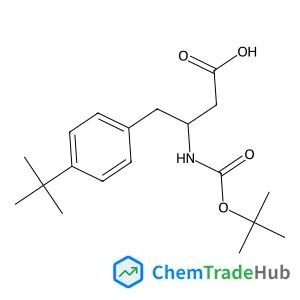
(S)-3-((tert-Butoxycarbonyl)amino)-4-(4-(tert-butyl)phenyl)butanoic acid
CAS番号:
403661-85-8
分子式:
C19H29NO4
おすすめサプライヤー





免責事項
このページに表示される学術雑誌情報は、参考および研究目的のみを目的としています。当社は雑誌出版社とは提携しておらず、投稿の取り扱いも行っておりません。出版に関するお問い合わせは、各雑誌出版社に直接ご連絡ください。
表示されている情報に誤りがある場合は、support@chemtradehub.com までご連絡ください。迅速に確認し、対応いたします。