











A near-infrared Nile red fluorescent probe for the discrimination of biothiols by dual-channel response and its bioimaging applications in living cells and animals
文献情報
出版日
2019-04-23
DOI
10.1039/C9AN00280D
インパクトファクター
4.616
著者
Jin-Shuai Lan, Rui-Feng Zeng, Yun Liu, Yan-Wei Xiang, Xiao-yi Jiang, Li Liu, Sai-Sai Xie, Yue Ding, Tong Zhang
原文を見る
要旨
Biothiols, including cysteine (Cys), homocysteine (Hcy), glutathione (GSH) and H2S, play important roles in human physiological processes. However, it is a great difficulty to distinguish biothiols from each other because of their similar chemical properties. Based on Nile red, we have designed and synthesized a near-infrared fluorescent probe for discriminating Cys/Hcy from GSH/H2S by a dual-channel detection method. Using an ether bond, near-infrared Nile red was attached to 7-nitrobenzofurazan to construct the probe. Due to the photo-induced electron transfer, the probe showed almost no fluorescence from the green to red emission band. But upon the addition of Cys (0–150 μM) or Hcy (0–200 μM), the probe exhibited a noteworthy fluorescence “turn-on” signal in two unique emission bands (Green and Red) with a fast response (within 30 min). In contrast, the probe displayed an increase in fluorescence only in the red channel when encountering GSH (0–70 μM) or H2S (0–50 μM), and GSH/H2S could be tested respectively by different response time. The limit of detection was calculated to be 0.09 μM (Cys), 0.30 μM (Hcy), 0.24 μM (GSH), and 0.04 μM (H2S), respectively (based on S/N = 3). The desirable dual-channel detection could be achieved in serum samples and living cells. Moreover, the probe could be applied for bioimaging in mice, which indicated its potential application in the clinic.
関連文献
Imine induced metal-free C–H arylation of indoles
Lin Zhang, Jianan Gao, Bin Wang, Azhar Iqbal, Weiwei Jin, Yu Xia, Yonghong Zhang
2023-10-04
Research Article
DOI: 10.1039/D3QO01002C
Enantioselective construction of quaternary stereocenters via organocatalytic arylation of isoxazolin-5-ones with o-quinone diimides
Ricardo Torán, Eduardo Portillo, Amparo Sanz-Marco, Carlos Vila, Gonzalo Blay
2023-10-24
Research Article
DOI: 10.1039/D3QO01600E
Visible-light-driven selective difluoroalkylation of α-CF3 alkenes to access CF2-containing gem-difluoroalkenes and trifluoromethylalkanes
Panpan Lei, Bingran Chen, Tonghui Zhang, Qinlin Chen, Liangming Xuan, Haifeng Wang, Qiongjiao Yan, Wei Wang, Jie Zeng
2023-11-23
Research Article
DOI: 10.1039/D3QO01551C
A non-diazo approach to functionalized (2-furyl)-2-pyrrolidines through a cascade reaction of enynal-derived zinc carbenoids with β-arylaminoketones
Chenxin Ou, Bidhan Ghosh, Indrajeet Sharma
2023-10-12
Research Article
DOI: 10.1039/D3QO01354E
Difluorocarbene as a C–F source for the construction of fluorinated benzothiazoles
Jiao Yu, Wei-Guo Cao, Ji-Chang Xiao
2023-11-13
Research Article
DOI: 10.1039/D3QO01422C
Site specifically probing the unfolding process of human telomere i-motif DNA using vibrationally enhanced alkynyl stretch
2024-01-04
Paper
DOI: 10.1039/D3CP05328H
A novel electrochemical flow-cell for operando XAS investigations in X-ray opaque supports
Guillaume Alizon, Andrea Zitolo, Andrea Di Cicco, Hélène Magnan, Emiliano Fonda
2024-01-08
Paper
DOI: 10.1039/D3CP04701F
こちらもおすすめ
化合物よくある質問
3-イチチルビフェニルはどのように合成されますか?
3-イチチルビフェニルは、ビフェニルとイチプロピオニトリルを回収率約90%で反応させて合成されます。触媒は通常、亜リチウムホウ素を用います。
5668-93-93-Ethylbiphenyl
化合物よくある質問
8-溴-5-三氟甲基喹啉はどのように合成されますか?
8-溴-5-三氟甲基喹啉は、5-トリフルオロメチル-2-メチル-1,3-ベンゼンジオールをブロモエタノールと反応させて生成します。この反応は塩基性条件下で行われ...
917251-92-48-Bromo-5-(trifluoro...
化合物よくある質問
ジメチル4-(4,4,5,5-テトラメチル-1,3,2-ドioxaborolan-2-基)-2,6-ピリジンジカルボイル酸フェニルアミニドの代替品はありますか?
ジメチル4-(4,4,5,5-テトラメチル-1,3,2-ドioxaborolan-2-基)-2,6-ピリジンジカルボイル酸フェニルアミニドの代替品としては、4-...
741709-66-0Dimethyl 4-(4,4,5,5-...
化合物よくある質問
N-(3,5-ヘキサクロロ-4-ピリドインイル)-8-メチオキシ-5-キノリンカーボン酸の市場動向や研究トレンドはどのようなものでしょうか?
N-(3,5-ヘキサクロロ-4-ピリドインイル)-8-メチオキシ-5-キノリンカーボン酸の市場動向は、主に産業用途での需要により影響を受けます。研究トレンドとし...
199871-63-1N-(3,5-Dichloro-4-py...
化合物よくある質問
イソステアロイルグリセリルは安全ですか?
イソステアロイルグリセリルは一般的に安全性が高いとされていますが、過度な使用や個人差により皮�owsん炎などの反応が起こる可能性があります。使用前に医師に相談す...
222723-55-92-[(5Z,8Z,11Z,14Z)-5...
化合物よくある質問
1-(二苯甲基)-3,3-二氟-氮杂环丁烷の市場動向や研究トレンドはどうですか?
1-(二苯甲基)-3,3-二氟-氮杂环丁烷の市場動向は、医薬品や合成化学の研究分野で注目を集めています。新興研究は、該当化合物の合成改良と生体内での作用メカニズ...
288315-02-61-Benzhydryl-3,3-dif...
化合物よくある質問
3-チオフェンスチオールの物理化学的性質は何ですか?
3-チオフェンスチオールのCAS番号は7774-73-4です。結晶性の白色粉末で、分子量は122.17です。この化合物は水に微溶解し、エタノールやジクロロメタン...
7774-73-43-Thiophenethiol
化合物よくある質問
2-Methyl-2-propanyl (2S)-2-(aminomethyl)-1-piperidinecarboxylateは安全ですか?
2-Methyl-2-propanyl (2S)-2-(aminomethyl)-1-piperidinecarboxylateは一定の安全性基準を満たしていま...
475105-35-22-Methyl-2-propanyl ...
化合物よくある質問
CAS番号1316822-90-8の化合物は安全ですか?
CAS番号1316822-90-8の化合物は安全性に関しては評価が不足していますが、一般的には生物学的に活性な物質であり、取り扱いには適切な安全防護措置が必要で...
1316822-90-8Gal beta(1-3)[Neu5Ac...
化合物よくある質問
Tert-butyl 2-(2-羟基乙基)哌嗪-1-羧酸はどのように保存すればよいですか?
Tert-butyl 2-(2-羟基乙基)哌嗪-1-羧酸は、冷暗所で保存し、直射日光から遠ざけてください。容器は密閉し、高湿度や高温を避けて保管してください。
517866-79-4Tert-butyl 2-(2-hydr...
掲載誌
Analyst

CiteScore:
7.8
自己引用率:
5.6%
年間論文数:
653
Analyst publishes analytical and bioanalytical research that reports premier fundamental discoveries and inventions, and the applications of those discoveries, unconfined by traditional discipline barriers.
おすすめ化合物
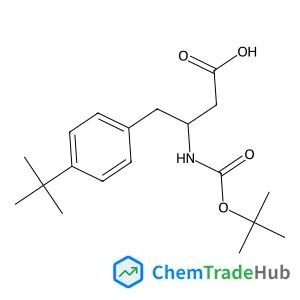
(S)-3-((tert-Butoxycarbonyl)amino)-4-(4-(tert-butyl)phenyl)butanoic acid
CAS番号:
403661-85-8
分子式:
C19H29NO4
![2,4-Dichloro-6-isopropyl-5H-pyrrolo[3,4-d]pyrimidin-7(6H)-one structure](https://static.chemtradehub.com/structs/107/1079649-94-7-ad4a.webp "2,4-Dichloro-6-isopropyl-5H-pyrrolo[3,4-d]pyrimidin-7(6H)-one structure")
おすすめサプライヤー




免責事項
このページに表示される学術雑誌情報は、参考および研究目的のみを目的としています。当社は雑誌出版社とは提携しておらず、投稿の取り扱いも行っておりません。出版に関するお問い合わせは、各雑誌出版社に直接ご連絡ください。
表示されている情報に誤りがある場合は、support@chemtradehub.com までご連絡ください。迅速に確認し、対応いたします。