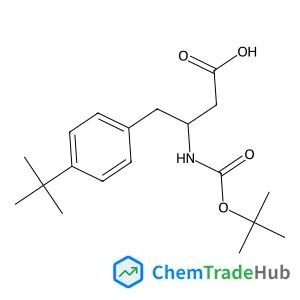
(S)-3-((tert-Butoxycarbonyl)amino)-4-(4-(tert-butyl)phenyl)butanoic acid
CAS番号:
403661-85-8
分子式:
C19H29NO4
The microscopic unfolding process of a cytosine-rich DNA forming i-motif by hemi-protonated base pairs is related to gene regulation. However, the detailed thermal unfolding mechanism and the protonation/deprotonation status of site-specific cytosine in DNA in a physiological environment are still obscure. To address this issue, a vibration-enhanced CC probe tagged on 5′E terminal cytosine of human telomere i-motif DNA was examined using linear and nonlinear infrared (IR) spectroscopies and quantum-chemistry calculations. The CC probe extended into the major groove of the i-motif was found using nonlinear IR results only to introduce a minor steric effect on both steady-state structure and local structure dynamics; however, its IR absorption profile effectively reports the cleavage of the hemi-protonated base pair of C1–C13 upon the unfolding with C1 remaining protonated. The temperature mid-point (Tm) of the local transition reported using the CC tag was slightly lower than the Tm of global transition, and the enthalpy of the former exceeds 60% of the global transition. It is shown that the base-pair unraveling is noncooperative, with outer base pairs breaking first and being likely the rate limiting step. Our results offered an in-depth understanding of the macroscopic unfolding characteristics of the i-motif DNA and provided a nonlinear IR approach to monitoring the local structural transition and dynamics of DNA and its complexes.
DOI: 10.1039/D3CC04314B
Franziska Rüttger, Dietmar Stalke, Michael John
DOI: 10.1039/D3CC05054H
Na Dong, Shuda Liu, Yuye Li, Shuyun Meng, Yifan Liu, Xia Li, Dong Liu
DOI: 10.1039/D3CC04991D
Lifeng Zhang, Liyue Xue, Jiaxi Bai, Kexin He, Bangmei Lu
DOI: 10.1039/D3CC03683A
Ruyi Wang, Shichun Gu, Dexiang Li, Chaoman Wang, Yu Sun, Xue Wang
DOI: 10.1039/D3CC04416E
Ningze Gao, Feng Li, Zhiyuan Wang, Xianghua Kong, Lei Wang, Yuanxiang Gu, Maojuan Bai
DOI: 10.1039/D3CC04440H
Emily E. Nahon, Gareth R. Nelmes, Penelope J. Brothers, Jamie Hicks
DOI: 10.1039/D3CC05182J
Minquan Jiang, Shichao Xu, Yuanxi Liu, Zhen-Gang Wang
DOI: 10.1039/D3CC04047J
Isabel M. Jensen, Shayanta Chowdhury, Gaohe Hu, Lasse Jensen, Jon P. Camden, David M. Jenkins
DOI: 10.1039/D3CC04973F
3-イチチルビフェニルは、ビフェニルとイチプロピオニトリルを回収率約90%で反応させて合成されます。触媒は通常、亜リチウムホウ素を用います。
8-溴-5-三氟甲基喹啉は、5-トリフルオロメチル-2-メチル-1,3-ベンゼンジオールをブロモエタノールと反応させて生成します。この反応は塩基性条件下で行われ...
ジメチル4-(4,4,5,5-テトラメチル-1,3,2-ドioxaborolan-2-基)-2,6-ピリジンジカルボイル酸フェニルアミニドの代替品としては、4-...
N-(3,5-ヘキサクロロ-4-ピリドインイル)-8-メチオキシ-5-キノリンカーボン酸の市場動向は、主に産業用途での需要により影響を受けます。研究トレンドとし...
イソステアロイルグリセリルは一般的に安全性が高いとされていますが、過度な使用や個人差により皮�owsん炎などの反応が起こる可能性があります。使用前に医師に相談す...
1-(二苯甲基)-3,3-二氟-氮杂环丁烷の市場動向は、医薬品や合成化学の研究分野で注目を集めています。新興研究は、該当化合物の合成改良と生体内での作用メカニズ...
3-チオフェンスチオールのCAS番号は7774-73-4です。結晶性の白色粉末で、分子量は122.17です。この化合物は水に微溶解し、エタノールやジクロロメタン...
2-Methyl-2-propanyl (2S)-2-(aminomethyl)-1-piperidinecarboxylateは一定の安全性基準を満たしていま...
CAS番号1316822-90-8の化合物は安全性に関しては評価が不足していますが、一般的には生物学的に活性な物質であり、取り扱いには適切な安全防護措置が必要で...
Tert-butyl 2-(2-羟基乙基)哌嗪-1-羧酸は、冷暗所で保存し、直射日光から遠ざけてください。容器は密閉し、高湿度や高温を避けて保管してください。

Physical Chemistry Chemical Physics (PCCP) is an international journal co-owned by 19 physical chemistry and physics societies from around the world. This journal publishes original, cutting-edge research in physical chemistry, chemical physics and biophysical chemistry. To be suitable for publication in PCCP, articles must include significant innovation and/or insight into physical chemistry; this is the most important criterion that reviewers and Editors will judge against when evaluating submissions. The journal has a broad scope and welcomes contributions spanning experiment, theory, computation and data science. Topical coverage includes spectroscopy, dynamics, kinetics, statistical mechanics, thermodynamics, electrochemistry, catalysis, surface science, quantum mechanics, quantum computing and machine learning. Interdisciplinary research areas such as polymers and soft matter, materials, nanoscience, energy, surfaces/interfaces, and biophysical chemistry are welcomed if they demonstrate significant innovation and/or insight into physical chemistry. Joined experimental/theoretical studies are particularly appreciated when complementary and based on up-to-date approaches.