



The use of silver nanoparticles for the recovery of uranium from seawater by means of biofouling mitigation
文献情報
出版日
2018-08-17
DOI
10.1039/C8SE00228B
インパクトファクター
6.367
著者
Margaret Flicker Byers, Sheldon Landsberger, Erich Schneider
原文を見る
要旨
Research currently being carried out by a consortium of national laboratory and university partners is leading to the development of advanced adsorbent materials suitable for the industrial-scale recovery of the essentially limitless supply of uranium naturally contained within the worlds oceans. Experiments have shown however that marine biofouling has decreased the uranium capacity of these adsorbent fibers by approximately 30%. Given the commensurate impact adsorbent capacity has on the projected cost of seawater uranium, this work seeks to mitigate the effects of marine biofouling in order to restore capacity to that of the unfouled fibers. A review of antifouling strategies showed that just one, incorporation of silver nanoparticles into the adsorbent matrix, was likely to meet cost and practicality goals. The ability of silver doped adsorbents to restore capacity to that of the unfouled adsorbents is quantified by means of a capacity restoration factor, seen to increase with silver content in the adsorbent. These results showed that the silver nanoparticles are extremely effective at eliminating the ca. 20% share of capacity loss that is directly attributed to the biological organisms. This work also identified the a-biotic conditioning film as a primary driver of loss in uptake due to biofouling, which provides finer resolved data and a deeper understanding of uranium uptake experiments, conducted externally, that showed a constant reduction in uptake at all measured data points, the smallest of which was 7 days. Data reduction showed that under the most extreme fouling conditions, approximately 80% of the uptake loss was ascribable to the fast-developing film, against which silver is observed to have little effect. Therefore this work was significant in proving that seawater uranium recovery efforts need to refocus on halting the formation of this abiotic film to improve uranium capacity.
おすすめジャーナル

Chinese Journal of Chemistry

Herald of the Russian Academy of Sciences

Critical Reviews in Solid State and Materials Sciences

Biocatalysis and Biotransformation

NDT & E International

Acta Metallurgica Sinica-English Letters

Journal of Asian Natural Products Research

Electroanalysis

Topics in Catalysis

Medicinal Chemistry Research
関連文献
Enhanced potassium selectivity in a bioinspired solid nanopore
Fabien Picaud, Sebastian Kraszewski, Christophe Ramseyer, Philippe Déjardin, Jean Marc Janot, François Henn
2013-07-31
Paper
DOI: 10.1039/C3CP52123K
Structural phase transition and photoluminescence properties of YF3 and YF3:Eu3+ under high pressure
Chen Gong, Quanjun Li, Ran Liu, Yuan Hou, Jinxian Wang, Xiangting Dong, Bo Liu, Xue Yang, Zhen Yao, Xiao Tan, Dongmei Li, Jing Liu, Zhiqiang Chen, Bo Zou, Tian Cui, Bingbing Liu
2013-10-01
Paper
DOI: 10.1039/C3CP53230E
Theoretical investigation of the coupling between hydrogen atoms transfer and stacking interaction in guanine–cytosine dimers
2013-09-20
Paper
DOI: 10.1039/C3CP52855C
Inorganic halogenligands in quantum dots: I−, Br−, Cl− and film fabrication through electrophoretic deposition
Guangda Niu, Liduo Wang, Rui Gao, Wenzhe Li, Xudong Guo, Haopeng Dong, Yong Qiu
2013-07-31
Paper
DOI: 10.1039/C3CP52678J
Post-synthesis reshaping of gold nanorods using a femtosecond laser
Joanna Olesiak-Banska, Katarzyna Matczyszyn, Claude Nogues, Malcolm Buckle, Marek Samoc
2013-10-29
Paper
DOI: 10.1039/C3CP53457J
Sulfur-doped graphene as a potential alternative metal-free electrocatalyst and Pt-catalyst supporting material for oxygen reduction reaction
Ji-eun Park, Yu Jin Jang, Yeo Jin Kim, Mi-sun Song, Seokhyun Yoon, Dong Ha Kim, Sung-Jin Kim
2013-10-18
Paper
DOI: 10.1039/C3CP54311K
Dynamical aspects of the unzipping of multiwalled boron nitride nanotubes
E. Perim, P. A. S. Autreto, R. Paupitz, D. S. Galvao
2013-08-09
Paper
DOI: 10.1039/C3CP52701H
Photoresponse of the protonated Schiff-base retinal chromophore in the gas phase
Y. Toker, D. B. Rahbek, H. V. Kiefer, J. Rajput, R. Antoine, P. Dugourd, S. Brøndsted Nielsen, L. H. Andersen
2013-10-09
Communication
DOI: 10.1039/C3CP51759D
Theoretical investigation of porphyrin-based photosensitizers with enhanced NIR absorption
Justyna Wójcik, Jerzy Peszke, Alicja Ratuszna, Piotr Kuś, Roman Wrzalik
2013-10-04
Paper
DOI: 10.1039/C3CP53143K
こちらもおすすめ
化合物よくある質問
カルボニル基が付いた5-氰基-1-{[(2-メチル-2-プロpanyl)オキシ]カーボンイル}1H-吲哚-2-イリド-2-ボリン酸はどのように保存すればよいですか?
カルボニル基が付いた5-氰基-1-{[(2-メチル-2-プロpanyl)オキシ]カーボンイル}1H-吲哚-2-イリド-2-ボリン酸は、直射日光を避けて室温(15...
475102-15-9(5-Cyano-1-{[(2-meth...
化合物よくある質問
tert-ブチル2-クロロメチルピリジン-3-基炭酸エステルの市場動向や研究トレンドはどうですか?
この化合物は合成化学分野において、特にピリジン化合物の合成や改良に用いられます。最近の研究では、ピリジン化合物の新規合成法や特性の改良が注目されています。市場動...
1203498-98-9tert-Butyl 2-chloro-...
化合物よくある質問
聚二季戊四醇六丙烯酸酯はどの業界で使用されていますか?
聚二季戊四醇六丙烯酸酯は、医薬品、ポリマー、センサー、半導体などの業界で広く使用されています。特にポリマー業界では硬化剤として、医薬分野では医療機器の製造に使用...
29570-58-93-(Acryloyloxy)-2-({...
化合物よくある質問
1-氯-5-硝基异喹啉の市場動向や研究トレンドはどうですか?
1-氯-5-硝基异喹啉は、薬理学や合成化学の研究分野で注目されています。市場動向としては、その生物学的な活性や合成可能性を評価する研究が増えています。また、代替...
58142-97-51-Chloro-5-nitroisoq...
化合物よくある質問
2-チロール-5-メチルスルフェニル-3-trifルオルメチルベンゼンはどのように合成されますか?
2-チロール-5-メチルスルフェニル-3-trifルオルメチルベンゼンは、トリフルオロメチル化反応と硫化反応を経て合成されます。通常、トリフルオロメチル化剤と硫...
957066-04-51-Chloro-4-(methylsu...
化合物よくある質問
p-トールイルマグネシウムブロミドの物理化学的性質は何ですか?
p-トールイルマグネシウムブロミドのCAS番号は4294-57-9です。この化合物は白色の結晶性粉末で、分子量は204.32です。溶剤中で良好に溶解しますが、水...
4294-57-9p-Tolylmagnesium bro...
化合物よくある質問
1-(5-甲基-2-硫化素基)プロパン-1-酮の市場動向や研究トレンドはどうですか?
1-(5-甲基-2-硫化素基)プロパン-1-酮の市場動向は、化学産業全体の需要に影響を受けますが、最近では pharmaceutical 分野での応用が注目され...
59303-13-81-(5-Methyl-2-thieny...
化合物よくある質問
十一碳烯酰甘氨酸を取り扱う際の実験室安全事項は何ですか?
十一碳烯酰甘氨酸は吸入や皮膚から吸収されることがあり、取り扱う際には防塵マスクと手袋を使用してください。ドラフトチャンバーを用いて漏洩を処理し、適切なSDS(S...
54301-26-7N-10-Undecenoylglyci...
化合物よくある質問
1H,1H-全氟-3,6-二氧杂葵-1-醇を取り扱う際の実験室安全事項は何ですか?
この化合物は吸入や皮膚吸収による毒性があるため、防塵マスク、ゴーグル、防護手袋を使用する必要があります。ドラフトチャンバーでの操作が必要です。漏洩時には即座に換...
152914-73-32,2-Difluoro-2-[1,1,...
化合物よくある質問
3-(4-(フルオロメチルオキシ)フェニル)-1,2,4-オキサジアゾール-5-カルボハイドライドは安全ですか?
安全性は化合物の使用方法によります。直接的な毒性は報告されていませんが、吸入や皮膚接触には注意が必要です。適切な防護服を着用し、換気を図ることを推奨します。
883028-82-83-(4-(Trifluorometho...
掲載誌
おすすめ化合物
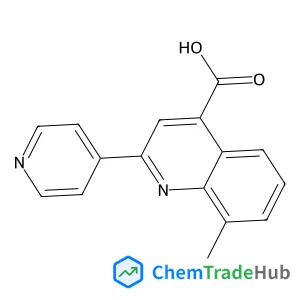
![2-morpholino-2-[2-(trifluoromethyl)pyrimidin-5-yl]ethanamine structure](https://static.chemtradehub.com/structs/119/1192570-20-9-2810.webp "2-morpholino-2-[2-(trifluoromethyl)pyrimidin-5-yl]ethanamine structure")
おすすめサプライヤー




免責事項
このページに表示される学術雑誌情報は、参考および研究目的のみを目的としています。当社は雑誌出版社とは提携しておらず、投稿の取り扱いも行っておりません。出版に関するお問い合わせは、各雑誌出版社に直接ご連絡ください。
表示されている情報に誤りがある場合は、support@chemtradehub.com までご連絡ください。迅速に確認し、対応いたします。