












Biomimetic antimicrobial polymers: recent advances in molecular design
文献情報
出版日
2018-04-23
DOI
10.1039/C8PY00012C
インパクトファクター
5.582
著者
Cansu Ergene, Kazuma Yasuhara, Edmund F. Palermo
原文を見る
要旨
The increasing prevalence of antibiotic-resistant bacterial infections, coupled with the decline in the number of new antibiotic drug approvals, has created a therapeutic gap that portends an emergent public health crisis. Since the 1980s, host defense peptides (HDPs) have been recognized as antibacterial compounds that do not induce resistance, but are hampered by their high cost and lack of synthetic scalability. Starting in the early 2000s, synthetic (co)polymers have been designed to mimic the salient physiochemical features of HDPs. These polymers have shown broad-spectrum antimicrobial activity, rapid bactericidal kinetics, and a very low propensity to induce resistance. Systematic optimization of the (co)polymer composition, chain length, hydrophobicity, and cationic charge has generated select examples that are also highly biocompatible (non-hemolytic and non-cytotoxic in vitro). These polymers are derived from inexpensive feedstocks and are produced using cost-effective, scalable processes. Accordingly, such polymers may be viewed as early stage pre-clinical candidates for potential use in pharmaceutical or therapeutic applications. In this review, we focus on the key macromolecular design principles that have been gleaned from more than a decade of structure–activity relationship (SAR) studies, as well as some key mechanistic investigations, across this multidisciplinary field. A fundamental understanding of these functional (co)polymers has arisen from a convergence of ideas in polymer chemistry, microbiology, and biophysics. In this context, we emphasize the recent advances from the past few years and emerging opportunities surrounding the rapidly growing field of HDP-mimetic antimicrobial polymers.
関連文献
Direct preparation of polyfunctional amino-substituted arylmagnesium reagents via an iodine–magnesium exchange reaction
Greta Varchi, Christiane Kofink, David M. Lindsay, Alfredo Ricci, Paul Knochel
2003-01-14
Communication
DOI: 10.1039/B211115B
Novel alignment technique for LCD-biosensors
Johan Hoogboom, Joost Clerx, Matthijs B. J. Otten, Alan E. Rowan, Theo Rasing, Roeland J. M. Nolte
2003-10-31
Communication
DOI: 10.1039/B310860K
Tuning molecular orientation with STM at the solid/liquid interface
Qing-Min Xu, Li-Jun Wan, Chen Wang, Chun-Li Bai, Bing Dai, Jin-Long Yang
2003-10-17
Communication
DOI: 10.1039/B308155A
First synthesis of an amythiamicin pyridine cluster
Mark C. Bagley, James W. Dale, Robert L. Jenkins, Justin Bower
2003-11-25
Communication
DOI: 10.1039/B310944E
Diastereoselective titanium-mediated construction of cis-2,3-ring annelated 1-(2′-chloroethyl)cyclopropanols
Frédéric Lecornué, Jean Ollivier
2003-01-29
Communication
DOI: 10.1039/B211642A
Redox-robust pentamethylamidoferrocenyl metallodendrimers that cleanly and selectively recognize the H2PO4− anion
Jaime Ruiz, Maria Jesus Ruiz Medel, Marie-Christine Daniel, Jean-Claude Blais, Didier Astruc
2003-01-27
Communication
DOI: 10.1039/B211772J
A 2,3-butanedione protected chiral glycine equivalent—a new building block for the stereoselective synthesis of enantiopure N-protected α-amino acids
Darren J. Dixon, Christopher I. Harding, Steven V. Ley, D. Matthew G. Tilbrook
2003-01-20
Communication
DOI: 10.1039/B210673F
Molecular tectonics: infinite cationic double stranded helical coordination networks
Abdelaziz Jouaiti, Mir Wais Hosseini, Nathalie Kyritsakas
2003-01-23
Communication
DOI: 10.1039/B211226B
Direct analysis of catalysts immobilised in ionic liquids using electrospray ionisation ion trap mass spectrometry
Paul J. Dyson, J. Scott McIndoe, Dongbin Zhao
2003-01-28
Communication
DOI: 10.1039/B211669C
The colourful fluorescence from readily-synthesised 3,4-diaryl-substituted maleimide fluorophores
Hsiu-Chih Yeh, Wei-Ching Wu, Chin-Ti Chen
2002-12-20
Communication
DOI: 10.1039/B211537A
こちらもおすすめ
化合物よくある質問
2,3-スチオエポキシマドルを取り扱う際の実験室安全事項は何ですか?
取り扱いにはPPE(プロテクティブ・パーソナル・エイド)が必要で、防ぐ手袋と保護眼鏡を着用してください。ドラフトチャンバーの使用を推奨します。漏洩した場合は、適...
4267-80-52,3-Thioepoxy Madol
53981-25-22-Amino-6-fluorophen...
化合物よくある質問
BOC-S-3-アミニ-4-(4-メチオキシベンチル)-ブタン酸の代替品はありますか?
この化合物の代替品としては、BOC保護基を有さないアミノ酸やその他の保護基化合物が考えられます。また、メチオキシ基を有しない他の芳香族アミノ酸も代替品として挙げ...
126800-59-7(3S)-4-(4-Methoxyphe...
化合物よくある質問
Methyl 2-(chloromethyl)-3-nitrobenzoate(1218910-61-2)の代替品はありますか?
Methyl 2-(chloromethyl)-3-nitrobenzoate(1218910-61-2)の代替品としては、化学組成を変えることで効果を達成する...
1218910-61-2Methyl 2-(chlorometh...
化合物よくある質問
(2R)-2-アミノ-N-ベンジル-3-ヒドロキシプロパナミドを含む廃棄物はどのように処理すべきですか?
(2R)-2-アミノ-N-ベンジル-3-ヒドロキシプロパナミドを含む廃棄物は、適切な廃棄物管理ガイドラインに基づき処理する必要があります。まず、廃棄物を適切に収...
175481-39-7(2R)-2-amino-N-benzy...
化合物よくある質問
6,7-二氢-咪唑並[1,2-a]ピリドイン-8(5h)-酮はどのように合成されますか?
6,7-二氢-咪唑並[1,2-a]ピリドイン-8(5h)-酮は、2-ブロモフェニルアセトインとリン酸ハロゲン化物を反応させることで合成できます。この反応は高温で...
457949-09-66,7-Dihydroimidazo[1...
化合物よくある質問
エチル(3R)-3-ピロリジニル酢酸水和塩とは何ですか?
エチル(3R)-3-ピロリジニル酢酸水和塩は、CAS番号1332459-32-1の化合物で、(R)-乙基2-(ピロリジン-3-基)酢酸塩水和塩と呼ばれます。この...
1332459-32-1Ethyl (3R)-3-pyrroli...
化合物よくある質問
(2S)-{[(2-メチルエチルオキシ]カルボニル}アミノ)[2-(トリアフルオロメチルフェニル]エチカシック酸の物理化学的性質は何ですか?
(2S)-{[(2-メチルエチルオキシ]カルボニル}アミノ)[2-(トリアフルオロメチルフェニル]エチカシック酸のCAS番号は1203454-45-8です。この...
1203454-45-8(2S)-({[(2-Methyl-2-...
化合物よくある質問
2-ブロモ-1-(2-メチル-2-プロパニル)-4-ニトロベンゼンはどのように保存すればよいですか?
2-ブロモ-1-(2-メチル-2-プロパニル)-4-ニトロベンゼンは、直射日光を避けて暗所で、室温(約15℃〜25℃)、乾燥した場所に保存する必要があります。ま...
6310-17-42-Bromo-1-(2-methyl-...
化合物よくある質問
1-[(4-硝基フェニル)スルホニル]-1H-1,2,4-三唑の市場動向や研究トレンドはどうですか?
市場動向としては、1-[(4-硝基フェニル)スルホニル]-1H-1,2,4-三唑は主に農業用除草剤や合成化学製品の原料として利用されています。研究トレンドとして...
57777-84-11-[(4-Nitrophenyl)su...
掲載誌
Polymer Chemistry

CiteScore:
8.6
自己引用率:
7.3%
年間論文数:
457
Polymer Chemistry welcomes submissions in all areas of polymer science that have a strong focus on macromolecular chemistry. Manuscripts may cover a broad range of fields, yet no direct application focus is required.
おすすめ化合物
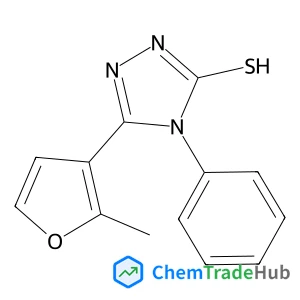
5-(2-Methyl-3-furyl)-4-phenyl-2,4-dihydro-3H-1,2,4-triazole-3-thione
CAS番号:
346464-59-3
分子式:
C13H11N3OS
おすすめサプライヤー







免責事項
このページに表示される学術雑誌情報は、参考および研究目的のみを目的としています。当社は雑誌出版社とは提携しておらず、投稿の取り扱いも行っておりません。出版に関するお問い合わせは、各雑誌出版社に直接ご連絡ください。
表示されている情報に誤りがある場合は、support@chemtradehub.com までご連絡ください。迅速に確認し、対応いたします。