












First synthesis of an amythiamicin pyridine cluster
文献情報
出版日
2003-11-25
DOI
10.1039/B310944E
インパクトファクター
6.222
著者
Mark C. Bagley, James W. Dale, Robert L. Jenkins, Justin Bower
原文を見る
要旨
The pyridine-containing central domain of the amythiamicin group of thiopeptide antibiotics is prepared in protected form in 9 steps, 93% ee and 18% overall yield from (S)-2-[1-(tert-butoxycarbonylamino)-2-methylpropyl]thiazole-4-carboxylic acid by Michael addition窶田yclodehydration of a 2-(2-thiazolyl)enamine and 1-(2-thiazolyl)propynone.
関連文献
How flexible is the water molecule structure? Analysis of crystal structures and the potential energy surface
Milan R. Milovanović, Jelena M. Živković, Dragan B. Ninković, Ivana M. Stanković
2020-01-28
Paper
DOI: 10.1039/C9CP07042G
Explaining doping in material research (Hf substitution in ZnO films) by directly quantifying the van der Waals force
Chia-Yun Lai, Sergio Santos, Boulos Alfakes, Nitul Rajput, Tobias Boström
2020-02-04
Paper
DOI: 10.1039/C9CP06441A
On the microscopic origin of the cryoprotective effect in lysine solutions
Guadalupe N. Ruiz, Nicola Steinke, Silvina Cerveny, Roberto Macovez, Elvira Guàrdia, Sebastian Busch, Sylvia E. McLain, Christian D. Lorenz, Luis Carlos Pardo
2020-03-06
Paper
DOI: 10.1039/C9CP06192D
Biological control of S-nitrosothiol reactivity: potential role of sigma-hole interactions
Niloufar Hendinejad, Qadir K. Timerghazin
2020-03-02
Paper
DOI: 10.1039/C9CP06377C
Role of ring-enlargement reactions in the formation of aromatic hydrocarbons
Martina Baroncelli, Qian Mao, Simon Galle, Nils Hansen, Heinz Pitsch
2020-02-05
Paper
DOI: 10.1039/C9CP05854K
Is the origin of green fluorescence in unsymmetrical four-ring bent-core liquid crystals single or double proton transfer?
Venkatesh Gude, Manobina Karmakar, Avishek Dey, Prasanta Kumar Datta, Kumar Biradha
2020-02-03
Paper
DOI: 10.1039/C9CP06307B
An in situ exchange mechanism for dye molecules and cations at the nano-semiconductor film/electrolyte interface
Simin Tu
2020-01-28
Communication
DOI: 10.1039/C9CP06288B
Deterministic control of surface mounted metal–organic framework growth orientation on metallic and insulating surfaces
Mathias Strauss, Carlos Alberto Rodrigues Costa, Cátia Crispilho Corrêa
2020-02-17
Paper
DOI: 10.1039/C9CP05717J
Excited state hydrogen transfer dynamics in phenol–(NH3)2 studied by picosecond UV-near IR-UV time-resolved spectroscopy
Shun-ichi Ishiuchi, Junko Kamizori, Norihiro Tsuji, Makoto Sakai, Mitsuhiko Miyazaki, Claude Dedonder
2020-02-10
Paper
DOI: 10.1039/C9CP06369B
こちらもおすすめ
化合物よくある質問
2,3-スチオエポキシマドルを取り扱う際の実験室安全事項は何ですか?
取り扱いにはPPE(プロテクティブ・パーソナル・エイド)が必要で、防ぐ手袋と保護眼鏡を着用してください。ドラフトチャンバーの使用を推奨します。漏洩した場合は、適...
4267-80-52,3-Thioepoxy Madol
53981-25-22-Amino-6-fluorophen...
化合物よくある質問
BOC-S-3-アミニ-4-(4-メチオキシベンチル)-ブタン酸の代替品はありますか?
この化合物の代替品としては、BOC保護基を有さないアミノ酸やその他の保護基化合物が考えられます。また、メチオキシ基を有しない他の芳香族アミノ酸も代替品として挙げ...
126800-59-7(3S)-4-(4-Methoxyphe...
化合物よくある質問
Methyl 2-(chloromethyl)-3-nitrobenzoate(1218910-61-2)の代替品はありますか?
Methyl 2-(chloromethyl)-3-nitrobenzoate(1218910-61-2)の代替品としては、化学組成を変えることで効果を達成する...
1218910-61-2Methyl 2-(chlorometh...
化合物よくある質問
(2R)-2-アミノ-N-ベンジル-3-ヒドロキシプロパナミドを含む廃棄物はどのように処理すべきですか?
(2R)-2-アミノ-N-ベンジル-3-ヒドロキシプロパナミドを含む廃棄物は、適切な廃棄物管理ガイドラインに基づき処理する必要があります。まず、廃棄物を適切に収...
175481-39-7(2R)-2-amino-N-benzy...
化合物よくある質問
6,7-二氢-咪唑並[1,2-a]ピリドイン-8(5h)-酮はどのように合成されますか?
6,7-二氢-咪唑並[1,2-a]ピリドイン-8(5h)-酮は、2-ブロモフェニルアセトインとリン酸ハロゲン化物を反応させることで合成できます。この反応は高温で...
457949-09-66,7-Dihydroimidazo[1...
化合物よくある質問
エチル(3R)-3-ピロリジニル酢酸水和塩とは何ですか?
エチル(3R)-3-ピロリジニル酢酸水和塩は、CAS番号1332459-32-1の化合物で、(R)-乙基2-(ピロリジン-3-基)酢酸塩水和塩と呼ばれます。この...
1332459-32-1Ethyl (3R)-3-pyrroli...
化合物よくある質問
(2S)-{[(2-メチルエチルオキシ]カルボニル}アミノ)[2-(トリアフルオロメチルフェニル]エチカシック酸の物理化学的性質は何ですか?
(2S)-{[(2-メチルエチルオキシ]カルボニル}アミノ)[2-(トリアフルオロメチルフェニル]エチカシック酸のCAS番号は1203454-45-8です。この...
1203454-45-8(2S)-({[(2-Methyl-2-...
化合物よくある質問
2-ブロモ-1-(2-メチル-2-プロパニル)-4-ニトロベンゼンはどのように保存すればよいですか?
2-ブロモ-1-(2-メチル-2-プロパニル)-4-ニトロベンゼンは、直射日光を避けて暗所で、室温(約15℃〜25℃)、乾燥した場所に保存する必要があります。ま...
6310-17-42-Bromo-1-(2-methyl-...
化合物よくある質問
1-[(4-硝基フェニル)スルホニル]-1H-1,2,4-三唑の市場動向や研究トレンドはどうですか?
市場動向としては、1-[(4-硝基フェニル)スルホニル]-1H-1,2,4-三唑は主に農業用除草剤や合成化学製品の原料として利用されています。研究トレンドとして...
57777-84-11-[(4-Nitrophenyl)su...
掲載誌
Chemical Communications

CiteScore:
8.6
自己引用率:
4.7%
年間論文数:
2458
ChemComm publishes urgent research which is of outstanding significance and interest to experts in the field, while also appealing to the journal’s broad chemistry readership. Our communication format is ideally suited to short, urgent studies that are of such importance that they require accelerated publication. Our scope covers all topics in chemistry, and research at the interface of chemistry and other disciplines (such as materials science, nanoscience, physics, engineering and biology) where there is a significant novelty in the chemistry aspects. Major topic areas covered include: Analytical Chemistry Catalysis Chemical Biology and medicinal chemistry Computational Chemistry and Machine Learning Energy and sustainable chemistry Environmental Chemistry Green Chemistry Inorganic Chemistry Materials Chemistry Nanoscience Organic Chemistry Physical Chemistry Polymer Chemistry Supramolecular Chemistry
おすすめ化合物
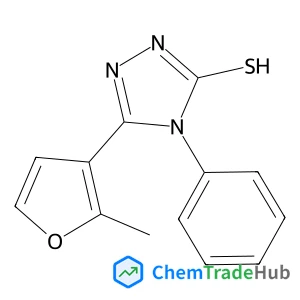
5-(2-Methyl-3-furyl)-4-phenyl-2,4-dihydro-3H-1,2,4-triazole-3-thione
CAS番号:
346464-59-3
分子式:
C13H11N3OS
おすすめサプライヤー




免責事項
このページに表示される学術雑誌情報は、参考および研究目的のみを目的としています。当社は雑誌出版社とは提携しておらず、投稿の取り扱いも行っておりません。出版に関するお問い合わせは、各雑誌出版社に直接ご連絡ください。
表示されている情報に誤りがある場合は、support@chemtradehub.com までご連絡ください。迅速に確認し、対応いたします。