












N,O-Bidentate ligand-tunable copper(ii) complexes as a catalyst for Chan–Lam coupling reactions of arylboronic acids with 1H-imidazole derivatives
文献情報
出版日
2018-11-07
DOI
10.1039/C8OB02254B
インパクトファクター
3.876
著者
Xuefeng Jia, Pai Peng
原文を見る
要旨
An efficient procedure for Chan–Lam coupling reactions of arylboronic acids with 1H-imidazole derivatives using N,O-bidentate ligand-tunable copper(II) complexes as a catalyst under base-free conditions has been developed. This protocol features mild reaction conditions, high yields and compatibility with different functional groups, providing a direct and facile strategy for the construction of C–N bonds and synthesis of heterocyclic compounds.
関連文献
Correction: A novel benzoxazine/cyanate ester blend with sea-island phase structures
Xiaoyong Luo, Yi Gu
2015-07-17
Correction
DOI: 10.1039/C5CP90128F
Disk to dual ring deposition transformation in evaporating nanofluid droplets from substrate cooling to heating
Xin Zhong, Fei Duan
2016-06-30
Paper
DOI: 10.1039/C6CP03231A
A computational study on the N-heterocyclic carbene-catalyzed Csp2–Csp3 bond activation/[4+2] cycloaddition cascade reaction of cyclobutenones with imines: a new application of the conservation principle of molecular orbital symmetry
Yang Wang, Bohua Wu, Haoyang Zhang, Donghui Wei, Mingsheng Tang
2016-07-04
Paper
DOI: 10.1039/C6CP03180C
Surface directed reversible imidazole ligation to nickel(ii) octaethylporphyrin at the solution/solid interface: a single molecule level study
Goutam Nandi, Bhaskar Chilukuri, K. W. Hipps, Ursula Mazur
2016-07-15
Paper
DOI: 10.1039/C6CP04454A
Energy landscapes of a hairpin peptide including NMR chemical shift restraints
Joanne M. Carr, Chris S. Whittleston, David C. Wade, David J. Wales
2015-07-17
Paper
DOI: 10.1039/C5CP01259G
Polarization-driven catalysis via ferroelectric oxide surfaces
2016-06-29
Paper
DOI: 10.1039/C6CP03170F
Photoinduced charge accumulation by metal ion-coupled electron transfer
Annabell G. Bonn, Oliver S. Wenger
2015-08-27
Paper
DOI: 10.1039/C5CP04718H
Colorimetric and fluorimetric response of Schiff base molecules towards fluoride anion, solution test kit fabrication, logical interpretations and DFT-D3 study
Pritam Ghosh, Biswajit Gopal Roy, Saibal Jana, Subhra Kanti Mukhopadhyay
2015-07-02
Paper
DOI: 10.1039/C5CP02525G
Experimental and molecular dynamics studies of anthraquinone dyes in a nematic liquid-crystal host: a rationale for observed alignment trends
Mark T. Sims, Laurence C. Abbott, Stephen J. Cowling, John W. Goodby, John N. Moore
2016-07-14
Paper
DOI: 10.1039/C6CP03823A
Energy transfer and tunable multicolor emission and paramagnetic properties of GdF3:Dy3+,Tb3+,Eu3+ phosphors
Hongxia Guan, Ye Sheng, Chengyi Xu, Yunzhi Dai, Xiaoming Xie, Haifeng Zou
2016-06-24
Paper
DOI: 10.1039/C6CP03989H
こちらもおすすめ
化合物よくある質問
間溴苯甲酰腈の市場動向や研究トレンドはどうですか?
間 brom 苯甲酰腈は、合成化学や薬物化学において重要な Intermediate として使用されています。市場動向としては、その合成性と機能性により、研究開...
24999-51-7(3-Bromophenyl)(oxo)...
287966-62-5Desulfo Glucoraphani...
化合物よくある質問
Methyl 2-amino-5-(trifluoromethyl)benzoateに適用される法規ガイドラインは何ですか?
CAS番号117324-58-0の塩酸メチル2アミノ-5-トリフルオロメチルベンゼートは、GHS分類により腐食性物質と判定されます。REACH規則では、製造、販...
117324-58-0Methyl 2-amino-5-(tr...
化合物よくある質問
3-ブロモ-1,3,4,5-四水化-2H-1-ベンザアゼピン-2-オンは安全ですか?
毒性があるため、適切な安全対策が必須です。皮膚や粘膜への刺激性が強く、吸入や誤飲により健康被害を引き起こす可能性があります。取扱時にはガスマスクや手袋、眼鏡を使...
86499-96-93-Bromo-1,3,4,5-tetr...
化合物よくある質問
三氟甲基ピリジン-2-甲アミン塩酸塩は安全ですか?
三氟甲基ピリジン-2-甲アミン塩酸塩は安全性に注意が必要です。毒性は低レベルですが、直接的接触や吸入は避けるべきです。適切な手袋や防塵マスクを着用し、密閉された...
871826-12-9(5-(Trifluoromethyl)...
化合物よくある質問
1-エチル-4-(4-硝基フェニル)ピペリジンは安全ですか?
1-エチル-4-(4-硝基フェニル)ピペリジンは有毒であり、取扱には注意が必要です。保管や作業中に手袋を着用し、目や皮膚に接触しないように注意する必要があります...
115619-00-61-Ethyl-4-(4-nitroph...
化合物よくある質問
1,1-ジメトキシプロパン-2-オンは安全ですか?
1,1-ジメトキシプロパン-2-オンは一般的に低毒性ですが、皮膚や目への刺激性があるため、取扱いには注意が必要です。蒸気や液体の吸入には有害な可能性があり、適切...
6342-56-91,1-dimethoxypropan-...
化合物よくある質問
コバルト(II) 3,3'-{[(1S,2S)-1,2-ジメチルフENCYCLICALE-1,2-エチエンジイル]ビス[ニトロリルメチルイリデン]}ビス[4-オキソ-2-ペンテン-2-olate]について「に適用される法規ガイドラインは何ですか?
この化合物はCAS番号259259-80-8に対応しています。GHS分類では、毒性、燃焼性、反応性、炎症性を考慮に入れ、適切な危険性分類が行われます。REACH...
259259-80-8Cobalt(2+) (2E,2'E)-...
化合物よくある質問
「カーバミル酸, N-[8-[[2-[[2-(2,6-ジオキソ-3-ピペリジニル)-2,3-ジオキソ-1,3-ジヒドロ-1H-イソイソインドール-4-イルオキシ]アセチル]アミノ]オクチル]-1,1-ジメチレチルエステル」はどのように保存すればよいですか?
この化合物は、冷却庫で-20℃の温度、乾燥した容器に保管し、直日光から保護する必要があります。湿度の高い環境や高温は避けてください。
1950635-34-32-Methyl-2-propanyl ...
1433975-21-3FMoc-D-4-Aph(tBu-CbM...
掲載誌
Organic & Biomolecular Chemistry

CiteScore:
3.4
自己引用率:
10.3%
年間論文数:
1041
Organic & Biomolecular Chemistry (OBC) publishes original and high impact research and reviews in organic chemistry. We welcome research that shows new or significantly improved protocols or methodologies in total synthesis, synthetic methodology or physical and theoretical organic chemistry as well as research that shows a significant advance in the organic chemistry or molecular design aspects of chemical biology, catalysis, supramolecular and macromolecular chemistry, theoretical chemistry, mechanism-oriented physical organic chemistry, medicinal chemistry or natural products. Articles published in the journal should report new work which makes a highly-significant impact in the field. Routine and incremental work is generally not suitable for publication in the journal. More details about key areas of our scope are below. In all cases authors should include in their article clear rationale for why their research has been carried out.
おすすめ化合物
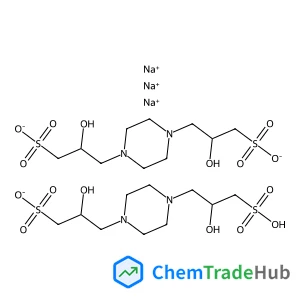
3,3'-(Piperazine-1,4-diyl)bis(2-hydroxypropane-1-sulfonic acid) Sodium Salt
CAS番号:
108321-08-0
分子式:
C20H41N4Na3O16S4
![(3R)-3-(3-Fluorophenyl)-3-({[(2-methyl-2-propanyl)oxy]carbonyl}amino)propanoic acid structure](https://static.chemtradehub.com/structs/500/500789-04-8-20dd.webp "(3R)-3-(3-Fluorophenyl)-3-({[(2-methyl-2-propanyl)oxy]carbonyl}amino)propanoic acid structure")
おすすめサプライヤー







免責事項
このページに表示される学術雑誌情報は、参考および研究目的のみを目的としています。当社は雑誌出版社とは提携しておらず、投稿の取り扱いも行っておりません。出版に関するお問い合わせは、各雑誌出版社に直接ご連絡ください。
表示されている情報に誤りがある場合は、support@chemtradehub.com までご連絡ください。迅速に確認し、対応いたします。