












Gravimetric tank method to evaluate material-enhanced hydrogen storage by physisorbing materials
文献情報
出版日
2018-10-19
DOI
10.1039/C8CP05241G
インパクトファクター
3.676
著者
Artem Iakunkov, Alexey Klechikov, Jinhua Sun, Timothy Steenhaut, Sophie Hermans, Yaroslav Filinchuk, Alexandr Talyzin
原文を見る
要旨
The most common methods to evaluate hydrogen sorption (volumetric and gravimetric) require significant experience and expensive equipment for providing reproducible results. Both methods allow one to measure excess uptake values which are used to calculate the total amount of hydrogen stored inside of a tank as required for applications. Here we propose an easy to use and inexpensive alternative approach which allows one to evaluate directly the weight of hydrogen inside a material-filled test tank. The weight of the same tank filled with compressed hydrogen in the absence of loaded material is used as a reference. We argue that the only parameter which is of importance for hydrogen storage applications is by how much the material improves the total weight of hydrogen inside of the given volume compared to compressed gas. This parameter which we propose to name Gain includes both volumetric and gravimetric characterization of the material; it can be determined directly without knowing the skeletal volume of the material or excess sorption. The feasibility of the Gravimetric Tank (GT) method was tested using several common carbon and Metal Organic Framework (MOF) materials. The best Gain value of ∼12% was found for the Cu-BTC MOF which means that the tank completely filled with this material stores a 12% higher amount of hydrogen compared to H2 gas at the same P–T conditions. The advantages of the GT method are its inexpensive design, extremely simple procedures and direct results in terms of tank capacity as required for industrial applications. The GT method could be proposed as a standard check for verification of the high hydrogen storage capacity of new materials. The GT method is expected to provide even better accuracy for evaluation of a material's performance for storage of denser gases like e.g. CO2 and CH4.
関連文献
Molecular simulations of imidazolium-based tricyanomethanide ionic liquids using an optimized classical force field
Niki Vergadou, Jörg-Rüdiger Hill
2016-02-01
Paper
DOI: 10.1039/C5CP05892A
Electron transport mechanism of bathocuproine exciton blocking layer in organic photovoltaics
Jeihyun Lee, Soohyung Park, Younjoo Lee, Hyein Kim, Dongguen Shin, Junkyeong Jeong, Kwangho Jeong, Sang Wan Cho, Hyunbok Lee, Yeonjin Yi
2016-01-19
Paper
DOI: 10.1039/C5CP07099F
Dynamics of GCN4 facilitate DNA interaction: a model-free analysis of an intrinsically disordered region
R. Andrew Byrd, Arthur G. Palmer, III
2015-11-30
Paper
DOI: 10.1039/C5CP06197K
Large-size nanosheets of 9,10-bis(phenylethynyl)anthracene with high photoresponse and light emission anisotropy
Hong-Dan Peng, Jia-Mei Yang, Jing-Hui Yan, Ge-Bo Pan
2015-10-13
Communication
DOI: 10.1039/C5CP05507E
Designing graphene as a new frustrated Lewis pair catalyst for hydrogen activation by co-doping
Bo Li, TianFu Liu, Jian Song, Dang Sheng Su
2016-03-24
Paper
DOI: 10.1039/C5CP07969A
Direct electrical transport measurement on a single thermoelectric nanowire embedded in an alumina template
Christophe Garagnon, Valerie Serradeil
2016-04-01
Paper
DOI: 10.1039/C6CP00972G
Effect of the alkaline cation size on the conductivity in gel polymer electrolytes and their influence on photo electrochemical solar cells
M. Furlani, I. Albinsson, J. L. Ratnasekera, B.-E. Mellander
2016-03-16
Paper
DOI: 10.1039/C6CP00013D
Molecular simulations of cytochrome c adsorption on positively charged surfaces: the influence of anion type and concentration
Chunwang Peng, Yun Xie, Jian Zhou
2016-03-04
Paper
DOI: 10.1039/C6CP00170J
Vibronic coupling in the excited-states of carotenoids
Takeshi Miki, Tiago Buckup, Marie S. Krause, June Southall, Richard J. Cogdell, Marcus Motzkus
2016-03-23
Paper
DOI: 10.1039/C5CP07542D
Indented Cu2MoS4 nanosheets with enhanced electrocatalytic and photocatalytic activities realized through edge engineering
Bang-Bao Chen, De-Kun Ma, Qing-Ping Ke, Wei Chen, Shao-Ming Huang
2016-02-08
Paper
DOI: 10.1039/C5CP07900D
こちらもおすすめ
化合物よくある質問
2-ヒドロキシ-5-ニトロベンジンブロモイドの代替品はありますか?
2-ヒドロキシ-5-ニトロベンジンブロモイドは特定の化学反応に適しているため、代替品は限られています。しかし、同様の構造を持つ2-ヒドロキシ-4-ニトロベンジン...
772-33-82-(Bromomethyl)-4-ni...
化合物よくある質問
N-(2-ブロモフェニル)-1-チロール-3-オキソ-3-(ピペリジニル)プロペン-2-イル)ベンゼンアミドを取り扱う際の実験室安全事項は何ですか?
N-(2-ブロモフェニル)-1-チロール-3-オキソ-3-(ピペリジニル)プロペン-2-イル)ベンゼンアミドは有毒で、皮膚や粘膜に刺激を与える可能性があります。...
1800044-77-2N-[(1Z)-1-(2-Bromoph...
化合物よくある質問
1,3プロパンジオール,2-[2-(2アミノ-6クロロ-9Hピリミジン-9-イル)エチル-1,1,2,2-D4]-2,3-ジアセタートの市場動向や研究トレンドはどうですか?
この化合物は、新規治療薬の開発に注目されています。市場では、その有効性と安全性が評価され、研究分野では、分子生物学と医薬化学の新たな発見が期待されています。
1020718-81-31,3-Propanediol, 2-[...
579-44-2Ethanone, 2-hydroxy-...
化合物よくある質問
Succinimidyl-alanyl-phenylalanyl-prolyl-phenylalanine 4-nitroanilide はどの業界で使用されていますか?
Succinimidyl-alanyl-phenylalanyl-prolyl-phenylalanine 4-nitroanilide は主に医薬品開発やポ...
128802-73-3succinimidyl-alanyl-...
化合物よくある質問
メチル6-アミノ-5-クロロピリジン-2-カーボイル酸について、適用される法規ガイドラインは何ですか?
メチル6-アミノ-5-クロロピリジン-2-カーボイル酸(CAS番号: 1256794-05-4)の使用には、GHS( Globally Harmonized S...
1256794-05-4Methyl 6-amino-5-chl...
化合物よくある質問
エチル4-(シクロ Pentagonyl)アミノ-2-メチル硫化基ピリミジン-5-カルボキシレートを取り扱う際の実験室安全事項は何ですか?
取り扱いには、耐薬品性の容器を使用し、通気性の良い場所で操作することを推奨します。漏れ時は、SDS(安全データシート)を参照して適切な措置を取ること。手洗いと洗...
211245-62-4ethyl 4-(cyclopentyl...
化合物よくある質問
(S)-3-ベンZYルピペリジン塩酸塩とは何ですか?
(S)-3-ベンZYルピペリジン塩酸塩は、CAS番号1258940-00-9で表される化合物です。これは、(S)-3-苯基哌啶的盐酸盐であり、主に医薬品の原料と...
1258940-00-9(S)-3-Phenylpiperidi...
化合物よくある質問
3,5-二甲基金剛胺の主な用途は何ですか?
3,5-二甲基金剛胺は、主に医薬品の原料として使用され、また抗うつ薬や抗アルツハイマー薬の開発に利用されます。さらに、化粧品や食品添加物の製造でも重要な役割を果...
19988-45-52-(2,3-Dihydroxyphen...
化合物よくある質問
ビス(4-メチル-2-ペンチル)フェニルカルボン酸エステルの代替品はありますか?
ビス(4-メチル-2-ペンチル)フェニルカルボン酸エステル (CAS番号: 1398066-13-1) の代替品には、ビス(2-エチルヘキシル)フェノールカルボ...
1398066-13-1Bis(4-methyl-2-penty...
掲載誌
Physical Chemistry Chemical Physics

CiteScore:
5.5
自己引用率:
10.3%
年間論文数:
3036
Physical Chemistry Chemical Physics (PCCP) is an international journal co-owned by 19 physical chemistry and physics societies from around the world. This journal publishes original, cutting-edge research in physical chemistry, chemical physics and biophysical chemistry. To be suitable for publication in PCCP, articles must include significant innovation and/or insight into physical chemistry; this is the most important criterion that reviewers and Editors will judge against when evaluating submissions. The journal has a broad scope and welcomes contributions spanning experiment, theory, computation and data science. Topical coverage includes spectroscopy, dynamics, kinetics, statistical mechanics, thermodynamics, electrochemistry, catalysis, surface science, quantum mechanics, quantum computing and machine learning. Interdisciplinary research areas such as polymers and soft matter, materials, nanoscience, energy, surfaces/interfaces, and biophysical chemistry are welcomed if they demonstrate significant innovation and/or insight into physical chemistry. Joined experimental/theoretical studies are particularly appreciated when complementary and based on up-to-date approaches.
おすすめ化合物
![2,6-Di(thiophen-2-yl)dithieno[3,2-b:2',3'-d]thiophene structure](https://static.chemtradehub.com/structs/910/910788-24-8-5b70.webp "2,6-Di(thiophen-2-yl)dithieno[3,2-b:2',3'-d]thiophene structure")
![1-[3-(4-Morpholinylsulfonyl)phenyl]methanamine structure](https://static.chemtradehub.com/structs/933/933989-32-3-51af.webp "1-[3-(4-Morpholinylsulfonyl)phenyl]methanamine structure")
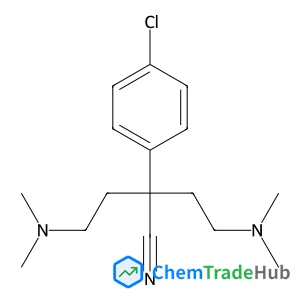
2-(4-Chlorophenyl)-4-(dimethylamino)-2-(2-(dimethylamino)ethyl)butanenitrile
CAS番号:
1246816-57-8
分子式:
C16H24ClN3
おすすめサプライヤー





免責事項
このページに表示される学術雑誌情報は、参考および研究目的のみを目的としています。当社は雑誌出版社とは提携しておらず、投稿の取り扱いも行っておりません。出版に関するお問い合わせは、各雑誌出版社に直接ご連絡ください。
表示されている情報に誤りがある場合は、support@chemtradehub.com までご連絡ください。迅速に確認し、対応いたします。