












![1-[3-(4-Morpholinylsulfonyl)phenyl]methanamine structure](https://static.chemtradehub.com/structs/933/933989-32-3-51af.webp "1-[3-(4-Morpholinylsulfonyl)phenyl]methanamine structure")
Effect of the alkaline cation size on the conductivity in gel polymer electrolytes and their influence on photo electrochemical solar cells
文献情報
出版日
2016-03-16
DOI
10.1039/C6CP00013D
インパクトファクター
3.676
著者
M. Furlani, I. Albinsson, J. L. Ratnasekera, B.-E. Mellander
原文を見る
要旨
The nature and concentration of cationic species in the electrolyte exert a profound influence on the efficiency of nanocrystalline dye-sensitized solar cells (DSSCs). A series of DSSCs based on gel electrolytes containing five alkali iodide salts (LiI, NaI, KI, RbI and CsI) and polyacrylonitrile with plasticizers were fabricated and studied, in order to investigate the dependence of solar cell performance on the cation size. The ionic conductivity of electrolytes with relatively large cations, K+, Rb+ and Cs+, was higher and essentially constant, while for the electrolytes containing the two smaller cations, Na+ and Li+, the conductivity values were lower. The temperature dependence of conductivity in this series appears to follow the Vogel–Tamman–Fulcher equation. The sample containing the smallest cation shows the lowest conductivity and the highest activation energy of ∼36.5 meV, while K+, Rb+ and Cs+ containing samples show an activation energy of ∼30.5 meV. DSSCs based on the gel electrolyte and a TiO2 double layer with the N719 dye exhibited an enhancement in the open circuit voltage with increasing cation size. This can be attributed to the decrease in the recombination rate of electrons and to the conduction band shift resulting from cation adsorption by TiO2. The maximum efficiency value, 3.48%, was obtained for the CsI containing cell. The efficiencies shown in this study are lower compared to values reported in the literature, and this can be attributed to the use of a single salt and the absence of other additives, since the focus of the present study was to analyze the cation effect. The highest short circuit current density of 9.43 mA cm−2 was shown by the RbI containing cell. The enhancement of the solar cell performance with increasing size of the cation is discussed in terms of the effect of the cations on the TiO2 anode and ion transport in the electrolyte. In liquid electrolyte based DSSCs, the short circuit current density has been reported to decrease with the increasing size of the cation. However, in this work, it follows an opposite trend highlighting a major difference between liquid and quasi-solid electrolytes on the solar cell performance.
関連文献
Production of biomass-derived furanic ethers and levulinate esters using heterogeneous acid catalysts
Patrícia Neves, Margarida M. Antunes, Patrícia A. Russo, Joana P. Abrantes, Sérgio Lima, Auguste Fernandes, Martyn Pillinger, Sílvia M. Rocha, Maria F. Ribeiro, Anabela A. Valente
2013-09-20
Paper
DOI: 10.1039/C3GC41908H
Green metrics evaluation of isoprene production by microalgae and bacteria
Cristina T. Matos, Luisa Gouveia, Ana Rita C. Morais, Alberto Reis, Rafał Bogel-Łukasik
2013-07-24
Paper
DOI: 10.1039/C3GC40997J
Direct, one-pot synthesis of POCOP-type pincer complexes from metallic nickel
Boris Vabre, Fabien Lindeperg, Davit Zargarian
2013-07-22
Paper
DOI: 10.1039/C3GC40968F
Shape-controlled synthesis of Ag@TiO2 cage-bell hybrid structure with enhanced photocatalytic activity and superior lithium storage
Wei Wang, Lixiang Liu, Yunbo He, Cuiping Li, Yapeng Wang
2013-08-14
Paper
DOI: 10.1039/C3GC41280F
Pharmaceutical Green Chemistry process changes – how long does it take to obtain regulatory approval?
2013-09-11
Perspective
DOI: 10.1039/C3GC41376D
N-Chlorosuccinimide-promoted synthesis of thiophosphates from thiols and phosphonates under mild conditions
Yi-Chen Liu, Chin-Fa Lee
2013-10-28
Paper
DOI: 10.1039/C3GC41839A
Self-healable polymer networks based on the cross-linking of epoxidised soybean oil by an aqueous citric acid solution
Facundo I. Altuna, Valeria Pettarin, Roberto J. J. Williams
2013-09-09
Paper
DOI: 10.1039/C3GC41384E
Direct oxidation of secondary alcohol to ester by performic acid
Xiao-Hong Li, Xiang-Guang Meng, Ying Liu, Xiao Peng
2013-09-25
Paper
DOI: 10.1039/C3GC41198B
こちらもおすすめ
化合物よくある質問
2-ヒドロキシ-5-ニトロベンジンブロモイドの代替品はありますか?
2-ヒドロキシ-5-ニトロベンジンブロモイドは特定の化学反応に適しているため、代替品は限られています。しかし、同様の構造を持つ2-ヒドロキシ-4-ニトロベンジン...
772-33-82-(Bromomethyl)-4-ni...
化合物よくある質問
N-(2-ブロモフェニル)-1-チロール-3-オキソ-3-(ピペリジニル)プロペン-2-イル)ベンゼンアミドを取り扱う際の実験室安全事項は何ですか?
N-(2-ブロモフェニル)-1-チロール-3-オキソ-3-(ピペリジニル)プロペン-2-イル)ベンゼンアミドは有毒で、皮膚や粘膜に刺激を与える可能性があります。...
1800044-77-2N-[(1Z)-1-(2-Bromoph...
化合物よくある質問
1,3プロパンジオール,2-[2-(2アミノ-6クロロ-9Hピリミジン-9-イル)エチル-1,1,2,2-D4]-2,3-ジアセタートの市場動向や研究トレンドはどうですか?
この化合物は、新規治療薬の開発に注目されています。市場では、その有効性と安全性が評価され、研究分野では、分子生物学と医薬化学の新たな発見が期待されています。
1020718-81-31,3-Propanediol, 2-[...
579-44-2Ethanone, 2-hydroxy-...
化合物よくある質問
Succinimidyl-alanyl-phenylalanyl-prolyl-phenylalanine 4-nitroanilide はどの業界で使用されていますか?
Succinimidyl-alanyl-phenylalanyl-prolyl-phenylalanine 4-nitroanilide は主に医薬品開発やポ...
128802-73-3succinimidyl-alanyl-...
化合物よくある質問
メチル6-アミノ-5-クロロピリジン-2-カーボイル酸について、適用される法規ガイドラインは何ですか?
メチル6-アミノ-5-クロロピリジン-2-カーボイル酸(CAS番号: 1256794-05-4)の使用には、GHS( Globally Harmonized S...
1256794-05-4Methyl 6-amino-5-chl...
化合物よくある質問
エチル4-(シクロ Pentagonyl)アミノ-2-メチル硫化基ピリミジン-5-カルボキシレートを取り扱う際の実験室安全事項は何ですか?
取り扱いには、耐薬品性の容器を使用し、通気性の良い場所で操作することを推奨します。漏れ時は、SDS(安全データシート)を参照して適切な措置を取ること。手洗いと洗...
211245-62-4ethyl 4-(cyclopentyl...
化合物よくある質問
(S)-3-ベンZYルピペリジン塩酸塩とは何ですか?
(S)-3-ベンZYルピペリジン塩酸塩は、CAS番号1258940-00-9で表される化合物です。これは、(S)-3-苯基哌啶的盐酸盐であり、主に医薬品の原料と...
1258940-00-9(S)-3-Phenylpiperidi...
化合物よくある質問
3,5-二甲基金剛胺の主な用途は何ですか?
3,5-二甲基金剛胺は、主に医薬品の原料として使用され、また抗うつ薬や抗アルツハイマー薬の開発に利用されます。さらに、化粧品や食品添加物の製造でも重要な役割を果...
19988-45-52-(2,3-Dihydroxyphen...
化合物よくある質問
ビス(4-メチル-2-ペンチル)フェニルカルボン酸エステルの代替品はありますか?
ビス(4-メチル-2-ペンチル)フェニルカルボン酸エステル (CAS番号: 1398066-13-1) の代替品には、ビス(2-エチルヘキシル)フェノールカルボ...
1398066-13-1Bis(4-methyl-2-penty...
掲載誌
Physical Chemistry Chemical Physics

CiteScore:
5.5
自己引用率:
10.3%
年間論文数:
3036
Physical Chemistry Chemical Physics (PCCP) is an international journal co-owned by 19 physical chemistry and physics societies from around the world. This journal publishes original, cutting-edge research in physical chemistry, chemical physics and biophysical chemistry. To be suitable for publication in PCCP, articles must include significant innovation and/or insight into physical chemistry; this is the most important criterion that reviewers and Editors will judge against when evaluating submissions. The journal has a broad scope and welcomes contributions spanning experiment, theory, computation and data science. Topical coverage includes spectroscopy, dynamics, kinetics, statistical mechanics, thermodynamics, electrochemistry, catalysis, surface science, quantum mechanics, quantum computing and machine learning. Interdisciplinary research areas such as polymers and soft matter, materials, nanoscience, energy, surfaces/interfaces, and biophysical chemistry are welcomed if they demonstrate significant innovation and/or insight into physical chemistry. Joined experimental/theoretical studies are particularly appreciated when complementary and based on up-to-date approaches.
おすすめ化合物
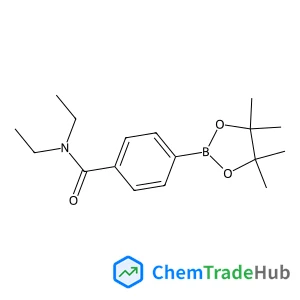
N,N-Diethyl-4-(4,4,5,5-tetramethyl-1,3,2-dioxaborolan-2-yl)benzamide
CAS番号:
325142-99-2
分子式:
C17H26BNO3
おすすめサプライヤー





免責事項
このページに表示される学術雑誌情報は、参考および研究目的のみを目的としています。当社は雑誌出版社とは提携しておらず、投稿の取り扱いも行っておりません。出版に関するお問い合わせは、各雑誌出版社に直接ご連絡ください。
表示されている情報に誤りがある場合は、support@chemtradehub.com までご連絡ください。迅速に確認し、対応いたします。