












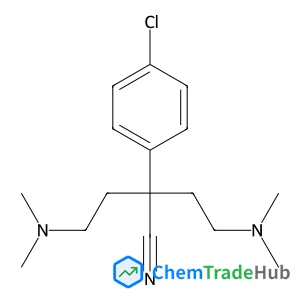
2-(4-Chlorophenyl)-4-(dimethylamino)-2-(2-(dimethylamino)ethyl)butanenitrile
CAS番号:
1246816-57-8
分子式:
C16H24ClN3
Abhay N. Singh, Harsha Devnani, Shwetambara Jha, Pravin P. Ingole
For the first time, the process of Fermi level equilibration has been studied and compared for plasmonic metal nanoparticles (PMNPs) supported on conducting substrates i.e. graphene oxide (GO) sheets. The extent of Fermi level equilibration has been monitored by recording the changes in the position and intensity of the surface plasmon resonance (SPR) band of Ag and Au PMNPs supported on reduced graphene oxide (rGO). Ag PMNPs supported on rGO show larger variation in the SPR band position and intensity as compared to rGO supported Au PMNPs. The average shift in the chemical potential has been determined through the changes in the SPR band position for Ag, Ag@rGO, Au, and Au@rGO, which are approximately −1812 ± 70 mV, −171 ± 20 mV, −96 ± 8 mV and −29 ± 4 mV, respectively. The calculated values of the shift in chemical potential suggest that Ag and its rGO composite are more prone to Fermi level equilibration as compared to the Au and Au@rGO composite. The electrochemical (galvanostatic) charging/discharging (GCD) measurements also brace the observations from the chemical charging/discharging method with minor variations due to the measurements under two different conditions; particulate films in the case of the former versus the dispersed phase in the case of the latter. Moreover, the average capacitance associated with single nanoparticles (Ag and Au) is estimated using the capacitance values determined from GCD curves and the approximate number of nanoparticles determined from the quantity of PMNPs used in the deposited films for GCD measurements. These values are in close agreement with the quantized double layer capacitance values of monolayer protected clusters reported in the literature. A similar inference is also drawn from the enzyme-less glucose sensing activity of these nanostructures, where Ag and Ag@rGO show better activity in terms of lower values of the limit of detection (LOD) and the limit of quantification (LOQ).
M. A. Stevens, J. E. McKay, J. L. S. Robinson, H. EL Mkami, G. M. Smith, D. G. Norman
DOI: 10.1039/C5CP04753F
Qin Wang, Shunyong Hou, Liang Xu, Jianping Yin
DOI: 10.1039/C5CP06392B
Joen J. Hermans, Annelies van Loon, Piet D. Iedema
DOI: 10.1039/C6CP00487C
Juliano Katrib, Paula A. Palade, Neil R. Champness, Samuel W. Kingman
DOI: 10.1039/C5CP05426E
Vu Thi Thu Huong, Truong Ba Tai, Minh Tho Nguyen
DOI: 10.1039/C5CP07277H
Niki Vergadou, Jörg-Rüdiger Hill
DOI: 10.1039/C5CP05892A
Saugata Sahu, Minati Das, G. Krishnamoorthy
DOI: 10.1039/C5CP07949G
Matteo Aramini, Johannes Niskanen, Daniele Pontiroli, Abdurrahman Musazay, Michael Krisch, Mikko Hakala, Simo Huotari
DOI: 10.1039/C5CP07783D
R. Andrew Byrd, Arthur G. Palmer, III
DOI: 10.1039/C5CP06197K
Fei Xie, Martin Turesson, Clifford E. Woodward, Kitty van Gruijthuijsen, Anna Stradner, Jan Forsman
DOI: 10.1039/C5CP07814H
2-ヒドロキシ-5-ニトロベンジンブロモイドは特定の化学反応に適しているため、代替品は限られています。しかし、同様の構造を持つ2-ヒドロキシ-4-ニトロベンジン...
N-(2-ブロモフェニル)-1-チロール-3-オキソ-3-(ピペリジニル)プロペン-2-イル)ベンゼンアミドは有毒で、皮膚や粘膜に刺激を与える可能性があります。...
この化合物は、新規治療薬の開発に注目されています。市場では、その有効性と安全性が評価され、研究分野では、分子生物学と医薬化学の新たな発見が期待されています。
Succinimidyl-alanyl-phenylalanyl-prolyl-phenylalanine 4-nitroanilide は主に医薬品開発やポ...
メチル6-アミノ-5-クロロピリジン-2-カーボイル酸(CAS番号: 1256794-05-4)の使用には、GHS( Globally Harmonized S...
取り扱いには、耐薬品性の容器を使用し、通気性の良い場所で操作することを推奨します。漏れ時は、SDS(安全データシート)を参照して適切な措置を取ること。手洗いと洗...
(S)-3-ベンZYルピペリジン塩酸塩は、CAS番号1258940-00-9で表される化合物です。これは、(S)-3-苯基哌啶的盐酸盐であり、主に医薬品の原料と...
3,5-二甲基金剛胺は、主に医薬品の原料として使用され、また抗うつ薬や抗アルツハイマー薬の開発に利用されます。さらに、化粧品や食品添加物の製造でも重要な役割を果...
ビス(4-メチル-2-ペンチル)フェニルカルボン酸エステル (CAS番号: 1398066-13-1) の代替品には、ビス(2-エチルヘキシル)フェノールカルボ...

Physical Chemistry Chemical Physics (PCCP) is an international journal co-owned by 19 physical chemistry and physics societies from around the world. This journal publishes original, cutting-edge research in physical chemistry, chemical physics and biophysical chemistry. To be suitable for publication in PCCP, articles must include significant innovation and/or insight into physical chemistry; this is the most important criterion that reviewers and Editors will judge against when evaluating submissions. The journal has a broad scope and welcomes contributions spanning experiment, theory, computation and data science. Topical coverage includes spectroscopy, dynamics, kinetics, statistical mechanics, thermodynamics, electrochemistry, catalysis, surface science, quantum mechanics, quantum computing and machine learning. Interdisciplinary research areas such as polymers and soft matter, materials, nanoscience, energy, surfaces/interfaces, and biophysical chemistry are welcomed if they demonstrate significant innovation and/or insight into physical chemistry. Joined experimental/theoretical studies are particularly appreciated when complementary and based on up-to-date approaches.

![4-Chloro-3-(trifluoromethyl)-1H-pyrrolo[2,3-b]pyridine structure](https://static.chemtradehub.com/structs/869/869335-75-1-a9d0.webp "4-Chloro-3-(trifluoromethyl)-1H-pyrrolo[2,3-b]pyridine structure")



