



Synthesis and properties of poly(trifluoroethylene) via a persistent radical mediated polymerization of trifluoroethylene
文献情報
出版日
2018-01-24
DOI
10.1039/C7PY02018J
インパクトファクター
5.582
著者
Maxime Colpaert, Sanjib Banerjee, Vincent Ladmiral, Taizo Ono, Bruno Améduri
原文を見る
要旨
The conventional radical homopolymerization of TrFE initiated by a ˙CF3 radical (generated in situ from perfluoro-3-ethyl-2,4-dimethyl-3-pentyl persistent radical, PPFR) is presented. Reactions were carried out at an increasing PPFR concentration (initial [TrFE]0 : [PPFR]0 molar ratios varying from 2.5 to 20.0 mol%) to influence the molar masses (Mn, ranging between 7700 and 38 100 g mol−1). PTrFE homopolymer yields were high (76–87%). The microstructures of such synthesized PTrFEs were characterized by 1H and 19F NMR spectroscopy. The generated PTrFE chains were exclusively terminated by CF3 end-groups, as revealed by MALDI-TOF spectroscopy and NMR analysis, indicating that the ˙CF3 radicals initiated the polymerization of TrFE. The addition of the ˙CF3 radicals onto TrFE was predominantly regioselective (66%) leading mainly to a CF3–CHF–CF2–PTrFE homopolymer. Furthermore, the CF3 end group could be used as an efficient label to determine the PTrFE molar masses by 19F NMR spectroscopy that also enabled us to assess the chain defects (14%). The thermal properties of these CF3–PTrFE–CF3 polymers revealed (i) a high thermal stability (their degradation under an oxidative atmosphere started from 362 °C and ranged even up to 428 °C for higher molar masses of PTrFEs) and (ii) a semi-crystalline behavior with a crystallinity rate averaging 36%.
おすすめジャーナル

Journal of Heterocyclic Chemistry

Kinetics and Catalysis

Planta Medica

Israel Journal of Chemistry

Nature

Molecular Pharmacology

Helvetica Chimica Acta

Proceedings of the National Academy of Sciences of the United States of America

Journal of Organometallic Chemistry

Organic Preparations and Procedures International
関連文献
Phosphine and phosphine oxide groups in metal–organic frameworks detected by P K-edge XAS
F. L. Morel, S. Pin, T. Huthwelker, M. Ranocchiari
2014-12-19
Paper
DOI: 10.1039/C4CP05151C
Pressure-induced molten globule state of human acetylcholinesterase: structural and dynamical changes monitored by neutron scattering
R. Schweins
2014-12-11
Paper
DOI: 10.1039/C4CP02992E
Thermodynamic insights into the self-assembly of capped nanoparticles using molecular dynamic simulations
André F. de Moura, Kalil Bernardino, Cleocir J. Dalmaschio, Edson R. Leite, Nicholas A. Kotov
2014-12-16
Paper
DOI: 10.1039/C4CP03519D
Molecular dynamics simulation of spin–lattice NMR relaxation in poly-l-lysine dendrimers: manifestation of the semiflexibility effect
Denis A. Markelov, Stanislav G. Falkovich, Maxim Yu. Ilyash, Vladimir V. Matveev, Erkki Lähderanta, Petri Ingman
2014-12-08
Paper
DOI: 10.1039/C4CP04825C
Exploring the binding mechanisms of MIF to CXCR2 using theoretical approaches
Lei Xu, Youyong Li, Dan Li, Peng Xu, Sheng Tian, Huiyong Sun, Hui Liu, Tingjun Hou
2014-12-11
Paper
DOI: 10.1039/C4CP05095A
Nonidentical intracellular drug release rates in Raman and fluorescence spectroscopic determination
Erdene-Ochir Ganbold, Jinha Yoon, Doseok Kim, Sang-Woo Joo
2014-11-24
Paper
DOI: 10.1039/C4CP04235B
The effect of sugar stereochemistry on protein self-assembly: the case of β-casein micellization in different aldohexose solutions
Ofer Setter
2014-12-16
Paper
DOI: 10.1039/C4CP03686G
Co(iii) protoporphyrin IX chloride in solution: spin-state and metal coordination revealed from resonant inelastic X-ray scattering and electronic structure calculations
Jie Xiao, Bernd Winter
2014-12-12
Paper
DOI: 10.1039/C4CP04703F
Laser-induced fast fusion of gold nanoparticle-modified polyelectrolyte microcapsules
Yingjie Wu, Johannes Frueh, Tieyan Si, Helmuth Möhwald, Qiang He
2014-12-09
Paper
DOI: 10.1039/C4CP05231E
こちらもおすすめ
化合物よくある質問
2-ブロモ-9,9-ジフェニル-9H-フルオレンの主な用途は何ですか?
2-溴-9,9-二苯基芴は、医薬品、工業材料、有機合成の研究分野で応用されます。特に、レーザー材料や機能性ポリマーの合成に使用されることがあります。また、蛍光色...
474918-32-62-Bromo-9,9-diphenyl...
化合物よくある質問
四氯化铱の市場動向や研究トレンドはどうですか?
四氯化铱の市場は研究開発分野で注目されており、特にナノ技術や金属有機框架(MOFs)の分野での需要が増加傾向にあります。価格は安定しており、中国や韓国での生産が...
207399-11-9Tetrachloroiridium h...
882-06-44-Nitrocinnamic acid
化合物よくある質問
1-(4-溴-3-氟苯基)-2-氯乙酮を含む廃棄物はどのように処理すべきですか?
1-(4-溴-3-氟苯基)-2-氯乙酮 (CAS番号: 1260857-14-4) の廃棄物は専門的な廃棄処理が必要です。まず、廃棄物は密閉された容器に収集し、...
1260857-14-41-(4-Bromo-3-fluorop...
化合物よくある質問
苦参酚Kとは何ですか?
苦参酚Kは、CAS番号101236-49-1を持つ化合物で、主に天然由来の生薬から抽出されます。この化合物は、抗炎症作用や抗癌作用を持つことが報告されています。
101236-49-1Kushenol K
化合物よくある質問
POTASSIUM (1-(TERTBUTOXYCARBONYL)AZETIDIN-3-YL)TRIFLUOROBORATE を含む廃棄物はどのように処理すべきですか?
POTASSIUM (1-(TERTBUTOXYCARBONYL)AZETIDIN-3-YL)TRIFLUOROBORATE を含む廃棄物は、まず安全なエント...
1430219-73-0Potassium (1-(tert-b...
化合物よくある質問
4-庚基-4’-联苯羧酸の市場動向や研究トレンドはどうですか?
4-庚基-4’-聯苯羧酸は、特殊化学品や合成化学の分野で用いられる化学物質ですが、市場動向としては、研究開発の進展とともに需要が増加しています。また、環境配慮型...
58573-94-74'-Heptyl-4-biphenyl...
化合物よくある質問
6-ブロモ-3-メトキシ-1-フェニル-1H-インドゾールを含む廃棄物はどのように処理すべきですか?
6-ブロモ-3-メトキシ-1-フェニル-1H-インドゾールを含む廃棄物は、適切な化学廃棄処理が必要です。通常、廃棄物は密閉容器に収集され、専門の廃棄処理業者に引...
1332527-03-36-Bromo-3-methoxy-1-...
化合物よくある質問
4,4-二甲基-2-吡咯烷酮はどの業界で使用されていますか?
4,4-二甲基-2-吡咯烷酮は医薬、ポリマー、センサー、半導体などの業界で広く使用されています。特に溶媒としての性能が高く評価されています。
66899-02-34,4-dimethylpyrrolid...
51312-42-6Sodium Phosphotungst...
掲載誌
Polymer Chemistry

CiteScore:
8.6
自己引用率:
7.3%
年間論文数:
457
Polymer Chemistry welcomes submissions in all areas of polymer science that have a strong focus on macromolecular chemistry. Manuscripts may cover a broad range of fields, yet no direct application focus is required.
おすすめ化合物
![1-Naphthalenesulfonic acid, 2-[(2-hydroxy-1-naphthalenyl)azo]-, bariumsalt (2:1) structure](https://static.chemtradehub.com/structs/110/1103-38-4-0b33.webp "1-Naphthalenesulfonic acid, 2-[(2-hydroxy-1-naphthalenyl)azo]-, bariumsalt (2:1) structure")
1-Naphthalenesulfonic acid, 2-[(2-hydroxy-1-naphthalenyl)azo]-, bariumsalt (2:1)
CAS番号:
1103-38-4
分子式:
C20H14BaN2O4S
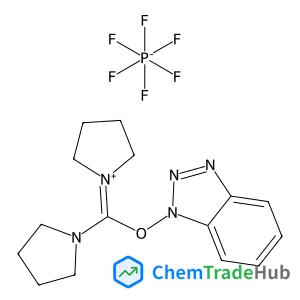
(1H-Benzotriazol-1-yloxy)(di-1-pyrrolidinyl)methylium hexafluorophosphate
CAS番号:
105379-24-6
分子式:
C15H21F6N5OP

おすすめサプライヤー






免責事項
このページに表示される学術雑誌情報は、参考および研究目的のみを目的としています。当社は雑誌出版社とは提携しておらず、投稿の取り扱いも行っておりません。出版に関するお問い合わせは、各雑誌出版社に直接ご連絡ください。
表示されている情報に誤りがある場合は、support@chemtradehub.com までご連絡ください。迅速に確認し、対応いたします。