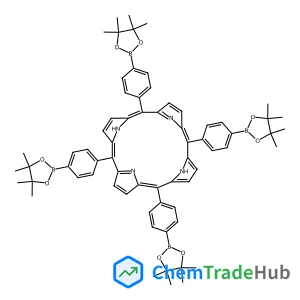
5,10,15,20-tetrakis(4-boronic acid pinacol ester phenyl) porphyrin
CAS番号:
1332748-00-1
分子式:
C68H74B4N4O8
Shin-Kung Wang, Hsun-Yun Chang, Yi-Hsuan Chu, Wei-Lun Kao, Chen-Yi Wu, Yi-Wei Lee, Yun-Wen You, Kuo-Jui Chu, Shu-Hang Hung
Gas cluster ion beam (GCIB) is a promising technique for preserving molecular structures during ion sputtering and successfully profiling biological and soft materials. However, although GCIB yields lower damage accumulation compared with C60+ and monoatomic ion beams, the inevitable alteration of the chemical structure can introduce artifacts into the resulting depth profile. To enhance the ionization yield and further mask damage, a low-energy O2+ (200–500 V) cosputter can be applied. While the energy per atom (E/n) of GCIB is known to be an important factor influencing the sputter process, the manner through which E/n affects the GCIB-O2+ cosputter process remains unclear. In this study, poly(ethylene terephthalate) (PET) was used as a model material to investigate the sputter process of 10–20 kV Ar1000–4000+ (E/n = 2.5–20 eV per atom) with and without O2+ cosputter at different energies and currents. Time-of-flight secondary ion mass spectrometry (ToF-SIMS) with Bi32+ as the primary ion was used to examine surfaces sputtered at different fluences. The sputter craters were also measured by alpha-step and atomic force microscopy in quantitative imaging mode. The SIMS results showed that the steady-state cannot be obtained with E/n values of less than 5 eV per atom due to damage accumulation using single GCIB sputtering. With a moderate E/n value of 5–15 eV per atom, the steady-state can be obtained, but the ∼50% decay in intensity indicated that damage cannot be masked completely despite the higher sputter yield. Furthermore, the surface Young's modulus decreased with increasing E/n, suggesting that depolymerization occurred. At an E/n value of 20 eV per atom, a failed profile was obtained with rapidly decreased sputter rate and secondary ion intensity due to the ion-induced crosslink. With O2+ cosputtering and a moderate E/n value, the oxidized species generated by O2+ enhanced the ionization yield, which led to a higher ion intensity at steady-state in general. Because higher kinetic energy or current density of O2+ led to a larger interaction volume and more structural damage that suppressed molecular ion intensity, the enhancement from O2+ was most apparent with low-energy–high-current (200 V, 80 μA cm−2) or high-energy–low-current (500 V, 5 μA cm−2) O2+ cosputtering with 0.5 μA cm−2 GCIBs. In these cases, little or no intensity drop was observed at the steady-state.
Jun Yan, Ziqi Yu, Hao-Zhao Wei, Yin Wei
DOI: 10.1039/D3QO01266B
Xiu-dong Jia, Zhi-wei Du
DOI: 10.1039/D3CP05290G
Yan-Lin Li, Kun Cui, Zheng-Yang Gu, Hu He
DOI: 10.1039/D3QO01281F
Shuhui Li, Xiaoxuan Li, Hui Yao, Mengting Tan, Dan Xu, Nianyu Huang, Nengzhong Wang
DOI: 10.1039/D3QO01734F
Dingguo Song, Shiliang Wang, Weiwei Huang, Rong Chen, Fangyuan Hu, Lingxin Cheng, Xianghua Zhao, Fei Ling, Weihui Zhong
DOI: 10.1039/D3QO90094K
Tao Ying, Hong Chen, Keyu Xiang, Weike Su, Haijiao Xie, Jingbo Yu
DOI: 10.1039/D3QO01467C
Xingchen Zhang, Dongfang Zhang, Xinya Chen, Dingyi Zhou, Jinying Zhang, Zhiyong Wang
DOI: 10.1039/D3CP05790A
Qiansong Gao, Lianyou Zheng, Shulin Ning, Lingling Shi, Cheng Wu, Mian Liu, Jinbao Xiang
DOI: 10.1039/D3QO01782F
Panpan Lei, Bingran Chen, Tonghui Zhang, Qinlin Chen, Liangming Xuan, Haifeng Wang, Qiongjiao Yan, Wei Wang, Jie Zeng
DOI: 10.1039/D3QO01551C
DOI: 10.1039/D3QO01435E
3-イチチルビフェニルは、ビフェニルとイチプロピオニトリルを回収率約90%で反応させて合成されます。触媒は通常、亜リチウムホウ素を用います。
8-溴-5-三氟甲基喹啉は、5-トリフルオロメチル-2-メチル-1,3-ベンゼンジオールをブロモエタノールと反応させて生成します。この反応は塩基性条件下で行われ...
ジメチル4-(4,4,5,5-テトラメチル-1,3,2-ドioxaborolan-2-基)-2,6-ピリジンジカルボイル酸フェニルアミニドの代替品としては、4-...
N-(3,5-ヘキサクロロ-4-ピリドインイル)-8-メチオキシ-5-キノリンカーボン酸の市場動向は、主に産業用途での需要により影響を受けます。研究トレンドとし...
イソステアロイルグリセリルは一般的に安全性が高いとされていますが、過度な使用や個人差により皮�owsん炎などの反応が起こる可能性があります。使用前に医師に相談す...
1-(二苯甲基)-3,3-二氟-氮杂环丁烷の市場動向は、医薬品や合成化学の研究分野で注目を集めています。新興研究は、該当化合物の合成改良と生体内での作用メカニズ...
3-チオフェンスチオールのCAS番号は7774-73-4です。結晶性の白色粉末で、分子量は122.17です。この化合物は水に微溶解し、エタノールやジクロロメタン...
2-Methyl-2-propanyl (2S)-2-(aminomethyl)-1-piperidinecarboxylateは一定の安全性基準を満たしていま...
CAS番号1316822-90-8の化合物は安全性に関しては評価が不足していますが、一般的には生物学的に活性な物質であり、取り扱いには適切な安全防護措置が必要で...
Tert-butyl 2-(2-羟基乙基)哌嗪-1-羧酸は、冷暗所で保存し、直射日光から遠ざけてください。容器は密閉し、高湿度や高温を避けて保管してください。

Analyst publishes analytical and bioanalytical research that reports premier fundamental discoveries and inventions, and the applications of those discoveries, unconfined by traditional discipline barriers.