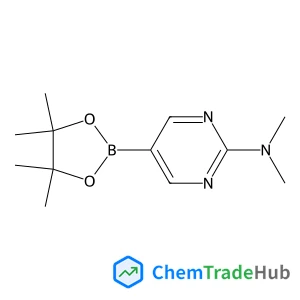
N,N-Dimethyl-5-(4,4,5,5-tetramethyl-1,3,2-dioxaborolan-2-yl)-2-pyrimidinamine
CAS番号:
1032759-30-0
分子式:
C12H20BN3O2
J. Lacombe, C. Soulié-Ziakovic
Thymine-functionalized telechelic poly(propylene glycol) (PPG) chains of 460–4000 g mol−1 present a long-range ordered lamellar microphase separation due to thymine crystallization. This organization is lost if the difference of polarity between the H-bonding units and the chain is not sufficiently high to induce segregation, as with a poly(ethylene glycol) (PEG) chain. Moreover, the mesoscopic order is gradually lost with the longest PPG chains i.e. with the smallest volume fractions of supramolecular units limiting their clusterization/crystallization. Methylated thymine (MeThy) end-functionalized PPG presents the same lamellar mesoscopic organization, proving that Thy/Thy H-bonding self-association does not drive their crystallization. Infrared spectroscopy evidences that the amide functions linking MeThy motifs to PPG chains interact with each other through H-bonds, forming either a random or an aligned pattern, just like protein secondary structures. On cooling from the melt, disordered H-bonded amides align and pre-order the supramolecular units just prior to the disorder–order transition driven by the MeThy crystallization. The close packing, necessary to induce crystallization, is no longer possible with bulky neo-pentyl functionalized thymines (tBuCH2Thy), preventing mesoscopic organization. Hence, the pattern formed by H-bonded amide links plays a major role in the long-range organization of the telechelic supramolecular polymer in helping supramolecular units to crystallize. Indeed, replacing the amide by an ester link suppresses their crystallization and thus the mesoscopic order.
W. X. Zhang, Y. Yin, C. He
DOI: 10.1039/D0CP04474A
Joseph Hufton, John Harding, Thomas Smith
DOI: 10.1039/D0CP04067C
Zahra Hooshmand, Mark R. Pederson
DOI: 10.1039/D0CP04455E
Tomohiro Toigawa, Dean R. Peterman, David S. Meeker, Travis S. Grimes, Peter R. Zalupski, Stephen P. Mezyk, Andrew R. Cook, Shinichi Yamashita, Yuta Kumagai, Tatsuro Matsumura, Gregory P. Horne
DOI: 10.1039/D0CP05720G
Min Li, WenCai Lu
DOI: 10.1039/D0CP04782A
Jan Schnatwinkel, Christian Herrmann
DOI: 10.1039/D0CP03040F
Trent R. Graham, Mateusz Dembowski, Hsiu-Wen Wang, Sebastian T. Mergelsberg, Emily T. Nienhuis, Jacob G. Reynolds, Calvin H. Delegard, Yihui Wei, Michelle Snyder, Ian I. Leavy, Steven R. Baum, Matthew S. Fountain, Kevin M. Rosso
DOI: 10.1039/D0CP04799F
Lin-Yan Feng, Kang Wang, Hua-Jin Zhai
DOI: 10.1039/D0CP05012A
Elder Augusto Viana Mota, Mayra Moura-Moreira, Marcelo Ricardo Souza Siqueira, Carlos Alberto Brito da Silva, Jr, Jordan Del Nero
DOI: 10.1039/D0CP06126C
V. P. Zhukov, B. V. Politov, A. Yu. Suntsov, V. L. Kozhevnikov
DOI: 10.1039/D0CP05497F
6- bromo-1-cyclopropyl-1H-benzimidazoleは、抗炎症、抗ウイルス作用を持つことが報告されており、新薬開発の研究対象として注目...
取り扱う際には、防護眼鏡と手袋を使用し、ドラフトチャンバー内で操作することを推奨します。漏洩時には適切な手順で処理し、安全データシートを常に参照してください。
2,2’-ジメチル-3,3’-ビピリジンは、ピリジンと2-メチルアクリルアミドを有機合成反応で合成します。この反応では、ピリジンと2-メチルアクリルアミドを含有...
6-甲基ピリジン-2-ボリック酸は、合成化学、医薬品合成、以及研究用途などに広く使用され、特に組換えDNA技術や分子生物学の研究において重要な役割を果たします。
(R)-3-(1-甲基-2-氧環己基)プロpano酸メチルは一定の安全性がありますが、直接的な皮膚接触や吸入は避けるべきです。使用する際は適切な個々の安全データ...
ketorolacは、密封して遮光容器に保管し、直射日光や高温を避けて保存してください。温度は常温で保存し、湿度をなるべく低く保つことが推奨されます。
L-2,3-二氨基丙酸二盐酸盐は腐食性が強く、皮膚や粘膜に刺激を与える可能性があります。取り扱う際は、防塵マスク、ゴーグル、手袋を使用し、適切な排気設備を使用し...
2-(4-溴ピリジン-2-基)乙腈のCAS番号は312325-73-8です。主に結晶形態で存在し、分子量は159.01 g/molです。この化合物は水に溶けやす...
この化合物は毒性は低いですが、直接的な接触や吸入に注意が必要です。PPE(個人防護具)を着用し、ドラフトチャンバーを使用して操作することを推奨します。また、漏洩...
3-(1-氧代-1,3-二氢-2H-2-异吲哚)丙酸は、薬理学研究や医薬品製造において広く用いられる化合物です。また、工業的な用途でも一部の化学反応の触媒や助剤...

Polymer Chemistry welcomes submissions in all areas of polymer science that have a strong focus on macromolecular chemistry. Manuscripts may cover a broad range of fields, yet no direct application focus is required.