












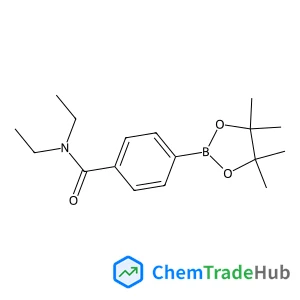
N,N-Diethyl-4-(4,4,5,5-tetramethyl-1,3,2-dioxaborolan-2-yl)benzamide
CAS番号:
325142-99-2
分子式:
C17H26BNO3
I. Rosbottom, J. H. Pickering, B. Etbon, R. B. Hammond, K. J. Roberts
Synthonic engineering tools, including grid-based searching molecular modelling, are applied to investigate the wetting interactions of the solute and four crystallisation solvents (ethanol, ethyl acetate, acetonitrile and toluene) with the {100}, {001} and {011} forms of RS-ibuprofen. The grid-based methods, in particular the construction of a crystal slab parallel to a given plane in a coordinate system with one axis perpendicular to the surface, are defined in detail. The interaction strengths and nature (dispersive, hydrogen bonding (H-bonding) or coulombic forces) are related to the crystal growth rates and morphologies. The solute is found to interact strongest with the capping {011}, then the side {001} and weakest with the top {100} habit surfaces. The solute interactions with the {100} and {001} surfaces are found to be almost solely dominated by dispersive force contributions, whilst the same with the {011} surfaces are found to have a greater contribution from H-bonding and coulombic forces. The increased surface rugosity, at the molecular level of the {011} surfaces, results in a favourable docking site in a surface ‘valley’, not present in the {100} and {001} surfaces. The H-bonding solvents ethanol, acetonitrile and ethyl acetate are found to strongly interact with the {011} surfaces and weakly with the {001} surfaces, with the {011} interactions having a much greater contribution from H-bonding and coulombic forces. The interaction energies of the apolar and aprotic solvent toluene, with the {011} and {001} surfaces, are found to be very close. Toluene is found having slightly stronger interactions with the {001} than the {011} surfaces, which are all dominated by dispersive interactions. The ratio of the average energy of the top 100 solvent interactions with the {001} surface divided by the average energy of the top 100 interactions with the {011} surface is compared to the ratio of the experimentally measured growth rates of the same forms. In general, the interaction energy ratio is found to have an inverse ratio with the growth rates, implying that the solvents which are calculated to interact strongly with a particular surface are impeding the growth of that surface and reducing the growth rate, in turn impacting upon the final morphology of the material.
Wiktor Zierkiewicz, Mariusz Michalczyk, Steve Scheiner
DOI: 10.1039/C7CP08048D
Nur Sena Yüzbasi, Paula M. Abdala, Qasim Imtiaz, Sung Min Kim, Agnieszka M. Kierzkowska, Andac Armutlulu, Wouter van Beek, Christoph R. Müller
DOI: 10.1039/C8CP01309H
Daiki Asakawa, Hidenori Takahashi, Shinichi Iwamoto, Koichi Tanaka
DOI: 10.1039/C8CP00733K
DOI: 10.1039/C7CP05882A
Xiaolong Zhang
DOI: 10.1039/C7CP07723H
Yong-Chao Rao, Peng Zhang, Shun-Fang Li, Xiang-Mei Duan, Su-Huai Wei
DOI: 10.1039/C8CP00880A
Daehyeon Choi, Joonhee Kang, Jinwoo Park, Byungchan Han
DOI: 10.1039/C7CP08037A
Longteng Tang, Yanli Wang, Liangdong Zhu, Karen Kallio, S. James Remington, Chong Fang
DOI: 10.1039/C8CP01907J
Bing Bai, Hui Bai, Hao-Jie Cao, Zhi-Hua Gao, Zhi-Jun Zuo, Wei Huang
DOI: 10.1039/C8CP02000K
M. Oldenburg, A. Turshatov, D. Busko, M. Jakoby, R. Haldar, K. Chen, G. Emandi, M. O. Senge, C. Wöll, J. M. Hodgkiss
DOI: 10.1039/C7CP08452H
2-ヒドロキシ-5-ニトロベンジンブロモイドは特定の化学反応に適しているため、代替品は限られています。しかし、同様の構造を持つ2-ヒドロキシ-4-ニトロベンジン...
N-(2-ブロモフェニル)-1-チロール-3-オキソ-3-(ピペリジニル)プロペン-2-イル)ベンゼンアミドは有毒で、皮膚や粘膜に刺激を与える可能性があります。...
この化合物は、新規治療薬の開発に注目されています。市場では、その有効性と安全性が評価され、研究分野では、分子生物学と医薬化学の新たな発見が期待されています。
Succinimidyl-alanyl-phenylalanyl-prolyl-phenylalanine 4-nitroanilide は主に医薬品開発やポ...
メチル6-アミノ-5-クロロピリジン-2-カーボイル酸(CAS番号: 1256794-05-4)の使用には、GHS( Globally Harmonized S...
取り扱いには、耐薬品性の容器を使用し、通気性の良い場所で操作することを推奨します。漏れ時は、SDS(安全データシート)を参照して適切な措置を取ること。手洗いと洗...
(S)-3-ベンZYルピペリジン塩酸塩は、CAS番号1258940-00-9で表される化合物です。これは、(S)-3-苯基哌啶的盐酸盐であり、主に医薬品の原料と...
3,5-二甲基金剛胺は、主に医薬品の原料として使用され、また抗うつ薬や抗アルツハイマー薬の開発に利用されます。さらに、化粧品や食品添加物の製造でも重要な役割を果...
ビス(4-メチル-2-ペンチル)フェニルカルボン酸エステル (CAS番号: 1398066-13-1) の代替品には、ビス(2-エチルヘキシル)フェノールカルボ...

Physical Chemistry Chemical Physics (PCCP) is an international journal co-owned by 19 physical chemistry and physics societies from around the world. This journal publishes original, cutting-edge research in physical chemistry, chemical physics and biophysical chemistry. To be suitable for publication in PCCP, articles must include significant innovation and/or insight into physical chemistry; this is the most important criterion that reviewers and Editors will judge against when evaluating submissions. The journal has a broad scope and welcomes contributions spanning experiment, theory, computation and data science. Topical coverage includes spectroscopy, dynamics, kinetics, statistical mechanics, thermodynamics, electrochemistry, catalysis, surface science, quantum mechanics, quantum computing and machine learning. Interdisciplinary research areas such as polymers and soft matter, materials, nanoscience, energy, surfaces/interfaces, and biophysical chemistry are welcomed if they demonstrate significant innovation and/or insight into physical chemistry. Joined experimental/theoretical studies are particularly appreciated when complementary and based on up-to-date approaches.
![2,6-Di(thiophen-2-yl)dithieno[3,2-b:2',3'-d]thiophene structure](https://static.chemtradehub.com/structs/910/910788-24-8-5b70.webp "2,6-Di(thiophen-2-yl)dithieno[3,2-b:2',3'-d]thiophene structure")


