


![tert-Butyl N-[(2-chloropyridin-4-yl)methyl]carbamate structure](https://static.chemtradehub.com/structs/916/916210-27-0-9f95.webp "tert-Butyl N-[(2-chloropyridin-4-yl)methyl]carbamate structure")
Fundamental study of hydrogen-attachment-induced peptide fragmentation occurring in the gas phase and during the matrix-assisted laser desorption/ionization process
文献情報
出版日
2018-04-09
DOI
10.1039/C8CP00733K
インパクトファクター
3.676
著者
Daiki Asakawa, Hidenori Takahashi, Shinichi Iwamoto, Koichi Tanaka
原文を見る
要旨
Mass spectrometry with hydrogen-radical-mediated fragmentation techniques has been used for the sequencing of proteins/peptides. The two methods, matrix-assisted laser desorption/ionization in-source decay (MALDI-ISD) and hydrogen attachment/abstraction dissociation (HAD) are known as hydrogen-radical-mediated fragmentation techniques. MALDI-ISD occurs during laser induced desorption processes, whereas HAD utilizes the association of hydrogen with peptide ions in the gas phase. In this study, the general mechanisms of MALDI-ISD and HAD of peptides were investigated. We demonstrated the fragmentation of four model peptides and investigated the fragment formation pathways using density functional theory (DFT) calculations. The current experimental and computational joint study indicated that MALDI-ISD and HAD produce aminoketyl radical intermediates, which immediately undergo radical-induced cleavage at the N–Cα bond located on the C-terminal side of the radical site, leading to the c′/z˙ fragment pair. In the case of MALDI-ISD, the z˙ fragments undergo a subsequent reaction with the matrix to give z′ and matrix adducts of the z fragments. In contrast, the c′ and z˙ fragments react with hydrogen atoms during the HAD processes, and various fragment species, such as c˙, c′, z˙ and z′, were observed in the HAD-MS/MS mass spectra.
おすすめジャーナル

Journal of Enzyme inhibition and Medicinal Chemistry

Advanced Engineering Materials

CrystEngComm

Current Pharmaceutical Biotechnology

European Journal of Organic Chemistry

Photochemical & Photobiological Sciences

Angewandte Chemie International Edition

Contact Lens & Anterior Eye

Physical Chemistry Chemical Physics

Lab on a Chip
関連文献
Metal free thiol–maleimide ‘Click’ reaction as a mild functionalisation strategy for degradable polymers
Ryan J. Pounder, Matthew J. Stanford, Paul Brooks, Stephen P. Richards, Andrew P. Dove
2008-09-29
Communication
DOI: 10.1039/B809167F
Changes in the electronic structure and properties of graphene induced by molecular charge-transfer
Rakesh Voggu, Chandra Sekhar Rout
2008-09-25
Communication
DOI: 10.1039/B808955H
Formation of a stable dicarbenoid and an unsaturated C2P2S2 ring from two-electron oxidation of the [C(PPh2S)2]2− dianion
Jari Konu, Tristram Chivers
2008-09-12
Communication
DOI: 10.1039/B810796C
Two-dimensional ordering of benzenethiol self-assembled monolayers guided by displacement of cyclohexanethiols on Au(111)
Hungu Kang, Haiwon Lee, Youngjong Kang, Jaegeun Noh
2008-09-12
Communication
DOI: 10.1039/B809261C
Heavier group 2 element-catalysed hydroamination of isocyanates
Anthony G. M. Barrett, Tanya C. Boorman, Mark R. Crimmin, Michael S. Hill, Gabriele Kociok-Köhn, Panayiotis A. Procopiou
2008-09-12
Communication
DOI: 10.1039/B809649J
Photochromic oligothienoacene derivatives with photo-switchable luminescene properties and computational studies
Chi-Chiu Ko, Wai Han Lam, Vivian Wing-Wah Yam
2008-09-12
Communication
DOI: 10.1039/B810585E
Recognition of lectin with a high signal to noise ratio: carbohydrate-tri(ethylene glycol)-alkanethiol co-adsorbed monolayer
Yukari Sato, Kyoko Yoshioka, Mutsuo Tanaka, Teiichi Murakami, Miho Neide Ishida, Osamu Niwa
2008-09-09
Communication
DOI: 10.1039/B809481K
Drastic effect of bidentate phosphine ligands on Pd-catalyzed hydroarylation of ethyl propiolate: a simple route to arylbutadienes
Juzo Oyamada, Tsugio Kitamura
2008-09-12
Communication
DOI: 10.1039/B810658D
Use of Sm(iii)–{1,2-propanediamine-N,N,N′,N′-tetra(α,α-dideuterioacetate)} complex for NMR determination of absolute configuration of each α-amino acid in peptide hydrolysate mixtures
Kenji Omata, Mika Fujioka, Kuninobu Kabuto, Yoichi Sasaki
2008-09-12
Communication
DOI: 10.1039/B809551E
こちらもおすすめ
化合物よくある質問
2-ヒドロキシ-5-ニトロベンジンブロモイドの代替品はありますか?
2-ヒドロキシ-5-ニトロベンジンブロモイドは特定の化学反応に適しているため、代替品は限られています。しかし、同様の構造を持つ2-ヒドロキシ-4-ニトロベンジン...
772-33-82-(Bromomethyl)-4-ni...
化合物よくある質問
N-(2-ブロモフェニル)-1-チロール-3-オキソ-3-(ピペリジニル)プロペン-2-イル)ベンゼンアミドを取り扱う際の実験室安全事項は何ですか?
N-(2-ブロモフェニル)-1-チロール-3-オキソ-3-(ピペリジニル)プロペン-2-イル)ベンゼンアミドは有毒で、皮膚や粘膜に刺激を与える可能性があります。...
1800044-77-2N-[(1Z)-1-(2-Bromoph...
化合物よくある質問
1,3プロパンジオール,2-[2-(2アミノ-6クロロ-9Hピリミジン-9-イル)エチル-1,1,2,2-D4]-2,3-ジアセタートの市場動向や研究トレンドはどうですか?
この化合物は、新規治療薬の開発に注目されています。市場では、その有効性と安全性が評価され、研究分野では、分子生物学と医薬化学の新たな発見が期待されています。
1020718-81-31,3-Propanediol, 2-[...
579-44-2Ethanone, 2-hydroxy-...
化合物よくある質問
Succinimidyl-alanyl-phenylalanyl-prolyl-phenylalanine 4-nitroanilide はどの業界で使用されていますか?
Succinimidyl-alanyl-phenylalanyl-prolyl-phenylalanine 4-nitroanilide は主に医薬品開発やポ...
128802-73-3succinimidyl-alanyl-...
化合物よくある質問
メチル6-アミノ-5-クロロピリジン-2-カーボイル酸について、適用される法規ガイドラインは何ですか?
メチル6-アミノ-5-クロロピリジン-2-カーボイル酸(CAS番号: 1256794-05-4)の使用には、GHS( Globally Harmonized S...
1256794-05-4Methyl 6-amino-5-chl...
化合物よくある質問
エチル4-(シクロ Pentagonyl)アミノ-2-メチル硫化基ピリミジン-5-カルボキシレートを取り扱う際の実験室安全事項は何ですか?
取り扱いには、耐薬品性の容器を使用し、通気性の良い場所で操作することを推奨します。漏れ時は、SDS(安全データシート)を参照して適切な措置を取ること。手洗いと洗...
211245-62-4ethyl 4-(cyclopentyl...
化合物よくある質問
(S)-3-ベンZYルピペリジン塩酸塩とは何ですか?
(S)-3-ベンZYルピペリジン塩酸塩は、CAS番号1258940-00-9で表される化合物です。これは、(S)-3-苯基哌啶的盐酸盐であり、主に医薬品の原料と...
1258940-00-9(S)-3-Phenylpiperidi...
化合物よくある質問
3,5-二甲基金剛胺の主な用途は何ですか?
3,5-二甲基金剛胺は、主に医薬品の原料として使用され、また抗うつ薬や抗アルツハイマー薬の開発に利用されます。さらに、化粧品や食品添加物の製造でも重要な役割を果...
19988-45-52-(2,3-Dihydroxyphen...
化合物よくある質問
ビス(4-メチル-2-ペンチル)フェニルカルボン酸エステルの代替品はありますか?
ビス(4-メチル-2-ペンチル)フェニルカルボン酸エステル (CAS番号: 1398066-13-1) の代替品には、ビス(2-エチルヘキシル)フェノールカルボ...
1398066-13-1Bis(4-methyl-2-penty...
掲載誌
Physical Chemistry Chemical Physics
CiteScore:
5.5
自己引用率:
10.3%
年間論文数:
3036
Physical Chemistry Chemical Physics (PCCP) is an international journal co-owned by 19 physical chemistry and physics societies from around the world. This journal publishes original, cutting-edge research in physical chemistry, chemical physics and biophysical chemistry. To be suitable for publication in PCCP, articles must include significant innovation and/or insight into physical chemistry; this is the most important criterion that reviewers and Editors will judge against when evaluating submissions. The journal has a broad scope and welcomes contributions spanning experiment, theory, computation and data science. Topical coverage includes spectroscopy, dynamics, kinetics, statistical mechanics, thermodynamics, electrochemistry, catalysis, surface science, quantum mechanics, quantum computing and machine learning. Interdisciplinary research areas such as polymers and soft matter, materials, nanoscience, energy, surfaces/interfaces, and biophysical chemistry are welcomed if they demonstrate significant innovation and/or insight into physical chemistry. Joined experimental/theoretical studies are particularly appreciated when complementary and based on up-to-date approaches.
おすすめ化合物
![2,6-Di(thiophen-2-yl)dithieno[3,2-b:2',3'-d]thiophene structure](https://static.chemtradehub.com/structs/910/910788-24-8-5b70.webp "2,6-Di(thiophen-2-yl)dithieno[3,2-b:2',3'-d]thiophene structure")
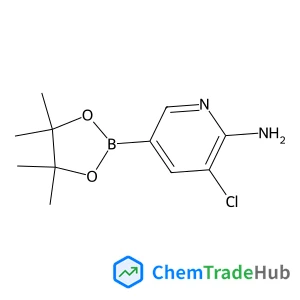
3-Chloro-5-(4,4,5,5-tetramethyl-1,3,2-dioxaborolan-2-yl)-2-pyridinamine
CAS番号:
1032758-99-8
分子式:
C11H16BClN2O2
おすすめサプライヤー




免責事項
このページに表示される学術雑誌情報は、参考および研究目的のみを目的としています。当社は雑誌出版社とは提携しておらず、投稿の取り扱いも行っておりません。出版に関するお問い合わせは、各雑誌出版社に直接ご連絡ください。
表示されている情報に誤りがある場合は、support@chemtradehub.com までご連絡ください。迅速に確認し、対応いたします。