












Dihydrogen vs. hydrogen bonding in the solvation of ammonia borane by tetrahydrofuran and liquid ammonia
文献情報
出版日
2018-04-23
DOI
10.1039/C7CP08220G
インパクトファクター
3.676
著者
Thomas F. Headen, Samantha K. Callear, Matthew Billing, Andrea Sella
原文を見る
要旨
The solvation structures of two systems rich in hydrogen and dihydrogen bonding interactions have been studied in detail experimentally through neutron diffraction with hydrogen/deuterium isotopic substitution. The results were analysed by an atomistic Monte Carlo simulation employing refinement to the experimental scattering data. The systems studied were the hydrogen storage material ammonia borane (NH3BH3, AB) dissolved in tetrahydrofuran (THF), and liquid ammonia (NH3), the latter in which AB shows unusually high solubility (260 g AB per 100 g NH3) and potential regeneration properties. The full orientational and positional manner in which AB–AB, AB–THF and AB–NH3 pairs interact with each other were successfully deciphered from the wide Q-range total neutron scattering data. This provided an unprecedented level of detail into such highly (di)hydrogen bonding solute–solvent interactions. In particular this allowed insight into the way in which H–B acts as a hydrogen bond acceptor. The (di)hydrogen bonding was naturally determined to dictate the intermolecular interactions, at times negating the otherwise expected tendency for polar molecules to align themselves with anti-parallel dipole moments. Several causes for the extreme solubility of AB in ammonia were determined, including the ability of ammonia to (di)hydrogen bond to both ends of the AB molecule and the small size of the ammonia molecule relative to AB and THF. The AB B–H to ammonia H dihydrogen bond was found to dominate the intermolecular interactions, occurring almost three times more often than any other hydrogen or dihydrogen bond in the system. The favourability of this interaction was seen on the bulk scale by a large decrease in AB clustering in ammonia compared to in the dihydrogen bond-less THF.
関連文献
Testing variations of the GW approximation on strongly correlated transition metal oxides: hematite (α-Fe2O3) as a benchmark
Peilin Liao, Emily A. Carter
2011-07-14
Paper
DOI: 10.1039/C1CP20829B
Multiscale quantum mechanics/electromagnetics simulation for electronic devices
ChiYung Yam, Lingyi Meng, GuanHua Chen, Quan Chen, Ngai Wong
2011-06-10
Paper
DOI: 10.1039/C1CP20766K
Ionic liquids and oligomer electrolytes based on the B(CN)4− anion; ion association, physical and electrochemical properties
Johan Scheers, Jagath Pitawala, Frederic Thebault, Jae-Kwang Kim, Jou-Hyeon Ahn, Aleksandar Matic, Per Jacobsson
2011-07-21
Paper
DOI: 10.1039/C1CP21062A
Covalent networks through on-surface chemistry in ultra-high vacuum: state-of-the-art and recent developments
2011-05-09
Perspective
DOI: 10.1039/C1CP20700H
Structural, morphological, and kinetic studies of β-amyloid peptide aggregation on self-assembled monolayers
Qiuming Wang, Nilam Shah, Jun Zhao, Chengshan Wang, Chao Zhao, Lingyun Liu, Lingyan Li, Feimeng Zhou, Jie Zheng
2011-07-19
Paper
DOI: 10.1039/C1CP21156K
π-Stacking between Casiopeinas® and DNA bases
Rodrigo Galindo-Murillo, Joseelyne Hernandez-Lima, Mayra González-Rendón, Lena Ruíz-Azuara, Rafael Moreno-Esparza
2011-07-12
Paper
DOI: 10.1039/C1CP20183B
A theoretical study on structural, spectroscopic and energetic properties of acetamide clusters [CH3CONH2] (n = 1–15)
A. Subha Mahadevi, Y. Indra Neela, G. Narahari Sastry
2011-07-14
Paper
DOI: 10.1039/C1CP21346F
Hydroxideoxidation and peroxide formation at embedded binuclear transition metal sites; TM = Cr, Mn, Fe, Co
M. Busch, E. Ahlberg, I. Panas
2011-07-20
Paper
DOI: 10.1039/C1CP20487D
Towards understanding the effects of carbon and nitrogen-doped carbon coating on the electrochemical performance of Li4Ti5O12 in lithium ion batteries: a combined experimental and theoretical study
Zijing Ding, Liang Zhao, Liumin Suo, Yang Jiao, Sheng Meng, Yong-Sheng Hu, Zhaoxiang Wang, Liquan Chen
2011-07-26
Paper
DOI: 10.1039/C1CP21513B
Voltammetry and in situscanning tunnelling spectroscopy of osmium, iron, and ruthenium complexes of 2,2′:6′,2′′-terpyridine covalently linked to Au(111)-electrodes
Princia Salvatore, Allan Glargaard Hansen, Thomas Bjørnholm, Richard John Nichols, Jens Ulstrup
2011-06-23
Paper
DOI: 10.1039/C1CP21197H
こちらもおすすめ
化合物よくある質問
2-ヒドロキシ-5-ニトロベンジンブロモイドの代替品はありますか?
2-ヒドロキシ-5-ニトロベンジンブロモイドは特定の化学反応に適しているため、代替品は限られています。しかし、同様の構造を持つ2-ヒドロキシ-4-ニトロベンジン...
772-33-82-(Bromomethyl)-4-ni...
化合物よくある質問
N-(2-ブロモフェニル)-1-チロール-3-オキソ-3-(ピペリジニル)プロペン-2-イル)ベンゼンアミドを取り扱う際の実験室安全事項は何ですか?
N-(2-ブロモフェニル)-1-チロール-3-オキソ-3-(ピペリジニル)プロペン-2-イル)ベンゼンアミドは有毒で、皮膚や粘膜に刺激を与える可能性があります。...
1800044-77-2N-[(1Z)-1-(2-Bromoph...
化合物よくある質問
1,3プロパンジオール,2-[2-(2アミノ-6クロロ-9Hピリミジン-9-イル)エチル-1,1,2,2-D4]-2,3-ジアセタートの市場動向や研究トレンドはどうですか?
この化合物は、新規治療薬の開発に注目されています。市場では、その有効性と安全性が評価され、研究分野では、分子生物学と医薬化学の新たな発見が期待されています。
1020718-81-31,3-Propanediol, 2-[...
579-44-2Ethanone, 2-hydroxy-...
化合物よくある質問
Succinimidyl-alanyl-phenylalanyl-prolyl-phenylalanine 4-nitroanilide はどの業界で使用されていますか?
Succinimidyl-alanyl-phenylalanyl-prolyl-phenylalanine 4-nitroanilide は主に医薬品開発やポ...
128802-73-3succinimidyl-alanyl-...
化合物よくある質問
メチル6-アミノ-5-クロロピリジン-2-カーボイル酸について、適用される法規ガイドラインは何ですか?
メチル6-アミノ-5-クロロピリジン-2-カーボイル酸(CAS番号: 1256794-05-4)の使用には、GHS( Globally Harmonized S...
1256794-05-4Methyl 6-amino-5-chl...
化合物よくある質問
エチル4-(シクロ Pentagonyl)アミノ-2-メチル硫化基ピリミジン-5-カルボキシレートを取り扱う際の実験室安全事項は何ですか?
取り扱いには、耐薬品性の容器を使用し、通気性の良い場所で操作することを推奨します。漏れ時は、SDS(安全データシート)を参照して適切な措置を取ること。手洗いと洗...
211245-62-4ethyl 4-(cyclopentyl...
化合物よくある質問
(S)-3-ベンZYルピペリジン塩酸塩とは何ですか?
(S)-3-ベンZYルピペリジン塩酸塩は、CAS番号1258940-00-9で表される化合物です。これは、(S)-3-苯基哌啶的盐酸盐であり、主に医薬品の原料と...
1258940-00-9(S)-3-Phenylpiperidi...
化合物よくある質問
3,5-二甲基金剛胺の主な用途は何ですか?
3,5-二甲基金剛胺は、主に医薬品の原料として使用され、また抗うつ薬や抗アルツハイマー薬の開発に利用されます。さらに、化粧品や食品添加物の製造でも重要な役割を果...
19988-45-52-(2,3-Dihydroxyphen...
化合物よくある質問
ビス(4-メチル-2-ペンチル)フェニルカルボン酸エステルの代替品はありますか?
ビス(4-メチル-2-ペンチル)フェニルカルボン酸エステル (CAS番号: 1398066-13-1) の代替品には、ビス(2-エチルヘキシル)フェノールカルボ...
1398066-13-1Bis(4-methyl-2-penty...
掲載誌
Physical Chemistry Chemical Physics

CiteScore:
5.5
自己引用率:
10.3%
年間論文数:
3036
Physical Chemistry Chemical Physics (PCCP) is an international journal co-owned by 19 physical chemistry and physics societies from around the world. This journal publishes original, cutting-edge research in physical chemistry, chemical physics and biophysical chemistry. To be suitable for publication in PCCP, articles must include significant innovation and/or insight into physical chemistry; this is the most important criterion that reviewers and Editors will judge against when evaluating submissions. The journal has a broad scope and welcomes contributions spanning experiment, theory, computation and data science. Topical coverage includes spectroscopy, dynamics, kinetics, statistical mechanics, thermodynamics, electrochemistry, catalysis, surface science, quantum mechanics, quantum computing and machine learning. Interdisciplinary research areas such as polymers and soft matter, materials, nanoscience, energy, surfaces/interfaces, and biophysical chemistry are welcomed if they demonstrate significant innovation and/or insight into physical chemistry. Joined experimental/theoretical studies are particularly appreciated when complementary and based on up-to-date approaches.
おすすめ化合物
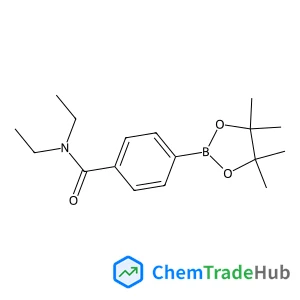
N,N-Diethyl-4-(4,4,5,5-tetramethyl-1,3,2-dioxaborolan-2-yl)benzamide
CAS番号:
325142-99-2
分子式:
C17H26BNO3
おすすめサプライヤー



免責事項
このページに表示される学術雑誌情報は、参考および研究目的のみを目的としています。当社は雑誌出版社とは提携しておらず、投稿の取り扱いも行っておりません。出版に関するお問い合わせは、各雑誌出版社に直接ご連絡ください。
表示されている情報に誤りがある場合は、support@chemtradehub.com までご連絡ください。迅速に確認し、対応いたします。