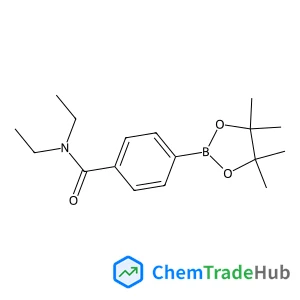
N,N-Diethyl-4-(4,4,5,5-tetramethyl-1,3,2-dioxaborolan-2-yl)benzamide
CAS番号:
325142-99-2
分子式:
C17H26BNO3
M. Busch, E. Ahlberg, I. Panas
Key steps in electro-catalytic water oxidation on binuclear Transition Metal (TM) sites are addressed. These comprise (a) two one-electron oxidation steps of TM–OH moieties to form the corresponding two TMO oxy-groups, and (b) a chemical step whereby the two oxy-species form a TM–O–O–TM peroxy-bridge. A test rig representing a generic low crystal field oxide support is described and employed. The energetics for homo-nuclear Cr(III–V), Mn(III–V), Fe(II–IV) and Co(II–IV) sites are compared. The uniqueness of the tyrosine/tyrosyl-radical (TyrOH/TyrO˙) reference potential for driving the oxidation steps is demonstrated. The oxidation of adsorbed TM–OH moieties on binuclear Mn and Co candidates requires an overpotential of approximately 0.5 V relative to the chosen reference potential. Correspondingly, the subsequent O–O bond formation becomes strongly exothermic, of the order of 1 eV. The hydroxide oxidation steps on binuclear CrCr and FeFe systems are, in total, exothermic by 1.21 and 0.61 eV, respectively, relative to the TyrOH/TyrO˙ reference potential. Consequently, the chemical step for transforming the TMO moieties to the peroxo species is found to be endothermic by the order of 0.7 eV. Based on these findings, a catalyst containing one TM from each class is suggested. The validity of this concept is demonstrated for the FeCo binuclear site. The results are discussed in the context of experimental observations, which display a preference for mixed oxide systems.
Meng Liu, Dong Li, Kun Li, Haitao Xu, Jiufu Lu, Xianzhao Shao, Taihong Liu
DOI: 10.1039/D1SD00016K
Olga D. Zakharova, Vladimir A. Lisitskiy, Igor A. Kirilyuk, Vladimir N. Silnikov, Tatyana S. Godovikova
DOI: 10.1039/C9MD00516A
Sunitha Rani Routhu, C. Ganesh Kumar
DOI: 10.1039/D0MD00188K
Mabel Catalán, Vicente Castro-Castillo, Javier Gajardo-de la Fuente, Jocelyn Aguilera, Jorge Ferreira, Ricardo Ramires-Fernandez, Ivonne Olmedo, Alfredo Molina-Berríos, Charlotte Palominos, Marcelo Valencia, Marta Domínguez, José A. Souto, José A. Jara
DOI: 10.1039/D0MD00153H
Guilherme Vieira de Castro, Alessio Ciulli
DOI: 10.1039/D1MD00215E
Alexander W. Weig, Samantha L. Barlock, Patrick M. O'Connor, Orry M. Marciano, Richard Smith, Robert K. Ernst, Roberta J. Melander, Christian Melander
DOI: 10.1039/D0MD00238K
Ekaterina S. Sazanova, Iuliia A. Gracheva, Diane Allegro, Pascale Barbier, Elena V. Svirshchevskaya, Alexey Yu Fedorov
DOI: 10.1039/D0MD00060D
Elisabeth Kronenberg, Frauke Weber, Dirk Schepmann, Bernhard Wünsch
DOI: 10.1039/D0MD00307G
Humera Ahmed, Charlotte R. Curtis, Sara Tur-Gracia, Toluwanimi O. Olatunji, Katharine C. Carter, Roderick A. M. Williams
DOI: 10.1039/D0MD00101E
2-ヒドロキシ-5-ニトロベンジンブロモイドは特定の化学反応に適しているため、代替品は限られています。しかし、同様の構造を持つ2-ヒドロキシ-4-ニトロベンジン...
N-(2-ブロモフェニル)-1-チロール-3-オキソ-3-(ピペリジニル)プロペン-2-イル)ベンゼンアミドは有毒で、皮膚や粘膜に刺激を与える可能性があります。...
この化合物は、新規治療薬の開発に注目されています。市場では、その有効性と安全性が評価され、研究分野では、分子生物学と医薬化学の新たな発見が期待されています。
Succinimidyl-alanyl-phenylalanyl-prolyl-phenylalanine 4-nitroanilide は主に医薬品開発やポ...
メチル6-アミノ-5-クロロピリジン-2-カーボイル酸(CAS番号: 1256794-05-4)の使用には、GHS( Globally Harmonized S...
取り扱いには、耐薬品性の容器を使用し、通気性の良い場所で操作することを推奨します。漏れ時は、SDS(安全データシート)を参照して適切な措置を取ること。手洗いと洗...
(S)-3-ベンZYルピペリジン塩酸塩は、CAS番号1258940-00-9で表される化合物です。これは、(S)-3-苯基哌啶的盐酸盐であり、主に医薬品の原料と...
3,5-二甲基金剛胺は、主に医薬品の原料として使用され、また抗うつ薬や抗アルツハイマー薬の開発に利用されます。さらに、化粧品や食品添加物の製造でも重要な役割を果...
ビス(4-メチル-2-ペンチル)フェニルカルボン酸エステル (CAS番号: 1398066-13-1) の代替品には、ビス(2-エチルヘキシル)フェノールカルボ...

Physical Chemistry Chemical Physics (PCCP) is an international journal co-owned by 19 physical chemistry and physics societies from around the world. This journal publishes original, cutting-edge research in physical chemistry, chemical physics and biophysical chemistry. To be suitable for publication in PCCP, articles must include significant innovation and/or insight into physical chemistry; this is the most important criterion that reviewers and Editors will judge against when evaluating submissions. The journal has a broad scope and welcomes contributions spanning experiment, theory, computation and data science. Topical coverage includes spectroscopy, dynamics, kinetics, statistical mechanics, thermodynamics, electrochemistry, catalysis, surface science, quantum mechanics, quantum computing and machine learning. Interdisciplinary research areas such as polymers and soft matter, materials, nanoscience, energy, surfaces/interfaces, and biophysical chemistry are welcomed if they demonstrate significant innovation and/or insight into physical chemistry. Joined experimental/theoretical studies are particularly appreciated when complementary and based on up-to-date approaches.