












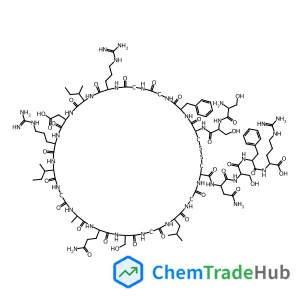
Structural, morphological, and kinetic studies of β-amyloid peptide aggregation on self-assembled monolayers
文献情報
出版日
2011-07-19
DOI
10.1039/C1CP21156K
インパクトファクター
3.676
著者
Qiuming Wang, Nilam Shah, Jun Zhao, Chengshan Wang, Chao Zhao, Lingyun Liu, Lingyan Li, Feimeng Zhou, Jie Zheng
原文を見る
要旨
The misfolding and aggregation of β-amyloid peptides (Aβ) into amyloid fibrils, a process that has been pathologically linked to the onset of Alzheimer's disease, is dependent on the presence of a heterogeneous surface (e.g., cell membrane). Understanding of the kinetics of amyloid fibril formation and associated structural transition from monomers to intermediates and eventually to fibrils is critical for the development of viable therapeutic agents. In this work, using circular dichroism (CD), atomic force microscopy (AFM), surface plasmon resonance (SPR), and molecular dynamics (MD) simulations, we studied the adsorption, aggregation, and conformational changes of Aβ1–42 from fresh monomers to fully grown fibrils on four model self-assembled monolayers (SAMs): hydrophobic CH3-terminated SAM, hydrophilic OH-terminated SAM, negatively charged COOH-terminated SAMs, and positively charged NH2-terminated SAM. The seeding effect of Aβ1–42 on the kinetics of Aβ aggregation on different SAMs is also examined. The CD, AFM, and SPR data show that all of these SAMs greatly accelerate the formation of β-sheets and amyloid fibrils through surface-enhanced interactions, but Aβ1–42peptides preferentially adsorb on a hydrophobic CH3-SAM and a positively charged NH2-SAM with much stronger interactions than on a hydrophilic OH-SAM and a negatively charged COOH-SAM. MD simulations further reveal that hydrophobic interactions present a general driving force for Aβ adsorption on all SAMs. As Aβ aggregates grow into larger species by packing hydrophobic C-terminals to form a hydrophobic core while exposing hydrophilic and negatively charged N-terminals to solution, electrostatic interactions become more strengthened when they interact with the SAMs especially for the COOH-SAM and the NH2-SAM. Thus, both hydrophobic and electrostatic interactions contribute differently to different Aβ–SAM systems and to different aggregation stages. A postulated mechanism is proposed to describe the structure and kinetics of Aβ aggregation from aqueous solution to the SAMs, providing valuable insights into Aβ aggregation on biological cell membranes.
関連文献
Peptide-based delivery vectors with pre-defined geometrical locks
Ruchika Goyal, Gaurav Jerath, Aneesh Chandrasekharan, T. R. Santhosh Kumar, Vibin Ramakrishnan
2020-08-13
Research Article
DOI: 10.1039/D0MD00229A
Insights into the modular design of kinase inhibitors and application to Abl and Axl
Sameer Phadke, Lluis Lopez-Barcons, Nathalie Vandecan, Zhifen Wu, Taylor K. Johnson, Eric J. Lachacz, Sofia D. Merajver, Matthew B. Soellner
2021-11-05
Research Article
DOI: 10.1039/D1MD00296A
4-Amino-1,8-naphthalimide–ferrocene conjugates as potential multi-targeted anticancer and fluorescent cellular imaging agents
Alex D. Johnson, Joseph A. Buhagiar, David C. Magri
2021-10-21
Research Article
DOI: 10.1039/D1MD00246E
Functionalized resorcinarenes effectively disrupt the aggregation of αA66-80 crystallin peptide related to cataracts
Kwaku Twum, Avik Bhattacharjee, Erving T. Laryea, Josephine Esposto, George Omolloh, Shaelyn Mortensen, Maya Jaradi, Naomi L. Stock, Bianca Elias, Elan Pszenica, Theresa M. McCormick, Ngong Kodiah Beyeh
2021-11-01
Research Article
DOI: 10.1039/D1MD00294E
New imidazo[2,1-b]thiazole-based aryl hydrazones: unravelling their synthesis and antiproliferative and apoptosis-inducing potential
Sunitha Rani Routhu, C. Ganesh Kumar
2020-07-22
Research Article
DOI: 10.1039/D0MD00188K
Synthesis and biological evaluation of S-lipidated lipopeptides of a connexin 43 channel inhibitory peptide
Connor A. Clemett, Simon J. O'Carroll
2020-07-10
Research Article
DOI: 10.1039/D0MD00172D
Normal breast epithelial MCF-10A cells to evaluate the safety of carbon dots
Diana M. A. Crista
2020-12-10
Research Article
DOI: 10.1039/D0MD00317D
Antibacterial activity of a dual peptide targeting the Escherichia coli sliding clamp and the ribosome
Christophe André, Florian Veillard, Philippe Wolff, Anne-Marie Lobstein, Guillaume Compain, Clément Monsarrat, Jean-Marc Reichhart, Camille Noûs, Dominique Y. Burnouf, Gilles Guichard, Jérôme E. Wagner
2020-07-16
Paper
DOI: 10.1039/D0CB00060D
Shifting the paradigm in treating multi-factorial diseases: polypharmacological co-inhibitors of HDAC6
Alexandria M. Chan
2020-12-11
Review Article
DOI: 10.1039/D0MD00286K
こちらもおすすめ
化合物よくある質問
2-ヒドロキシ-5-ニトロベンジンブロモイドの代替品はありますか?
2-ヒドロキシ-5-ニトロベンジンブロモイドは特定の化学反応に適しているため、代替品は限られています。しかし、同様の構造を持つ2-ヒドロキシ-4-ニトロベンジン...
772-33-82-(Bromomethyl)-4-ni...
化合物よくある質問
N-(2-ブロモフェニル)-1-チロール-3-オキソ-3-(ピペリジニル)プロペン-2-イル)ベンゼンアミドを取り扱う際の実験室安全事項は何ですか?
N-(2-ブロモフェニル)-1-チロール-3-オキソ-3-(ピペリジニル)プロペン-2-イル)ベンゼンアミドは有毒で、皮膚や粘膜に刺激を与える可能性があります。...
1800044-77-2N-[(1Z)-1-(2-Bromoph...
化合物よくある質問
1,3プロパンジオール,2-[2-(2アミノ-6クロロ-9Hピリミジン-9-イル)エチル-1,1,2,2-D4]-2,3-ジアセタートの市場動向や研究トレンドはどうですか?
この化合物は、新規治療薬の開発に注目されています。市場では、その有効性と安全性が評価され、研究分野では、分子生物学と医薬化学の新たな発見が期待されています。
1020718-81-31,3-Propanediol, 2-[...
579-44-2Ethanone, 2-hydroxy-...
化合物よくある質問
Succinimidyl-alanyl-phenylalanyl-prolyl-phenylalanine 4-nitroanilide はどの業界で使用されていますか?
Succinimidyl-alanyl-phenylalanyl-prolyl-phenylalanine 4-nitroanilide は主に医薬品開発やポ...
128802-73-3succinimidyl-alanyl-...
化合物よくある質問
メチル6-アミノ-5-クロロピリジン-2-カーボイル酸について、適用される法規ガイドラインは何ですか?
メチル6-アミノ-5-クロロピリジン-2-カーボイル酸(CAS番号: 1256794-05-4)の使用には、GHS( Globally Harmonized S...
1256794-05-4Methyl 6-amino-5-chl...
化合物よくある質問
エチル4-(シクロ Pentagonyl)アミノ-2-メチル硫化基ピリミジン-5-カルボキシレートを取り扱う際の実験室安全事項は何ですか?
取り扱いには、耐薬品性の容器を使用し、通気性の良い場所で操作することを推奨します。漏れ時は、SDS(安全データシート)を参照して適切な措置を取ること。手洗いと洗...
211245-62-4ethyl 4-(cyclopentyl...
化合物よくある質問
(S)-3-ベンZYルピペリジン塩酸塩とは何ですか?
(S)-3-ベンZYルピペリジン塩酸塩は、CAS番号1258940-00-9で表される化合物です。これは、(S)-3-苯基哌啶的盐酸盐であり、主に医薬品の原料と...
1258940-00-9(S)-3-Phenylpiperidi...
化合物よくある質問
3,5-二甲基金剛胺の主な用途は何ですか?
3,5-二甲基金剛胺は、主に医薬品の原料として使用され、また抗うつ薬や抗アルツハイマー薬の開発に利用されます。さらに、化粧品や食品添加物の製造でも重要な役割を果...
19988-45-52-(2,3-Dihydroxyphen...
化合物よくある質問
ビス(4-メチル-2-ペンチル)フェニルカルボン酸エステルの代替品はありますか?
ビス(4-メチル-2-ペンチル)フェニルカルボン酸エステル (CAS番号: 1398066-13-1) の代替品には、ビス(2-エチルヘキシル)フェノールカルボ...
1398066-13-1Bis(4-methyl-2-penty...
掲載誌
Physical Chemistry Chemical Physics

CiteScore:
5.5
自己引用率:
10.3%
年間論文数:
3036
Physical Chemistry Chemical Physics (PCCP) is an international journal co-owned by 19 physical chemistry and physics societies from around the world. This journal publishes original, cutting-edge research in physical chemistry, chemical physics and biophysical chemistry. To be suitable for publication in PCCP, articles must include significant innovation and/or insight into physical chemistry; this is the most important criterion that reviewers and Editors will judge against when evaluating submissions. The journal has a broad scope and welcomes contributions spanning experiment, theory, computation and data science. Topical coverage includes spectroscopy, dynamics, kinetics, statistical mechanics, thermodynamics, electrochemistry, catalysis, surface science, quantum mechanics, quantum computing and machine learning. Interdisciplinary research areas such as polymers and soft matter, materials, nanoscience, energy, surfaces/interfaces, and biophysical chemistry are welcomed if they demonstrate significant innovation and/or insight into physical chemistry. Joined experimental/theoretical studies are particularly appreciated when complementary and based on up-to-date approaches.
おすすめ化合物
![1-[3-(4-Morpholinylsulfonyl)phenyl]methanamine structure](https://static.chemtradehub.com/structs/933/933989-32-3-51af.webp "1-[3-(4-Morpholinylsulfonyl)phenyl]methanamine structure")
![tert-Butyl N-[(2-chloropyridin-4-yl)methyl]carbamate structure](https://static.chemtradehub.com/structs/916/916210-27-0-9f95.webp "tert-Butyl N-[(2-chloropyridin-4-yl)methyl]carbamate structure")
おすすめサプライヤー






免責事項
このページに表示される学術雑誌情報は、参考および研究目的のみを目的としています。当社は雑誌出版社とは提携しておらず、投稿の取り扱いも行っておりません。出版に関するお問い合わせは、各雑誌出版社に直接ご連絡ください。
表示されている情報に誤りがある場合は、support@chemtradehub.com までご連絡ください。迅速に確認し、対応いたします。