


The effect of pressure on the crystallization of rapidly supercooled zirconium melts
文献情報
出版日
2017-04-13
DOI
10.1039/C7CP00865A
インパクトファクター
3.676
著者
Zean Tian, Rangsu Liu, Lili Zhou, Zhaoyang Hou
原文を見る
要旨
Molecular dynamics simulations have been performed to explore the effect of pressure (P) on the crystallization of zirconium (Zr) under rapid cooling. The structural evolutions have been analysed in terms of the system energy, the pair distribution function and the largest standard cluster analysis. It was found that at the cooling rate of 1.0 × 10¹¹ K s−1, which can crystallize Zr melts into hcp crystals via the bcc intermediate state under zero pressure, the critical pressure (Pc) for vitrification is about 28.75 GPa, and the larger the pressure, the higher the glass transition temperature Tg. At P < Pc the Ostwald's step rule is applied to Zr melts. Crystallization of rapidly super-cooled Zr melts under pressure always begins with the bcc phase and ends in the hcp crystal; the higher the pressure, the lower the onset temperature (Tc) of crystallization. Unlike the single-intermediate-state crystallization (SisC) under zero pressure, multiple-intermediate-state crystallization (MisC) is usually observed under pressure. Structural analysis reveals that if nucleation is essentially completed at the end of the first crystalline (bcc-dominated) stage, MisC will occur; otherwise, SisC occurs. The origin of such an observation is also discussed from the effect of pressure upon the thermodynamics and kinetics factors. These findings are useful for comprehensively understanding the solidification of metals under pressure.
おすすめジャーナル

Proceedings of the National Academy of Sciences of the United States of America

Journal of Catalysis

Journal of Heterocyclic Chemistry

Israel Journal of Chemistry

Fibre Chemistry

Nature

Journal of Physics and Chemistry of Solids

Journal of Organometallic Chemistry

Organic Preparations and Procedures International

Pure and Applied Chemistry
関連文献
Rh(i)-Catalyzed intramolecular [3 + 2] cycloaddition reactions of yne-vinylidenecyclopropanes
Kang-Hua Rui
2019-04-03
Research Article
DOI: 10.1039/C9QO00343F
A facile approach to ketones via Pd-catalyzed sequential carbonylation of olefins with formic acid
Wenju Chang, Jie Dai, Jingfu Li, Yuan Shi, Wenlong Ren
2017-02-22
Research Article
DOI: 10.1039/C7QO00111H
Chemoselective N-arylation of aminobenzene sulfonamides via copper catalysed Chan–Evans–Lam reactions
Weisai Zu, Shuai Liu, Xin Jia, Liang Xu
2019-01-17
Research Article
DOI: 10.1039/C8QO01313F
Organic photoredox catalytic decarboxylative cross-coupling of gem-difluoroalkenes with unactivated carboxylic acids
Hui Yang, Chao Tian, Dongsheng Qiu, Haitao Tian, Guangming Li
2019-05-10
Research Article
DOI: 10.1039/C9QO00495E
Synthesis of α-aminoketones from N-sulfonyl-1,2,3-triazoles via N-sulfinyl imines generated by intramolecular oxygen transfer
Ze-Feng Xu, Lihong Shan, Wan Zhang, Mengjie Cen, Chuan-Ying Li
2019-03-05
Research Article
DOI: 10.1039/C9QO00126C
Copper-promoted dehydrogenative cross-coupling reaction of dialkyl phosphites with sulfoximines
Surabhi Gupta, Siddharth Baranwal, Priyanka Chaudhary, Jeyakumar Kandasamy
2019-05-06
Research Article
DOI: 10.1039/C9QO00469F
When the strategies for cellular selectivity fail. Challenges and surprises in the design and application of fluorescent benzothiadiazole derivatives for mitochondrial staining
Jose R. Correa, Karen L. R. Paiva, Michele Baril, Daniel F. S. Machado, Jackson D. Scholten, Paulo E. N. de Souza, Fabiane H. Veiga-Souza, John Spencer
2019-05-06
Research Article
DOI: 10.1039/C9QO00428A
Rh(i)-Catalyzed intramolecular [2 + 2 + 1] cycloaddition of diynes with the N-terminal of the diazo group
Bo Wang, Yuankai Wang, Zixuan Wang
2019-05-08
Research Article
DOI: 10.1039/C9QO00403C
I2-Catalyzed sulfenylation of indoles and pyrroles using triethylammonium thiolates as sulfenylating agents
Wei Fan, Zhen Yang
2017-02-20
Research Article
DOI: 10.1039/C6QO00851H
CuBr-mediated radical cascade difluoroacetamidation of acrylamides using α,α-difluoro-α-(TMS)-acetamides
Kai Liu, Lin-Chao Sui, Qiao Jin, Deng-Yuan Li, Pei-Nian Liu
2017-05-08
Research Article
DOI: 10.1039/C7QO00209B
こちらもおすすめ
化合物よくある質問
6- bromo-1-cyclopropyl-1H-benzimidazoleの市場動向や研究トレンドはどうですか?
6- bromo-1-cyclopropyl-1H-benzimidazoleは、抗炎症、抗ウイルス作用を持つことが報告されており、新薬開発の研究対象として注目...
1416713-53-56-Bromo-1-cyclopropy...
化合物よくある質問
環氧プロpanol-d5を取り扱う際の実験室安全事項は何ですか?
取り扱う際には、防護眼鏡と手袋を使用し、ドラフトチャンバー内で操作することを推奨します。漏洩時には適切な手順で処理し、安全データシートを常に参照してください。
1246819-20-4Glycidol-d5
化合物よくある質問
2,2’-ジメチル-3,3’-ビピリジンはどのように合成されますか?
2,2’-ジメチル-3,3’-ビピリジンは、ピリジンと2-メチルアクリルアミドを有機合成反応で合成します。この反応では、ピリジンと2-メチルアクリルアミドを含有...
86156-55-02,2’-Dimethyl-3,3’-b...
化合物よくある質問
6-甲基ピリジン-2-ボリック酸の主な用途は何ですか?
6-甲基ピリジン-2-ボリック酸は、合成化学、医薬品合成、以及研究用途などに広く使用され、特に組換えDNA技術や分子生物学の研究において重要な役割を果たします。
372963-50-3(6-Methyl-2-pyridiny...
化合物よくある質問
(R)-3-(1-甲基-2-氧環己基)プロpano酸メチルは安全ですか?
(R)-3-(1-甲基-2-氧環己基)プロpano酸メチルは一定の安全性がありますが、直接的な皮膚接触や吸入は避けるべきです。使用する際は適切な個々の安全データ...
94089-47-1methyl 3-[(1R)-1-met...
化合物よくある質問
ketorolacはどのように保存すればよいですか?
ketorolacは、密封して遮光容器に保管し、直射日光や高温を避けて保存してください。温度は常温で保存し、湿度をなるべく低く保つことが推奨されます。
74103-06-3rac Ketorolac
化合物よくある質問
L-2,3-二氨基丙酸二盐酸盐を取り扱う際の実験室安全事項は何ですか?
L-2,3-二氨基丙酸二盐酸盐は腐食性が強く、皮膚や粘膜に刺激を与える可能性があります。取り扱う際は、防塵マスク、ゴーグル、手袋を使用し、適切な排気設備を使用し...
19777-68-5(S)-2,3-Diaminopropa...
化合物よくある質問
2-(4-溴ピリジン-2-基)乙腈の物理化学的性質は何ですか?
2-(4-溴ピリジン-2-基)乙腈のCAS番号は312325-73-8です。主に結晶形態で存在し、分子量は159.01 g/molです。この化合物は水に溶けやす...
312325-73-8(4-Bromo-2-pyridinyl...
化合物よくある質問
3-フローロ-[1,1-ベンジレン]-3,4-ジカルボン酸を取り扱う際の実験室安全事項は何ですか?
この化合物は毒性は低いですが、直接的な接触や吸入に注意が必要です。PPE(個人防護具)を着用し、ドラフトチャンバーを使用して操作することを推奨します。また、漏洩...
1261915-32-53'-Fluoro-[1,1'-biph...
化合物よくある質問
3-(1-氧代-1,3-二氢-2H-2-异吲哚)丙酸の主な用途は何ですか?
3-(1-氧代-1,3-二氢-2H-2-异吲哚)丙酸は、薬理学研究や医薬品製造において広く用いられる化合物です。また、工業的な用途でも一部の化学反応の触媒や助剤...
83747-30-23-(1-Oxo-1,3-dihydro...
掲載誌
Physical Chemistry Chemical Physics

CiteScore:
5.5
自己引用率:
10.3%
年間論文数:
3036
Physical Chemistry Chemical Physics (PCCP) is an international journal co-owned by 19 physical chemistry and physics societies from around the world. This journal publishes original, cutting-edge research in physical chemistry, chemical physics and biophysical chemistry. To be suitable for publication in PCCP, articles must include significant innovation and/or insight into physical chemistry; this is the most important criterion that reviewers and Editors will judge against when evaluating submissions. The journal has a broad scope and welcomes contributions spanning experiment, theory, computation and data science. Topical coverage includes spectroscopy, dynamics, kinetics, statistical mechanics, thermodynamics, electrochemistry, catalysis, surface science, quantum mechanics, quantum computing and machine learning. Interdisciplinary research areas such as polymers and soft matter, materials, nanoscience, energy, surfaces/interfaces, and biophysical chemistry are welcomed if they demonstrate significant innovation and/or insight into physical chemistry. Joined experimental/theoretical studies are particularly appreciated when complementary and based on up-to-date approaches.
おすすめ化合物
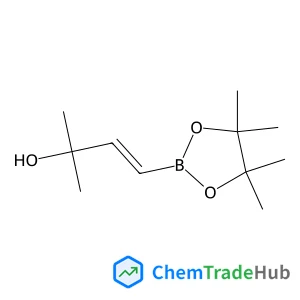
(E)-2-methyl-4-(4,4,5,5-tetramethyl-1,3,2-dioxaborolan-2-yl)but-3-en-2-ol
CAS番号:
581802-26-8
分子式:
C11H21BO3
![[4-(Isobutyrylamino)phenyl]boronic acid structure](https://static.chemtradehub.com/structs/874/874219-50-8-6ab5.webp "[4-(Isobutyrylamino)phenyl]boronic acid structure")
おすすめサプライヤー


免責事項
このページに表示される学術雑誌情報は、参考および研究目的のみを目的としています。当社は雑誌出版社とは提携しておらず、投稿の取り扱いも行っておりません。出版に関するお問い合わせは、各雑誌出版社に直接ご連絡ください。
表示されている情報に誤りがある場合は、support@chemtradehub.com までご連絡ください。迅速に確認し、対応いたします。