












Monodispersed ultramicroporous semi-cycloaliphatic polyimides for the highly efficient adsorption of CO2, H2 and organic vapors
文献情報
出版日
2016-11-15
DOI
10.1039/C6PY01734G
インパクトファクター
5.582
著者
Jun Yan, Biao Zhang, Zhonggang Wang
原文を見る
要旨
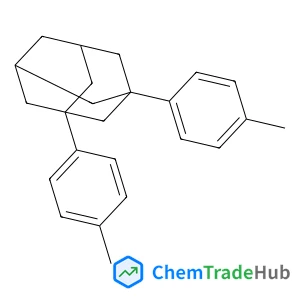
Ultramicroporous semi-cycloaliphatic polyimides (sPIs) have been synthesized via solution polycondensation from bicyclo[2.2.2]oct-7-ene-2,3,5,6-tetracarboxylic dianhydride with 1,3,5,7-tetrakis(4-aminophenyl)adamantane and tetrakis(4-aminophenyl)methane, respectively. The well-controlled kinetic conditions result in a monodispersed pore size of 0.6 nm, located in the ultra-microporous region. Moreover, the introduction of cycloaliphatic moieties decreases the concentration of benzene rings, disrupts the π electron delocalization across the conjugated polyimide backbone and thereby effectively reduces the charge-transfer (CT) interactions between the neighboring polyimide segments. Thus, the improved porous environment gives rise to remarkably large adsorption capacities for both gases and organic vapors. For example, sPIs can uptake 23.75 wt% CO2 (273 K, 1 bar), 2.50 wt% H2 (77 K, 1 bar), 176.0 wt% benzene and 85.1 wt% cyclohexane (298 K, P/P0 = 0.9), which are among the highest values for microporous organic polymers reported to date. In addition, it is interesting to observe that the adsorbed ratio of benzene to cyclohexane in the sPIs was tunable using various concentrations of cycloaliphatic and phenyl groups in the polyimide networks.
関連文献
How flexible is the disulfide linker? A combined rotational–computational investigation of diallyl disulfide
Jean Demaison, Rizalina Tama Saragi, Marcos Juanes, Heinz Dieter Rudolph, Alberto Lesarri
2019-06-03
Communication
DOI: 10.1039/C9CP02508A
Fluorescence upconversion by triplet–triplet annihilation in all-organic poly(methacrylate)-terpolymers
Helmar Görls
2020-01-29
Paper
DOI: 10.1039/D0CP00232A
A coarse-grained model of ionic liquid crystals: the effect of stoichiometry on the stability of the ionic nematic phase
Katsuhiko Satoh
2019-08-29
Paper
DOI: 10.1039/C9CP03296G
Effects of temperature and grain size on deformation of polycrystalline copper–graphene nanolayered composites
Yunlong Ma, Sen Zhang, Yunfei Xu, Xiaoyi Liu
2020-02-10
Paper
DOI: 10.1039/C9CP06830A
Electric-field-tunable molecular adsorption on germanane
J. P. Ye, G. Liu, Y. Han, W. W. Luo, B. Z. Sun, X. L. Lei, B. Xu, C. Y. Ouyang, H. L. Zhang
2019-08-28
Paper
DOI: 10.1039/C9CP04122B
Correction: Hydrophobic silane coating films for the inhibition of water ingress into the nanometer pore of calcium silicate hydrate gels
Jiao Yu, Shaochun Li, Dongshuai Hou, Zuquan Jin, Qing-feng Liu
2019-09-17
Correction
DOI: 10.1039/C9CP90225B
Carrier recombination and transport dynamics in superstrate solar cells analyzed by modeling the intensity modulated photoresponses
Yesica Di Iorio, Mariana Berruet, Marcela Vazquez, Ricardo E. Marotti
2019-08-29
Paper
DOI: 10.1039/C9CP04256C
Strain-tunable CO2 storage by black phosphorene and α-PC from combined first principles and molecular dynamics studies
Xiaohan Song, Yang Liu, Yanmei Yang, Weifeng Li, Mingwen Zhao
2019-08-19
Paper
DOI: 10.1039/C9CP03676H
A DFT+U revisit of reconstructed CeO2(100) surfaces: structures, thermostabilities and reactivities
Chong-Yuan Zhou, Dong Wang, Xue-Qing Gong
2019-08-19
Paper
DOI: 10.1039/C9CP03408K
Design of single-porphyrin donors toward high open-circuit voltage for organic solar cells via an energy level gradient-distribution screening strategy of fragments: a theoretical study
Li-Na Wu, Ming-Yue Sui, Song Xiao, Yu-Zhong Xie
2020-01-22
Paper
DOI: 10.1039/C9CP04903G
こちらもおすすめ
化合物よくある質問
H-Leu-Ser-Lys-Leu-OH trifluoroacetate saltに適用される法規ガイドラインは何ですか?
CAS番号162559-45-7のH-Leu-Ser-Lys-Leu-OH trifluoroacetate saltは、GHS( Chemicals Clas...
162559-45-7H-Leu-Ser-Lys-Leu-OH...
化合物よくある質問
Trimethyltin Chlorideの物理化学的性質は何ですか?
CAS番号1066-45-1のトリメチルチリドは、白色結晶性粉末で、分子量は297.77です。この化合物は水にわずかに溶けますが、酢酸、エタノール、ジエチルエー...
1066-45-1Trimethyltin Chlorid...
化合物よくある質問
ニコール酸化物水和物の主な用途は何ですか?
ニコール酸化物水和物は、主に金属分離、研磨剤、酸化剤、染料製造の原料として利用されます。また、電気化学製品、触媒、分析化学の分野でも広く使用されています。
7789-49-3Nickel(II) Bromide T...
化合物よくある質問
(2,3-二甲基-2H-吲唑-6-基)boronic acidを取り扱う際の実験室安全事項は何ですか?
(2,3-二甲基-2H-吲唑-6-基)boronic acidを取り扱う際は、PPE(防護服、ゴーグル、マスク、手袋)を使用する必要があります。ドラフトチャンバ...
1253912-00-3(2,3-dimethyl-2H-ind...
化合物よくある質問
4-ブロモ-1-メトキシ-2-(2-メトキシエトオキシ)ベンゼンは安全ですか?
4-ブロモ-1-メトキシ-2-(2-メトキシエトオキシ)ベンゼンは一般的に安全とは言えません。取扱いには注意が必要で、直接的な皮膚接触や吸入は避けてください。
1132672-05-94-Bromo-1-methoxy-2-...
化合物よくある質問
4,4-双(5-甲基-2-苯并噁唑基)二苯乙烯はどの業界で使用されていますか?
4,4-双(5-甲基-2-苯并噁唑基)二苯乙烯は医薬業界、ポリマー業界、センサー業界、半導体業界で使用されています。特に、光触媒や蛍光材料として利用されています...
2397-00-42,2'-(1,2-Ethenediyl...
化合物よくある質問
2,3,5,6-四氯-4-ピリジンスチオールを取り扱う際の実験室安全事項は何ですか?
2,3,5,6-四氯-4-ピリジンスチオールは非常に毒性があり、皮膚や粘膜に刺激を与える可能性があります。取り扱う際には、ゴーグル、ゴム手袋、防塵マスクを着用し...
10351-06-12,3,5,6-Tetrachloro-...
515815-47-1Telmisartan sodium
化合物よくある質問
TG 4-155はどのように合成されますか?
TG 4-155は、2-(2-メチル-1H-インドン-1-イル)エチルアミドと3,4,5-トリメトキシフェノールを反応させ、選択性的に合成できます。一般的には、...
1164462-05-8(2E)-N-[2-(2-Methyl-...
化合物よくある質問
エチルヒドロキシキニリン-6-カルボキシ酸は適用される法規ガイドラインは何ですか?
エチルヒドロキシキニリン-6-カルボキシ酸のCAS番号1261631-01-9は、GHS分類の第2クラスの腐食物質(皮膚に強い腐食性)に分類されます。また、EU...
1261631-01-9Ethyl 7-Hydroxyquino...
掲載誌
Polymer Chemistry

CiteScore:
8.6
自己引用率:
7.3%
年間論文数:
457
Polymer Chemistry welcomes submissions in all areas of polymer science that have a strong focus on macromolecular chemistry. Manuscripts may cover a broad range of fields, yet no direct application focus is required.
おすすめ化合物
![4-Chloro-N-{[4-(dimethylamino)phenyl]carbamoyl}benzenesulfonamide structure](https://static.chemtradehub.com/structs/558/5581-42-0-7dcb.webp "4-Chloro-N-{[4-(dimethylamino)phenyl]carbamoyl}benzenesulfonamide structure")
おすすめサプライヤー






免責事項
このページに表示される学術雑誌情報は、参考および研究目的のみを目的としています。当社は雑誌出版社とは提携しておらず、投稿の取り扱いも行っておりません。出版に関するお問い合わせは、各雑誌出版社に直接ご連絡ください。
表示されている情報に誤りがある場合は、support@chemtradehub.com までご連絡ください。迅速に確認し、対応いたします。