












A theoretical study of the potential energy surfaces for the double proton transfer reaction of model DNA base pairs
文献情報
出版日
2017-01-17
DOI
10.1039/C6CP07716A
インパクトファクター
3.676
著者
Chaozheng Li, Yonggang Yang, Donglin Li, Yufang Liu
原文を見る
要旨
The excited-state double proton transfer (ESDPT) mechanism in a model DNA base pair, 7-azaindole (7AI) dimer, has been debated over the years. Recently, Otero and coworkers concluded that the stepwise mechanism is not possible and the concerted mechanism dominates the dynamics (Chem. Sci., 2015, 6, 5762). In this work, the potential energy surfaces of the 7AI dimer in the ground state (S0) and the lowest energy excited singlet state (S1) were constructed. After vertical excitation to the S1 state, the single proton transfer can occur. The second proton transfer process in the stepwise mechanism is blocked by a high potential barrier (36.4 kcal mol−1), which is consistent with the result proposed by Otero and coworkers. However, the single proton transfer process is compatible with the concerted mechanism and we show that the single proton transfer process rather than the concerted mechanism dominates the dynamics. The concerted process is unfavorable in the S1 state compared with the barrierless single proton transfer process. In addition, the proton transfer process in the S0 state is revealed. The single proton transfer tautomer in the S1 state returns to the S0 state and transfers the second proton via a barrierless process. Finally, the double proton transfer tautomer in the S0 state can recover to the normal dimer through the reverse proton transfer reaction.
おすすめジャーナル
関連文献
Effects of incorporating different chalcogenophene comonomers into random acceptor terpolymers on the morphology and performance of all-polymer solar cells
Yujin An, Jiyeon Oh, Shanshan Chen, Byongkyu Lee, Sang Myeon Lee, Daehee Han, Changduk Yang
2018-01-03
Paper
DOI: 10.1039/C7PY01907F
Fe-Porphyrin functionalized microporous organic nanotube networks and their application for the catalytic olefination of aldehydes and carbene insertion into N–H bonds
Minghong Zhou, Hui Zhang, Linfeng Xiong, Zidong He, Tianqi Wang, Yang Xu, Kun Huang
2017-05-31
Paper
DOI: 10.1039/C7PY00530J
Novel conjugated polymers based on bis-dithieno[3,2-b;2′,3′-d]pyrrole vinylene donor and diketopyrrolopyrrole acceptor: side chain engineering in organic field effect transistors
Song-Di Lin, Chih-Hao Chin, Wei-Tsung Chuang, Chain-Shu Hsu
2017-11-17
Paper
DOI: 10.1039/C7PY01340J
Nitroxide-mediated polymerization-induced self-assembly of amphiphilic block copolymers with a pH/temperature dual sensitive stabilizer block
P.-Y. Dugas, B. Charleux, M. Lansalot, E. Bourgeat-Lami
2017-06-14
Paper
DOI: 10.1039/C7PY00595D
Phosphazene/triisobutylaluminum-promoted anionic ring-opening polymerization of 1,2-epoxybutane initiated by secondary carbamates
L. Hassouna, N. Illy, P. Guégan
2017-06-13
Paper
DOI: 10.1039/C7PY00675F
Enzymatic grafting of amylose on chitin nanofibers for hierarchical construction of controlled microstructures
Naomichi Egashira, Kazuya Yamamoto, Jun-ichi Kadokawa
2017-05-05
Paper
DOI: 10.1039/C7PY00521K
Facile construction of crosslinked anion exchange membranes based on fluorenyl-containing polysulfone via click chemistry
Bo Hu, Luyang Miao, Yang Bai, Changli Lü
2017-06-27
Paper
DOI: 10.1039/C7PY00789B
RAFT synthesis and micellization of a photo-, temperature- and pH-responsive diblock copolymer based on spiropyran
Yuan Zhang, Mengjiao Cao, Bing Yuan, Tianying Guo
2017-11-03
Paper
DOI: 10.1039/C7PY01714F
Structure/property relationships in copolymers comprising renewable isosorbide, glucarodilactone, and 2,5-bis(hydroxymethyl)furan subunits
Leon M. Lillie, William B. Tolman, Theresa M. Reineke
2017-06-12
Paper
DOI: 10.1039/C7PY00575J
Polymer side-chain substituents elucidate thermochromism of benzodithiophene–dithiophenylacrylonitrile copolymers – polymer solubility correlation of thermochromism and photovoltaic performance
Chiao-Wen Lin, Chao-Tsen Chen, Jan Golder
2017-05-23
Paper
DOI: 10.1039/C7PY00338B
こちらもおすすめ
化合物よくある質問
2-ブロモ-9,9-ジフェニル-9H-フルオレンの主な用途は何ですか?
2-溴-9,9-二苯基芴は、医薬品、工業材料、有機合成の研究分野で応用されます。特に、レーザー材料や機能性ポリマーの合成に使用されることがあります。また、蛍光色...
474918-32-62-Bromo-9,9-diphenyl...
化合物よくある質問
四氯化铱の市場動向や研究トレンドはどうですか?
四氯化铱の市場は研究開発分野で注目されており、特にナノ技術や金属有機框架(MOFs)の分野での需要が増加傾向にあります。価格は安定しており、中国や韓国での生産が...
207399-11-9Tetrachloroiridium h...
882-06-44-Nitrocinnamic acid
化合物よくある質問
1-(4-溴-3-氟苯基)-2-氯乙酮を含む廃棄物はどのように処理すべきですか?
1-(4-溴-3-氟苯基)-2-氯乙酮 (CAS番号: 1260857-14-4) の廃棄物は専門的な廃棄処理が必要です。まず、廃棄物は密閉された容器に収集し、...
1260857-14-41-(4-Bromo-3-fluorop...
化合物よくある質問
苦参酚Kとは何ですか?
苦参酚Kは、CAS番号101236-49-1を持つ化合物で、主に天然由来の生薬から抽出されます。この化合物は、抗炎症作用や抗癌作用を持つことが報告されています。
101236-49-1Kushenol K
化合物よくある質問
POTASSIUM (1-(TERTBUTOXYCARBONYL)AZETIDIN-3-YL)TRIFLUOROBORATE を含む廃棄物はどのように処理すべきですか?
POTASSIUM (1-(TERTBUTOXYCARBONYL)AZETIDIN-3-YL)TRIFLUOROBORATE を含む廃棄物は、まず安全なエント...
1430219-73-0Potassium (1-(tert-b...
化合物よくある質問
4-庚基-4’-联苯羧酸の市場動向や研究トレンドはどうですか?
4-庚基-4’-聯苯羧酸は、特殊化学品や合成化学の分野で用いられる化学物質ですが、市場動向としては、研究開発の進展とともに需要が増加しています。また、環境配慮型...
58573-94-74'-Heptyl-4-biphenyl...
化合物よくある質問
6-ブロモ-3-メトキシ-1-フェニル-1H-インドゾールを含む廃棄物はどのように処理すべきですか?
6-ブロモ-3-メトキシ-1-フェニル-1H-インドゾールを含む廃棄物は、適切な化学廃棄処理が必要です。通常、廃棄物は密閉容器に収集され、専門の廃棄処理業者に引...
1332527-03-36-Bromo-3-methoxy-1-...
化合物よくある質問
4,4-二甲基-2-吡咯烷酮はどの業界で使用されていますか?
4,4-二甲基-2-吡咯烷酮は医薬、ポリマー、センサー、半導体などの業界で広く使用されています。特に溶媒としての性能が高く評価されています。
66899-02-34,4-dimethylpyrrolid...
51312-42-6Sodium Phosphotungst...
掲載誌
Physical Chemistry Chemical Physics

CiteScore:
5.5
自己引用率:
10.3%
年間論文数:
3036
Physical Chemistry Chemical Physics (PCCP) is an international journal co-owned by 19 physical chemistry and physics societies from around the world. This journal publishes original, cutting-edge research in physical chemistry, chemical physics and biophysical chemistry. To be suitable for publication in PCCP, articles must include significant innovation and/or insight into physical chemistry; this is the most important criterion that reviewers and Editors will judge against when evaluating submissions. The journal has a broad scope and welcomes contributions spanning experiment, theory, computation and data science. Topical coverage includes spectroscopy, dynamics, kinetics, statistical mechanics, thermodynamics, electrochemistry, catalysis, surface science, quantum mechanics, quantum computing and machine learning. Interdisciplinary research areas such as polymers and soft matter, materials, nanoscience, energy, surfaces/interfaces, and biophysical chemistry are welcomed if they demonstrate significant innovation and/or insight into physical chemistry. Joined experimental/theoretical studies are particularly appreciated when complementary and based on up-to-date approaches.
おすすめ化合物
![1,2-Diphenyl-4-[2-(phenylsulfinyl)ethyl]-3,5-pyrazolidinedione structure](https://static.chemtradehub.com/structs/57-/57-96-5-efcc.webp "1,2-Diphenyl-4-[2-(phenylsulfinyl)ethyl]-3,5-pyrazolidinedione structure")
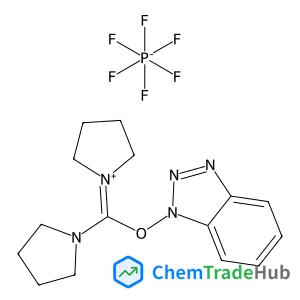
(1H-Benzotriazol-1-yloxy)(di-1-pyrrolidinyl)methylium hexafluorophosphate
CAS番号:
105379-24-6
分子式:
C15H21F6N5OP
おすすめサプライヤー



免責事項
このページに表示される学術雑誌情報は、参考および研究目的のみを目的としています。当社は雑誌出版社とは提携しておらず、投稿の取り扱いも行っておりません。出版に関するお問い合わせは、各雑誌出版社に直接ご連絡ください。
表示されている情報に誤りがある場合は、support@chemtradehub.com までご連絡ください。迅速に確認し、対応いたします。