












Structural and relative energy assessments of DFT functionals and the MP2 method to describe the gas phase methylation of nitronates: [R1R2CNO2]− + CH3I
文献情報
出版日
2016-05-26
DOI
10.1039/C5CP07833D
インパクトファクター
3.676
著者
Ayyaz Mahmood, Ricardo L. Longo
原文を見る
要旨
The performances of 26 combinations of density-functional theory (DFT) functionals or second-order Møller–Plesset (MP2) methods and basis sets were evaluated for the calculation of the activation energy (Δ‡E), the energy available (ΔRCE) to the reactant complex, the energy of reaction (ΔrE), and rotational constants of the main structures involved in the methylation reactions of nitronates, [R1R2CNO2]− + CH3I, in the gas phase, where R1 = R2 = H, R1 = H and R2 = CH3, R1 = R2 = CH3, and R1 + R2 = c-(CH2)2. The separated reactants and products, the reactant and product complexes, and the transition states were considered, leading to 43 data points for the statistical analysis for each method under assessment. Five statistical quantifiers: the mean signed error (MSE), the mean unsigned error (MUE), the percent mean relative error (% MRE), best and worse (BW), and the confidence interval (CI) were used to assess the performance of methods relative to the CCSD(T)/CBS//MP2/aug-cc-pVTZ reference method. The DFT functionals included the widely applied B3LYP and M06-2X global-hybrids and the recently available DSD-PBEP86, DSD-PBEP86-D3BJ and PWPB95 double-hybrids. The basis sets involved an effective core potential (ECP) for describing the inner electrons of iodine such as LANL2DZdp and aug-cc-pVXZ-PP (X = D, T, and Q), and all-electron basis sets for the remaining atoms. The energy available to the reactant complex is described quite well by all methods, however, only the MP2/aug-cc-pVTZ-PP method provided values within 2 kcal mol−1 (8.4 kJ mol−1) from the reference method for Δ‡E and ΔrE. Amongst the DFT methods, the global-hybrid M06-2X functional produced the best overall results including BW and CI. Notice that all methods yielded the smallest Δ‡E for the C-methylation pathway. The rotational constants of the reactant complexes and the transition state structures were compared, for which the MP2 method and the M06-2X functional provided the most accurate results. Thus, unlike previous assessments of DFT functionals for describing SN2 reactions, M06-2X was the most accurate for these methylation reactions of nitronates, followed closely by the DSD-PBEP86 double-hybrid functional. The inclusion of dispersion effects with DSD-PBEP86-D3BJ does not improve the accuracy. Whereas MP2/aug-cc-pVTZ was the most accurate and nearly provided results with chemical accuracy.
関連文献
Sulfonate compounds embraced from acid copper electroplating baths as innovative additives for alkaline Zn batteries
Katerina Bogomolov, Ekaterina Grishina
2023-10-18
Paper
DOI: 10.1039/D3TA04612E
Ligand-modified eggshells for rapid naked-eye detection and removal of trace level Ni2+ ions
P. Rosaiah, S. Vadivel, Kalaivani Dayanidhi, Mohammad Rezaul Karim, Ibrahim A. Alnaser, Sambasivam Sangaraju, M. Dhananjaya, Sang Woo Joo
2024-01-02
Paper
DOI: 10.1039/D3NJ05321K
Radiolytic stability and effects on metal extraction of N,N,N′-trioctyldiglycolamide, an important TODGA degradation product
Iván Sánchez-García, Richard J. M. Egberink, Willem Verboom, Hitos Galán
2024-01-10
Paper
DOI: 10.1039/D3NJ04265K
Structural insights into the diverse prenylating capabilities of DMATS prenyltransferases
Evan T. Miller, Oleg V. Tsodikov, Sylvie Garneau-Tsodikova
2023-11-06
Review Article
DOI: 10.1039/D3NP00036B
Synergy of oxygen vacancies and Bi nanoparticles on BiOBr nanosheets for enhanced photocatalytic H2O2 production
Li Feng, Hanping Fu, Tianxiang Zhang, Qing Zhang, Shufen Ren, Jiayun Cheng, Qingshuang Liang, Xiufeng Xiao
2023-12-25
Paper
DOI: 10.1039/D3NJ03815G
One-pot, efficient synthesis of fused quinoline analogues via room temperature C(sp3)–N cleavage/aromatization reaction
Subramaniyan Prasanna Kumari, Subbiah Thamotharan, Subramaniapillai Selva Ganesan
2024-01-02
Paper
DOI: 10.1039/D3NJ05462D
The role of Caenorhabditis elegans in the discovery of natural products for healthy aging
Benjamin Kirchweger, Julia Zwirchmayr, Ulrike Grienke, Judith M. Rollinger
2023-08-16
Review Article
DOI: 10.1039/D3NP00021D
Enhancing Li+ transport efficiency in solid-state Li-ion batteries with a ceramic-array-based composite electrolyte
Shu-Ming Yeh, Chia-Chen Li
2023-10-16
Paper
DOI: 10.1039/D3TA05329F
Exploring the potential of triple conducting perovskite cathodes for high-performance solid oxide fuel cells: a comprehensive review
Yujie Xu
2023-10-07
Review Article
DOI: 10.1039/D3TA05035A
こちらもおすすめ
化合物よくある質問
2-メトキシ-4-(メチルスルフィニル)アミンの主な用途は何ですか?
2-メトキシ-4-(メチルスルフィニル)アミンは、主に医薬品および農薬の製造に使用されます。また、合成化学の一部として研究用材料としても利用されます。
41608-73-52-Methoxy-4-(methyls...
118684-13-24-(Bromomethyl)-3-me...
化合物よくある質問
4,6-二氯-N-甲基ピラミジンアミンの代替品はありますか?
代替品としては、4,6-二クロロピラミジンアミンや他のピラミジン系化合物が考えられます。ただし、目的と用途によって最適な代替品は異なります。
10397-15-64,6-Dichloro-N-methy...
化合物よくある質問
6-氯-4-甲基-1H-吲哚を含む廃棄物はどのように処理すべきですか?
6-氯-4-甲基-1H-吲哚の廃棄物は、適切な容器に収集し、密閉して保管します。温度は常温、湿度は低く、直射日光を避けて保管することを推奨します。廃棄処理は専門...
885520-84-36-chloro-4-methyl-1H...
化合物よくある質問
2-フローユロ-4-(トリフルオロメチル)ベンゾイドについて「に適用される法規ガイドラインは何ですか」
2-フローユロ-4-(トリフルオロメチル)ベンゾイドのCAS番号は207974-08-1です。この化合物はGHS分類で毒性物質と有害な反応物質として分類されます...
207974-08-1[2-Fluoro-4-(trifluo...
化合物よくある質問
4-ニトロフェニルN-[(ベンゼルオキシルカーボンイル]グリシングリシングリシン酸はどのように保存すればよいですか?
4-ニトロフェニルN-[(ベンゼルオキシルカーボンイル]グリシングリシングリシン酸は、室温で暗所に保管し、乾燥した環境で保存することを推奨します。容器は密閉性の...
19811-64-44-Nitrophenyl N-[(be...
化合物よくある質問
イソデスロラタドリンの代替品はありますか?
イソデスロラタドリンの代替品としては、デスロラタドリンや他の抗ヒスタミン薬が挙げられます。具体的には、デスロラタドリン、ラセカミド、フェルタドリンなどが、症状や...
183198-49-4Iso Desloratadine
化合物よくある質問
5-甲氧基-1,2,3,4-四氢异喹啉盐酸盐はどのように合成されますか?
5-甲氧基-1,2,3,4-四氢异喹啉盐酸盐の一般的な合成方法は、メタノール中で5-メトキシ-1,2,3,4-四ヒュドロイソキシンを塩酸で塩化します。この反応で...
103030-69-95-Methoxy-1,2,3,4-te...
化合物よくある質問
4-アミノ-5-メトキシ-2-トルエンサルホニック酸についての法規ガイドラインは何ですか?
CAS番号6471-78-9の4-アミノ-5-メトキシ-2-トルエンサルホニック酸は、GHS分類では corrosive(腐食性)と識別されます。EUのREAC...
6471-78-94-Amino-5-Methoxy-2-...
化合物よくある質問
甲基孕酮を取り扱う際の実験室安全事項は何ですか?
甲基孕酮の取り扱いは、PPE(個人保護具)の使用が必要な重要な安全事項を伴います。防塵マスク、ゴーグル、手袋を着用することが推奨されます。ドラフトチャンバーを使...
204063-33-22-[(Diphenylmethyl)a...
掲載誌
Physical Chemistry Chemical Physics

CiteScore:
5.5
自己引用率:
10.3%
年間論文数:
3036
Physical Chemistry Chemical Physics (PCCP) is an international journal co-owned by 19 physical chemistry and physics societies from around the world. This journal publishes original, cutting-edge research in physical chemistry, chemical physics and biophysical chemistry. To be suitable for publication in PCCP, articles must include significant innovation and/or insight into physical chemistry; this is the most important criterion that reviewers and Editors will judge against when evaluating submissions. The journal has a broad scope and welcomes contributions spanning experiment, theory, computation and data science. Topical coverage includes spectroscopy, dynamics, kinetics, statistical mechanics, thermodynamics, electrochemistry, catalysis, surface science, quantum mechanics, quantum computing and machine learning. Interdisciplinary research areas such as polymers and soft matter, materials, nanoscience, energy, surfaces/interfaces, and biophysical chemistry are welcomed if they demonstrate significant innovation and/or insight into physical chemistry. Joined experimental/theoretical studies are particularly appreciated when complementary and based on up-to-date approaches.
おすすめ化合物
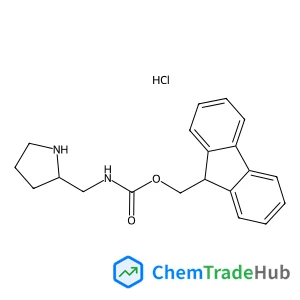
(S)-(9H-Fluoren-9-yl)methyl (pyrrolidin-2-ylmethyl)carbamate hydrochloride
CAS番号:
1217813-15-4
分子式:
C20H23ClN2O2
おすすめサプライヤー




免責事項
このページに表示される学術雑誌情報は、参考および研究目的のみを目的としています。当社は雑誌出版社とは提携しておらず、投稿の取り扱いも行っておりません。出版に関するお問い合わせは、各雑誌出版社に直接ご連絡ください。
表示されている情報に誤りがある場合は、support@chemtradehub.com までご連絡ください。迅速に確認し、対応いたします。