












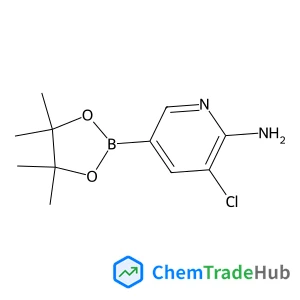
3-Chloro-5-(4,4,5,5-tetramethyl-1,3,2-dioxaborolan-2-yl)-2-pyridinamine
CAS番号:
1032758-99-8
分子式:
C11H16BClN2O2
Chao Feng, Carol Beth Post
The phosphorylation of interdomain A (IA), a linker region between tandem SH2 domains of Syk tyrosine kinase, regulates the binding affinity for association of Syk with doubly-phosphorylated ITAM regions of the B cell receptor. The mechanism of this allosteric regulation has been suggested to be a switch from the high-affinity bifunctional binding, mediated through both SH2 domains binding two phosphotyrosine residues of ITAM, to a substantially lower-affinity binding of only one SH2 domain. IA phosphorylation triggers the switch by inducing disorder in IA and weakening the SH2–SH2 interaction. The postulated switch to a single-SH2-domain binding mode is examined using NMR to monitor site-specific binding to each SH2 domain of Syk variants engineered to have IA regions that differ in conformational flexibility. The combined analysis of titration curves and NMR line-shapes provides sufficient information to determine the energetics of inter-molecular binding at each SH2 site along with an intra-molecular binding or isomerization step. A less favorable isomerization equilibrium associated with the changes in the SH2–SH2 conformational ensemble and IA flexibility accounts for the inhibition of Syk association with membrane ITAM regions when IA is phosphorylated, and refutes the proposed switch to single-SH2-domain binding. Syk localizes in the cell through its SH2 interactions, and this basis for allosteric regulation of ITAM association proposes for the first time a phosphorylation-dependent model to regulate Syk binding to alternate receptors and other signaling proteins that differ either in the number of residues separating ITAM phosphotyrosines or by having only one phosphotyrosine, a half ITAM.
W. Graham Forsythe, Mark D. Garrett, Christopher Hardacre, Mark Nieuwenhuyzen, Gary N. Sheldrake
DOI: 10.1039/C3GC41110A
Jan Dijkmans, Dries Gabriëls, Michiel Dusselier, Filip de Clippel, Pieter Vanelderen, Kristof Houthoofd, Annelies Malfliet, Yiannis Pontikes, Bert F. Sels
DOI: 10.1039/C3GC41239C
Patrícia Neves, Margarida M. Antunes, Patrícia A. Russo, Joana P. Abrantes, Sérgio Lima, Auguste Fernandes, Martyn Pillinger, Sílvia M. Rocha, Maria F. Ribeiro, Anabela A. Valente
DOI: 10.1039/C3GC41908H
Carlotta Raviola, Veronica Canevari, Stefano Protti, Angelo Albini, Maurizio Fagnoni
DOI: 10.1039/C3GC41009A
Changping Li, Dan Li, Shuangshuang Zou, Jingmei Yin, Ailing Wang, Yingna Cui, Zhilong Yao, Qi Zhao
DOI: 10.1039/C3GC41067F
Thanh Binh Nguyen, Ludmila Ermolenko, Ali Al-Mourabit
DOI: 10.1039/C3GC41186A
Rohitkumar G. Gore, Lauren Myles, Marcel Spulak, Ian Beadham, Teresa M. Garcia, Stephen J. Connon, Nicholas Gathergood
DOI: 10.1039/C3GC40992A
Jae Yul Kim, Ji-Wook Jang, Duck Hyun Youn, Eun Sun Kim, Sun Hee Choi, Tae Joo Shin, Jae Sung Lee
DOI: 10.1039/C3GC41343H
Yin Ngai Sum, Dingyi Yu, Yugen Zhang
DOI: 10.1039/C3GC41269E
Rémi Auvergne, Sylvain Caillol
DOI: 10.1039/C3GC41004H
2-ヒドロキシ-5-ニトロベンジンブロモイドは特定の化学反応に適しているため、代替品は限られています。しかし、同様の構造を持つ2-ヒドロキシ-4-ニトロベンジン...
N-(2-ブロモフェニル)-1-チロール-3-オキソ-3-(ピペリジニル)プロペン-2-イル)ベンゼンアミドは有毒で、皮膚や粘膜に刺激を与える可能性があります。...
この化合物は、新規治療薬の開発に注目されています。市場では、その有効性と安全性が評価され、研究分野では、分子生物学と医薬化学の新たな発見が期待されています。
Succinimidyl-alanyl-phenylalanyl-prolyl-phenylalanine 4-nitroanilide は主に医薬品開発やポ...
メチル6-アミノ-5-クロロピリジン-2-カーボイル酸(CAS番号: 1256794-05-4)の使用には、GHS( Globally Harmonized S...
取り扱いには、耐薬品性の容器を使用し、通気性の良い場所で操作することを推奨します。漏れ時は、SDS(安全データシート)を参照して適切な措置を取ること。手洗いと洗...
(S)-3-ベンZYルピペリジン塩酸塩は、CAS番号1258940-00-9で表される化合物です。これは、(S)-3-苯基哌啶的盐酸盐であり、主に医薬品の原料と...
3,5-二甲基金剛胺は、主に医薬品の原料として使用され、また抗うつ薬や抗アルツハイマー薬の開発に利用されます。さらに、化粧品や食品添加物の製造でも重要な役割を果...
ビス(4-メチル-2-ペンチル)フェニルカルボン酸エステル (CAS番号: 1398066-13-1) の代替品には、ビス(2-エチルヘキシル)フェノールカルボ...

Physical Chemistry Chemical Physics (PCCP) is an international journal co-owned by 19 physical chemistry and physics societies from around the world. This journal publishes original, cutting-edge research in physical chemistry, chemical physics and biophysical chemistry. To be suitable for publication in PCCP, articles must include significant innovation and/or insight into physical chemistry; this is the most important criterion that reviewers and Editors will judge against when evaluating submissions. The journal has a broad scope and welcomes contributions spanning experiment, theory, computation and data science. Topical coverage includes spectroscopy, dynamics, kinetics, statistical mechanics, thermodynamics, electrochemistry, catalysis, surface science, quantum mechanics, quantum computing and machine learning. Interdisciplinary research areas such as polymers and soft matter, materials, nanoscience, energy, surfaces/interfaces, and biophysical chemistry are welcomed if they demonstrate significant innovation and/or insight into physical chemistry. Joined experimental/theoretical studies are particularly appreciated when complementary and based on up-to-date approaches.
![2,6-Di(thiophen-2-yl)dithieno[3,2-b:2',3'-d]thiophene structure](https://static.chemtradehub.com/structs/910/910788-24-8-5b70.webp "2,6-Di(thiophen-2-yl)dithieno[3,2-b:2',3'-d]thiophene structure")



