












Enhanced fluorescent resonant energy transfer of DNA conjugates complexed with surfactants and divalent metal ions
文献情報
出版日
2016-03-08
DOI
10.1039/C5AN02516H
インパクトファクター
4.616
著者
Taeseok Oh, Jae-Young Choi
原文を見る
要旨
Dimerization and resultant quenching of donor and acceptor dyes conjugated on DNA causes loss of fluorescent resonant energy transfer (FRET) efficiency. However, when complexed with surfactants and divalent metal ions, sheathing effects insulate and shield the DNA structures, reducing dimerization and quenching which leads to significant enhancement of FRET efficiency.
関連文献
Evidence of the O–Pd–O and Pd–O4 structure units as oxide seeds and their origin on Pd(211): revealing the mechanism of surface oxide formation
Xiran Cheng, Ziyun Wang, Yu Mao, P. Hu
2019-02-19
Paper
DOI: 10.1039/C8CP06224B
Theoretical study of the adsorption of hydrogen on cobalt clusters
Kevin García-Díez, Julio Fernández-Fernández, María J. López
2018-07-20
Paper
DOI: 10.1039/C8CP03048K
Fundamental limitations of the time-dependent Stokes shift for investigating protein hydration dynamics
Esther Heid
2019-02-01
Paper
DOI: 10.1039/C8CP07623E
Size and shape dependency of the surface energy of metallic nanoparticles: unifying the atomic and thermodynamic approaches
Bastiaan Molleman, Tjisse Hiemstra
2018-07-13
Paper
DOI: 10.1039/C8CP02346H
Experimental and theoretical investigation of long-wavelength fluorescence emission in push–pull benzazoles: intramolecular proton transfer or charge transfer in the excited state?
Guilherme Wiethaus, Josene Maria Toldo, Fabiano da Silveira Santos, Rodrigo da Costa Duarte, Paulo Fernando Bruno Gonçalves, Fabiano Severo Rodembusch
2019-01-28
Paper
DOI: 10.1039/C8CP05186K
Understanding dissolution process of chitin crystal in ionic liquids: theoretical study
Takuya Uto, Satoshi Idenoue, Kazuya Yamamoto, Jun-ichi Kadokawa
2018-07-30
Paper
DOI: 10.1039/C8CP02749H
Quantitative analysis of 14N quadrupolar coupling using 1H detected 14N solid-state NMR
James A. Jarvis, Maria Concistre, Richard W. Bounds, Ilya Kuprov, Marina Carravetta, Philip T. F. Williamson
2019-02-27
Paper
DOI: 10.1039/C8CP06276E
Intermolecular energy flows between surface molecules on metal nanoparticles
Jiebo Li, Yufan Zhang, Junrong Zheng
2019-02-05
Paper
DOI: 10.1039/C8CP05932B
Enhancing the electrocatalytic activity of 2H-WS2 for hydrogen evolution via defect engineering
Longfei Wu, Arno J. F. van Hoof, Nelson Y. Dzade, Lu Gao, Heiner Friedrich, Nora H. De Leeuw, Emiel J. M. Hensen, Jan P. Hofmann
2019-02-21
Paper
DOI: 10.1039/C9CP00722A
こちらもおすすめ
化合物よくある質問
2-ブロモ-9,9-ジフェニル-9H-フルオレンの主な用途は何ですか?
2-溴-9,9-二苯基芴は、医薬品、工業材料、有機合成の研究分野で応用されます。特に、レーザー材料や機能性ポリマーの合成に使用されることがあります。また、蛍光色...
474918-32-62-Bromo-9,9-diphenyl...
化合物よくある質問
四氯化铱の市場動向や研究トレンドはどうですか?
四氯化铱の市場は研究開発分野で注目されており、特にナノ技術や金属有機框架(MOFs)の分野での需要が増加傾向にあります。価格は安定しており、中国や韓国での生産が...
207399-11-9Tetrachloroiridium h...
882-06-44-Nitrocinnamic acid
化合物よくある質問
1-(4-溴-3-氟苯基)-2-氯乙酮を含む廃棄物はどのように処理すべきですか?
1-(4-溴-3-氟苯基)-2-氯乙酮 (CAS番号: 1260857-14-4) の廃棄物は専門的な廃棄処理が必要です。まず、廃棄物は密閉された容器に収集し、...
1260857-14-41-(4-Bromo-3-fluorop...
化合物よくある質問
苦参酚Kとは何ですか?
苦参酚Kは、CAS番号101236-49-1を持つ化合物で、主に天然由来の生薬から抽出されます。この化合物は、抗炎症作用や抗癌作用を持つことが報告されています。
101236-49-1Kushenol K
化合物よくある質問
POTASSIUM (1-(TERTBUTOXYCARBONYL)AZETIDIN-3-YL)TRIFLUOROBORATE を含む廃棄物はどのように処理すべきですか?
POTASSIUM (1-(TERTBUTOXYCARBONYL)AZETIDIN-3-YL)TRIFLUOROBORATE を含む廃棄物は、まず安全なエント...
1430219-73-0Potassium (1-(tert-b...
化合物よくある質問
4-庚基-4’-联苯羧酸の市場動向や研究トレンドはどうですか?
4-庚基-4’-聯苯羧酸は、特殊化学品や合成化学の分野で用いられる化学物質ですが、市場動向としては、研究開発の進展とともに需要が増加しています。また、環境配慮型...
58573-94-74'-Heptyl-4-biphenyl...
化合物よくある質問
6-ブロモ-3-メトキシ-1-フェニル-1H-インドゾールを含む廃棄物はどのように処理すべきですか?
6-ブロモ-3-メトキシ-1-フェニル-1H-インドゾールを含む廃棄物は、適切な化学廃棄処理が必要です。通常、廃棄物は密閉容器に収集され、専門の廃棄処理業者に引...
1332527-03-36-Bromo-3-methoxy-1-...
化合物よくある質問
4,4-二甲基-2-吡咯烷酮はどの業界で使用されていますか?
4,4-二甲基-2-吡咯烷酮は医薬、ポリマー、センサー、半導体などの業界で広く使用されています。特に溶媒としての性能が高く評価されています。
66899-02-34,4-dimethylpyrrolid...
51312-42-6Sodium Phosphotungst...
掲載誌
Analyst

CiteScore:
7.8
自己引用率:
5.6%
年間論文数:
653
Analyst publishes analytical and bioanalytical research that reports premier fundamental discoveries and inventions, and the applications of those discoveries, unconfined by traditional discipline barriers.
おすすめ化合物
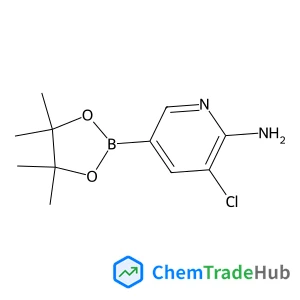
3-Chloro-5-(4,4,5,5-tetramethyl-1,3,2-dioxaborolan-2-yl)-2-pyridinamine
CAS番号:
1032758-99-8
分子式:
C11H16BClN2O2
おすすめサプライヤー






免責事項
このページに表示される学術雑誌情報は、参考および研究目的のみを目的としています。当社は雑誌出版社とは提携しておらず、投稿の取り扱いも行っておりません。出版に関するお問い合わせは、各雑誌出版社に直接ご連絡ください。
表示されている情報に誤りがある場合は、support@chemtradehub.com までご連絡ください。迅速に確認し、対応いたします。