













Binary cooperative NiCo2O4 on the nickel foams with quasi-two-dimensional precursors: a bridge between ‘supercapacitor’ and ‘battery’ in electrochemical energy storage
文献情報
出版日
2015-01-27
DOI
10.1039/C4CP05228E
インパクトファクター
3.676
著者
Tao Peng, Zhongyu Qian, Jun Wang, Liangti Qu, Peng Wang
原文を見る
要旨
Some inorganic quasi-two-dimensional nanomaterials such as cobalt–nickel hydroxides are kinetically facile for a capacitive charge storage process. However, high performance capacitive charge storage needs a balance of the ionic and electronic transporting, and to build up an integrated architecture on substrates step by step and utilize the interface better is still a key challenge. As the interfacial assembly has conflicted with our goals for high-performance capacitive charge storage process, we identify theoretically and experimentally binary cooperative nanoscale interfacial materials to solve the problem. Co–Ni-hydroxide precursors were prepared by hybrid quasi-two-dimensional nanosheets and hetero-oriented nanocrystallines walls. Followed by dip-dry and annealing, NiCo2O4 could adhere to the nickel foams robustly with a solution-based surface treatment. Moreover, an unusual phenomenon in the electrochemical test inspired us to establish a bridge between ‘supercapacitor’ and ‘battery’. The bridged gap highlights a new design idea for high-performance energy storage.
関連文献
Palladium-catalyzed carbonylation of benzylic ammonium salts to amides and esters via C–N bond activation
Weijie Yu, Shuwu Yang, Fei Xiong, Tianxiang Fan, Yan Feng, Yuanyuan Huang, Junkai Fu, Tao Wang
2018-04-04
Communication
DOI: 10.1039/C8OB00488A
Glycosyl nitrates in synthesis: streamlined access to glucopyranose building blocks differentiated at C-2
Tinghua Wang, Swati S. Nigudkar, Jagodige P. Yasomanee, Nigam P. Rath, Keith J. Stine, Alexei V. Demchenko
2018-04-13
Paper
DOI: 10.1039/C8OB00477C
Diselenoamino acid derivatives as GPx mimics and as substrates of TrxR: in vitro and in silico studies
Pablo Andrei Nogara, Rogério Aquino Saraiva, Caroline Wagner, Eduardo Eliezer Alberto, Antonio Luiz Braga, Roselei Fachinetto, Paulo Cesar Piquini, João Batista Teixeira Rocha
2018-04-23
Paper
DOI: 10.1039/C8OB00451J
A practical route to 2-iodoanilines via the transition-metal-free and base-free decarboxylative iodination of anthranilic acids under oxygen
2021-06-07
Research Article
DOI: 10.1039/D1QO00461A
Darzens reaction of thioisatins and sulfonium salts: approach to the synthesis of thiochromenone derivatives with anticancer potency
Jinhui Shen, Yang Yang, Xiaoli Hou, Wenlei Zeng, Aimin Yu, Xiaowei Zhao, Xiangtai Meng
2018-04-16
Paper
DOI: 10.1039/C8OB00402A
Consecutive Lossen rearrangement/transamidation reaction of hydroxamic acids under catalyst- and additive-free conditions
Mengmeng Jia, Heng Zhang, Yongjia Lin, Dimei Chen, Yanmei Chen
2018-04-20
Paper
DOI: 10.1039/C8OB00490K
Construction of the tetracyclic core of (±)-cycloclavine and 4-amino Uhle's ketone
Jin-Quan Chen, Yang Mi, Zi-Fa Shi, Xiao-Ping Cao
2018-05-09
Paper
DOI: 10.1039/C7OB03067C
Design and synthesis of novel monoterpenoid indole alkaloid-like analogues and their antitumour activities in vitro
Mengyuan Xia, Yuehu Wang, Shuzhen Mu
2018-03-29
Paper
DOI: 10.1039/C8OB00677F
A new strategy for the synthesis of diverse benzo[a]carbazoles via a divergent catalytic Michael reaction
Arya Kripalaya Ratheesh, Hazel A. Sparkes, Karnam Jayarampillai Rajendra Prasad
2018-03-20
Paper
DOI: 10.1039/C8OB00154E
こちらもおすすめ
化合物よくある質問
2-メトキシ-4-(メチルスルフィニル)アミンの主な用途は何ですか?
2-メトキシ-4-(メチルスルフィニル)アミンは、主に医薬品および農薬の製造に使用されます。また、合成化学の一部として研究用材料としても利用されます。
41608-73-52-Methoxy-4-(methyls...
118684-13-24-(Bromomethyl)-3-me...
化合物よくある質問
4,6-二氯-N-甲基ピラミジンアミンの代替品はありますか?
代替品としては、4,6-二クロロピラミジンアミンや他のピラミジン系化合物が考えられます。ただし、目的と用途によって最適な代替品は異なります。
10397-15-64,6-Dichloro-N-methy...
化合物よくある質問
6-氯-4-甲基-1H-吲哚を含む廃棄物はどのように処理すべきですか?
6-氯-4-甲基-1H-吲哚の廃棄物は、適切な容器に収集し、密閉して保管します。温度は常温、湿度は低く、直射日光を避けて保管することを推奨します。廃棄処理は専門...
885520-84-36-chloro-4-methyl-1H...
化合物よくある質問
2-フローユロ-4-(トリフルオロメチル)ベンゾイドについて「に適用される法規ガイドラインは何ですか」
2-フローユロ-4-(トリフルオロメチル)ベンゾイドのCAS番号は207974-08-1です。この化合物はGHS分類で毒性物質と有害な反応物質として分類されます...
207974-08-1[2-Fluoro-4-(trifluo...
化合物よくある質問
4-ニトロフェニルN-[(ベンゼルオキシルカーボンイル]グリシングリシングリシン酸はどのように保存すればよいですか?
4-ニトロフェニルN-[(ベンゼルオキシルカーボンイル]グリシングリシングリシン酸は、室温で暗所に保管し、乾燥した環境で保存することを推奨します。容器は密閉性の...
19811-64-44-Nitrophenyl N-[(be...
化合物よくある質問
イソデスロラタドリンの代替品はありますか?
イソデスロラタドリンの代替品としては、デスロラタドリンや他の抗ヒスタミン薬が挙げられます。具体的には、デスロラタドリン、ラセカミド、フェルタドリンなどが、症状や...
183198-49-4Iso Desloratadine
化合物よくある質問
5-甲氧基-1,2,3,4-四氢异喹啉盐酸盐はどのように合成されますか?
5-甲氧基-1,2,3,4-四氢异喹啉盐酸盐の一般的な合成方法は、メタノール中で5-メトキシ-1,2,3,4-四ヒュドロイソキシンを塩酸で塩化します。この反応で...
103030-69-95-Methoxy-1,2,3,4-te...
化合物よくある質問
4-アミノ-5-メトキシ-2-トルエンサルホニック酸についての法規ガイドラインは何ですか?
CAS番号6471-78-9の4-アミノ-5-メトキシ-2-トルエンサルホニック酸は、GHS分類では corrosive(腐食性)と識別されます。EUのREAC...
6471-78-94-Amino-5-Methoxy-2-...
化合物よくある質問
甲基孕酮を取り扱う際の実験室安全事項は何ですか?
甲基孕酮の取り扱いは、PPE(個人保護具)の使用が必要な重要な安全事項を伴います。防塵マスク、ゴーグル、手袋を着用することが推奨されます。ドラフトチャンバーを使...
204063-33-22-[(Diphenylmethyl)a...
掲載誌
Physical Chemistry Chemical Physics

CiteScore:
5.5
自己引用率:
10.3%
年間論文数:
3036
Physical Chemistry Chemical Physics (PCCP) is an international journal co-owned by 19 physical chemistry and physics societies from around the world. This journal publishes original, cutting-edge research in physical chemistry, chemical physics and biophysical chemistry. To be suitable for publication in PCCP, articles must include significant innovation and/or insight into physical chemistry; this is the most important criterion that reviewers and Editors will judge against when evaluating submissions. The journal has a broad scope and welcomes contributions spanning experiment, theory, computation and data science. Topical coverage includes spectroscopy, dynamics, kinetics, statistical mechanics, thermodynamics, electrochemistry, catalysis, surface science, quantum mechanics, quantum computing and machine learning. Interdisciplinary research areas such as polymers and soft matter, materials, nanoscience, energy, surfaces/interfaces, and biophysical chemistry are welcomed if they demonstrate significant innovation and/or insight into physical chemistry. Joined experimental/theoretical studies are particularly appreciated when complementary and based on up-to-date approaches.
おすすめ化合物

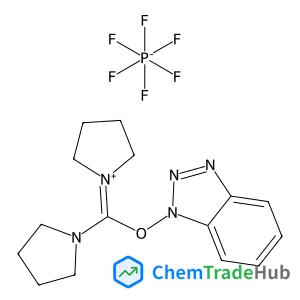
(1H-Benzotriazol-1-yloxy)(di-1-pyrrolidinyl)methylium hexafluorophosphate
CAS番号:
105379-24-6
分子式:
C15H21F6N5OP
おすすめサプライヤー





免責事項
このページに表示される学術雑誌情報は、参考および研究目的のみを目的としています。当社は雑誌出版社とは提携しておらず、投稿の取り扱いも行っておりません。出版に関するお問い合わせは、各雑誌出版社に直接ご連絡ください。
表示されている情報に誤りがある場合は、support@chemtradehub.com までご連絡ください。迅速に確認し、対応いたします。