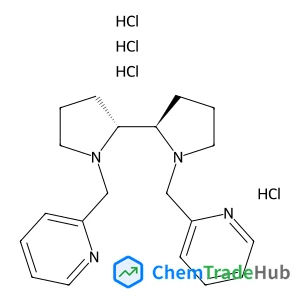
(2R,2'R)-1,1'-Bis(2-pyridinylmethyl)-2,2'-bipyrrolidine tetrahydrochloride
CAS番号:
1228077-88-0
分子式:
C20H30Cl4N4
Sheng Cai, Zhijuan Cao, Choiwan Lau, Jianzhong Lu
By using the allosteric hairpin DNA switch, a novel assay for the detection of microRNA (miRNA) let-7a via a hybridization chain reaction (HCR) was introduced. Briefly, the hairpin DNA switch probe is a single-stranded DNA consisting of a streptavidin (SA) aptamer sequence, a target binding sequence and a certain sequence that acts as a trigger of the HCR. In the presence of target let-7a, the hairpin DNA switch would open and expose the stem region sequences, where a part of this sequence acts as initiator sequence strands for the HCR and triggers a cascade of hybridization events that yields nicked double helices analogous to alternating copolymers, another part is the SA aptamer sequence which activates its binding affinity to SA on SA-coated magnetic particles. The hybridization event could be sensitively detected via an instantaneous derivatization reaction between a special chemiluminescence (CL) reagent, 3,4,5-trimethoxylphenylglyoxal (TMPG) and the guanine nucleotides within the target, the hairpin DNA switch probe, and HCR helices to form an unstable CL intermediate for the generation of light. Our results show that the coupling of the hairpin DNA switch probe and the HCR for the amplified detection of let-7a achieves a better performance (e.g. wide linear response range: 0.1–1000 fmol, low detection limit: 0.1 fmol, and high specificity). Furthermore, this approach could be easily applied to the detection of let-7a in human lung cells, and extended to detect other types of miRNA and proteins such as PDGF based on aptamers. We believe such advancements will represent a significant step towards improved diagnostics and more personalized medical treatment.

Medicinal Chemistry Research

Journal of the Indian Institute of Science

Critical Reviews in Solid State and Materials Sciences

Journal of Asian Natural Products Research

Colloid Journal

Cellulose

Polycyclic Aromatic Compounds

Bioorganic & Medicinal Chemistry

Electroanalysis

Acta Metallurgica Sinica-English Letters
Rodolfo Gómez-Balderas, Jesús Hernández-Trujillo
DOI: 10.1039/B922203K
Osama K. Abou-Zied, Othman I. K. Al-Shihi
DOI: 10.1039/B823405A
A. Borgschulte, R. Gremaud, Z. Łodziana, A. Züttel
DOI: 10.1039/C000229A
Yong-Hui Tian, Jingsong Huang, Miklos Kertesz
DOI: 10.1039/B925259B
Simon Coleman, Robert Byrne, Stela Minkovska
DOI: 10.1039/B901417A
Melepurath Deepa, Arvind Awadhia, Shweta Bhandari
DOI: 10.1039/B900091G
Stijn F. L. Mertens, Thomas Wandlowski
DOI: 10.1039/B921368F
R. Devanathan, S. Thevuthasan, J. D. Gale
DOI: 10.1039/B902764E
Betsy M. Rice, Krzysztof Szalewicz
DOI: 10.1039/B902015B
Pitamber Mahanandia, Jörg J. Schneider, Marina Khaneft, Bernd Stühn, Tiago P. Peixoto, Barbara Drossel
DOI: 10.1039/B922906J
カルボニル基が付いた5-氰基-1-{[(2-メチル-2-プロpanyl)オキシ]カーボンイル}1H-吲哚-2-イリド-2-ボリン酸は、直射日光を避けて室温(15...
この化合物は合成化学分野において、特にピリジン化合物の合成や改良に用いられます。最近の研究では、ピリジン化合物の新規合成法や特性の改良が注目されています。市場動...
聚二季戊四醇六丙烯酸酯は、医薬品、ポリマー、センサー、半導体などの業界で広く使用されています。特にポリマー業界では硬化剤として、医薬分野では医療機器の製造に使用...
1-氯-5-硝基异喹啉は、薬理学や合成化学の研究分野で注目されています。市場動向としては、その生物学的な活性や合成可能性を評価する研究が増えています。また、代替...
2-チロール-5-メチルスルフェニル-3-trifルオルメチルベンゼンは、トリフルオロメチル化反応と硫化反応を経て合成されます。通常、トリフルオロメチル化剤と硫...
p-トールイルマグネシウムブロミドのCAS番号は4294-57-9です。この化合物は白色の結晶性粉末で、分子量は204.32です。溶剤中で良好に溶解しますが、水...
1-(5-甲基-2-硫化素基)プロパン-1-酮の市場動向は、化学産業全体の需要に影響を受けますが、最近では pharmaceutical 分野での応用が注目され...
十一碳烯酰甘氨酸は吸入や皮膚から吸収されることがあり、取り扱う際には防塵マスクと手袋を使用してください。ドラフトチャンバーを用いて漏洩を処理し、適切なSDS(S...
この化合物は吸入や皮膚吸収による毒性があるため、防塵マスク、ゴーグル、防護手袋を使用する必要があります。ドラフトチャンバーでの操作が必要です。漏洩時には即座に換...
安全性は化合物の使用方法によります。直接的な毒性は報告されていませんが、吸入や皮膚接触には注意が必要です。適切な防護服を着用し、換気を図ることを推奨します。

Analyst publishes analytical and bioanalytical research that reports premier fundamental discoveries and inventions, and the applications of those discoveries, unconfined by traditional discipline barriers.
amine structure](https://static.chemtradehub.com/structs/629/62924-61-2-0728.webp "[(2-chlorophenyl)methyl](ethyl)amine structure")
![5,7-Dihydroxy-3-(4-hydroxyphenyl)-6-[(1R,6R)-3-methyl-6-prop-1-en-2-ylcyclohex-2-en-1-yl]chromen-4-one structure](https://static.chemtradehub.com/structs/191/1914963-20-4-2b05.webp "5,7-Dihydroxy-3-(4-hydroxyphenyl)-6-[(1R,6R)-3-methyl-6-prop-1-en-2-ylcyclohex-2-en-1-yl]chromen-4-one structure")