












Impact of molecular solvophobicity vs. solvophilicity on device performances of dimeric perylene diimide based solution-processed non-fullerene organic solar cells
文献情報
出版日
2013-06-06
DOI
10.1039/C3CP51475G
インパクトファクター
3.676
著者
Zhenhuan Lu, Xin Zhang, Chuanlang Zhan, Bo Jiang, Xinliang Zhang, Lili Chen, Jiannian Yao
原文を見る
要旨
Because of their outstanding molecular optoelectronic properties, perylene diimides (PDIs) are promising alternatives to the commonly used PCBM. However, the overly strong aggregation ability, poor solution-processability and compatibility of PDIs severely limit their photovoltaic applications. We turned to borrowing the amphiphile concept to improve these supramolecular properties. Practically, we fine-tuned the molecular solvophobicity with respect to the molecular solvophilicity, e.g. Fsolvophob/solvophil, by changing the number of the weakly solvophobic 2-methoxyethoxyl (EG) groups in the bay-region of the thienyl-bridged dimeric PDI backbone, forming three PDI dimers of Bis-PDI-T (0 EG), Bis-PDI-T-EG (2 EG) and Bis-PDI-T-di-EG (4 EG) (Scheme 1). The photovoltaic properties using these dimers as the solution-processed non-fullerene electron-acceptor and P3HT as the electron-donor were investigated via the device configuration of ITO/PEDOT:PSS/P3HT:PDI dimer/Ca/Al. Bis-PDI-T exhibited overly strong aggregation ability and very poor solution-processability, which severely limited compatibility, giving a very poor power conversion efficiency (PCE) of 0.007%. When two EG groups were attached at the 1,1′-positions, the resulted Bis-PDI-T-EG showed dramatically reduced aggregation ability, improved solution-processability, compatibility and proper phase separation. Small sized phases (∼20 nm) dominated in the active layer and the best PCE was increased to 0.39%. When four solvophobic EG functions were introduced, affording Bis-PDI-T-di-EG with excellent supramolecular properties, particularly, the improvement of the phase separation with an increased phase size of 24 nm and the enhanced electron and hole mobilities, by 2–4 times, with respect to that of Bis-PDI-T-EG. The best PCE was further enhanced to 0.88%. After using 1-chloronaphthalene as the co-solvent of 1,2-dichlorobenzene to further improve the compatibility, the PCE was improved further up to 0.41% for Bis-PDI-T, 0.76% for Bis-PDI-T-EG and 1.54% for Bis-PDI-T-di-EG.
関連文献
Development of a novel test for the identification of hereditary erythrocyte membrane defects by TGA/Chemometrics
Stefano Materazzi, Patrizia Caprari, Giuseppina Gullifa, Sara Massimi, Elena Carcassi, Roberta Risoluti
2020-05-27
Paper
DOI: 10.1039/D0AN00649A
A fast and validated capillary zone electrophoresis method for the determination of selected fatty acids applied to food and cosmetic purposes
Tatiane Lima Amorim, Mariana Gavioli dos Reis Pena, Fabiano Freire Costa, Marcone Augusto Leal de Oliveira, Paula Rocha Chellini
2019-10-08
Paper
DOI: 10.1039/C9AY01917K
Aspects and applications of non-aqueous high temperature packed capillary liquid chromatography
Paper
DOI: 10.1039/A903908B
Determination of membrane capacitance and cytoplasm conductivity by simultaneous electrorotation
Masato Suzuki, Satoshi Arimoto, Tsuguhiro Korenaga, Tomoyuki Yasukawa
2020-05-28
Paper
DOI: 10.1039/D0AN00100G
All-solid-state reference electrodes based on conducting polymers
Anna Kisiel, Honorata Marcisz, Agata Michalska, Krzysztof Maksymiuk
2005-10-27
Paper
DOI: 10.1039/B510868C
Development of a novel UHPLC-UV combined with UHPLC-QTOF/MS fingerprint method for the comprehensive evaluation of Nao-Luo-Xin-Tong: multi-wavelength setting based on traditional Chinese medicinal prescription composition
Lina Wang, Yanling Wang, Guangyun Tong, Yu Li, Mengnan Lei, Huan Wu
2019-11-05
Paper
DOI: 10.1039/C9AY01975H
こちらもおすすめ
化合物よくある質問
6- bromo-1-cyclopropyl-1H-benzimidazoleの市場動向や研究トレンドはどうですか?
6- bromo-1-cyclopropyl-1H-benzimidazoleは、抗炎症、抗ウイルス作用を持つことが報告されており、新薬開発の研究対象として注目...
1416713-53-56-Bromo-1-cyclopropy...
化合物よくある質問
環氧プロpanol-d5を取り扱う際の実験室安全事項は何ですか?
取り扱う際には、防護眼鏡と手袋を使用し、ドラフトチャンバー内で操作することを推奨します。漏洩時には適切な手順で処理し、安全データシートを常に参照してください。
1246819-20-4Glycidol-d5
化合物よくある質問
2,2’-ジメチル-3,3’-ビピリジンはどのように合成されますか?
2,2’-ジメチル-3,3’-ビピリジンは、ピリジンと2-メチルアクリルアミドを有機合成反応で合成します。この反応では、ピリジンと2-メチルアクリルアミドを含有...
86156-55-02,2’-Dimethyl-3,3’-b...
化合物よくある質問
6-甲基ピリジン-2-ボリック酸の主な用途は何ですか?
6-甲基ピリジン-2-ボリック酸は、合成化学、医薬品合成、以及研究用途などに広く使用され、特に組換えDNA技術や分子生物学の研究において重要な役割を果たします。
372963-50-3(6-Methyl-2-pyridiny...
化合物よくある質問
(R)-3-(1-甲基-2-氧環己基)プロpano酸メチルは安全ですか?
(R)-3-(1-甲基-2-氧環己基)プロpano酸メチルは一定の安全性がありますが、直接的な皮膚接触や吸入は避けるべきです。使用する際は適切な個々の安全データ...
94089-47-1methyl 3-[(1R)-1-met...
化合物よくある質問
ketorolacはどのように保存すればよいですか?
ketorolacは、密封して遮光容器に保管し、直射日光や高温を避けて保存してください。温度は常温で保存し、湿度をなるべく低く保つことが推奨されます。
74103-06-3rac Ketorolac
化合物よくある質問
L-2,3-二氨基丙酸二盐酸盐を取り扱う際の実験室安全事項は何ですか?
L-2,3-二氨基丙酸二盐酸盐は腐食性が強く、皮膚や粘膜に刺激を与える可能性があります。取り扱う際は、防塵マスク、ゴーグル、手袋を使用し、適切な排気設備を使用し...
19777-68-5(S)-2,3-Diaminopropa...
化合物よくある質問
2-(4-溴ピリジン-2-基)乙腈の物理化学的性質は何ですか?
2-(4-溴ピリジン-2-基)乙腈のCAS番号は312325-73-8です。主に結晶形態で存在し、分子量は159.01 g/molです。この化合物は水に溶けやす...
312325-73-8(4-Bromo-2-pyridinyl...
化合物よくある質問
3-フローロ-[1,1-ベンジレン]-3,4-ジカルボン酸を取り扱う際の実験室安全事項は何ですか?
この化合物は毒性は低いですが、直接的な接触や吸入に注意が必要です。PPE(個人防護具)を着用し、ドラフトチャンバーを使用して操作することを推奨します。また、漏洩...
1261915-32-53'-Fluoro-[1,1'-biph...
化合物よくある質問
3-(1-氧代-1,3-二氢-2H-2-异吲哚)丙酸の主な用途は何ですか?
3-(1-氧代-1,3-二氢-2H-2-异吲哚)丙酸は、薬理学研究や医薬品製造において広く用いられる化合物です。また、工業的な用途でも一部の化学反応の触媒や助剤...
83747-30-23-(1-Oxo-1,3-dihydro...
掲載誌
Physical Chemistry Chemical Physics

CiteScore:
5.5
自己引用率:
10.3%
年間論文数:
3036
Physical Chemistry Chemical Physics (PCCP) is an international journal co-owned by 19 physical chemistry and physics societies from around the world. This journal publishes original, cutting-edge research in physical chemistry, chemical physics and biophysical chemistry. To be suitable for publication in PCCP, articles must include significant innovation and/or insight into physical chemistry; this is the most important criterion that reviewers and Editors will judge against when evaluating submissions. The journal has a broad scope and welcomes contributions spanning experiment, theory, computation and data science. Topical coverage includes spectroscopy, dynamics, kinetics, statistical mechanics, thermodynamics, electrochemistry, catalysis, surface science, quantum mechanics, quantum computing and machine learning. Interdisciplinary research areas such as polymers and soft matter, materials, nanoscience, energy, surfaces/interfaces, and biophysical chemistry are welcomed if they demonstrate significant innovation and/or insight into physical chemistry. Joined experimental/theoretical studies are particularly appreciated when complementary and based on up-to-date approaches.
おすすめ化合物
![2-{[(1R,2S)-2-Aminocyclohexyl]amino}-4-{[3-(2H-1,2,3-triazol-2-yl)phenyl]amino}-5-pyrimidinecarboxamide structure](https://static.chemtradehub.com/structs/137/1370261-96-3-40df.webp "2-{[(1R,2S)-2-Aminocyclohexyl]amino}-4-{[3-(2H-1,2,3-triazol-2-yl)phenyl]amino}-5-pyrimidinecarboxamide structure")
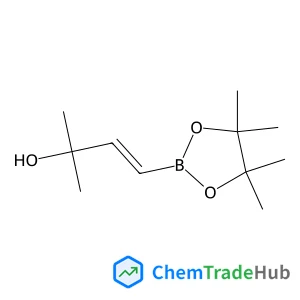
(E)-2-methyl-4-(4,4,5,5-tetramethyl-1,3,2-dioxaborolan-2-yl)but-3-en-2-ol
CAS番号:
581802-26-8
分子式:
C11H21BO3
おすすめサプライヤー




免責事項
このページに表示される学術雑誌情報は、参考および研究目的のみを目的としています。当社は雑誌出版社とは提携しておらず、投稿の取り扱いも行っておりません。出版に関するお問い合わせは、各雑誌出版社に直接ご連絡ください。
表示されている情報に誤りがある場合は、support@chemtradehub.com までご連絡ください。迅速に確認し、対応いたします。