


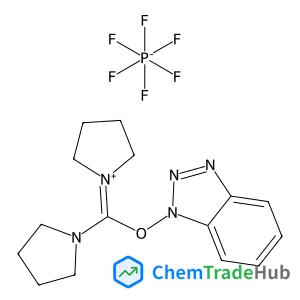
(1H-Benzotriazol-1-yloxy)(di-1-pyrrolidinyl)methylium hexafluorophosphate
CAS番号:
105379-24-6
分子式:
C15H21F6N5OP
Wilbee D. Sasikala, Arnab Mukherjee
DNA intercalation is a clinically relevant biophysical process due to its potential to inhibit the growth and survival of tumor cells and microbes through the arrest of the transcription and replication processes. Extensive kinetic and thermodynamic studies have followed since the discovery of the intercalative binding mode. However, the molecular mechanism and the origin of the thermodynamic and kinetic profile of the process are still not clear. Here we have constructed the free energy landscape of intercalation, de-intercalation and dissociation from both the major and minor grooves of DNA using extensive all-atom metadynamics simulations, capturing both the free energy barriers and stability in close agreement with fluorescence kinetic experiments. In the intercalated state, an alternate orientation of proflavine is found with an almost equal stability compared to the crystal orientation, however, separated by a 5.0 kcal mol−1 barrier that decreases as the drug approaches the groove edges. This study provides a comprehensive picture in comparison with experiments, which indicates that the intercalation and de-intercalation of proflavine happen through the major groove side, although the effective intercalation barrier increases because the path of intercalation goes through the stable (abortive) minor groove bound state, making the process a millisecond long one in excellent agreement with the experiments. The molecular origin of the higher barrier for the intercalation from the minor groove side is attributed to the desolvation energy of DNA and the loss of entropy, while the barrier from the major groove, in the absence of desolvation energy, is primarily entropic.

Journal of the Indian Institute of Science

Biocatalysis and Biotransformation

Topics in Catalysis

Colloid Journal

Critical Reviews in Solid State and Materials Sciences

Acta Metallurgica Sinica-English Letters

Heteroatom Chemistry

Electroanalysis

Bioorganic & Medicinal Chemistry

Journal of Asian Natural Products Research
Devesh Barshilia, Akhil Chandrakanth Komaram, Pin-Chuan Chen
DOI: 10.1039/D2AN01092E
Juliette Phillips, Elizabeth Harrild, Rebecca J. Tidy, Lincoln Codd, Kirsty Richardson, Liesl Celliers
DOI: 10.1039/D2AN01271E
Samantha F. Douman, Onyinyechi V. Uhuo, Kefilwe V. Mokwebo, Nelia Sanga, Emmanuel I. Iwuoha
DOI: 10.1039/D2AN01357F
Xiaoqin Wu, Juanli Xi, Xuehong Wei, Caixia Yin
DOI: 10.1039/D2AN01865A
Andrew Mills, Pauline Grosshans
DOI: 10.1039/B820288E
Ilkka Lähdesmäki, Petr Chocholouš, Andrea D. Carroll, Judy Anderson, Peter S. Rabinovitch, Jaromir Ruzicka
DOI: 10.1039/B822070K
M. Brown, W. B. Dunn, P. Dobson, Y. Patel, C. L. Winder, S. Francis-McIntyre, P. Begley, K. Carroll, D. Broadhurst, A. Tseng, N. Swainston, I. Spasic
DOI: 10.1039/B901179J
Andrea Dorsa, Qing Xie, Martin Wagner, Xiaoji G. Xu
DOI: 10.1039/D2AN01103D
M. Seray Ural, Emmanuel Dartois, Jérémie Mathurin, Didier Desmaële, Philippe Collery, Alexandre Dazzi, Ariane Deniset-Besseau, Ruxandra Gref
DOI: 10.1039/D2AN01079H
Matthew R. Hicks, Timothy R. Dafforn, Angeliki Damianoglou, Paul Wormell, Alison Rodger, Søren V. Hoffmann
DOI: 10.1039/B902523E
2-溴-9,9-二苯基芴は、医薬品、工業材料、有機合成の研究分野で応用されます。特に、レーザー材料や機能性ポリマーの合成に使用されることがあります。また、蛍光色...
四氯化铱の市場は研究開発分野で注目されており、特にナノ技術や金属有機框架(MOFs)の分野での需要が増加傾向にあります。価格は安定しており、中国や韓国での生産が...
1-(4-溴-3-氟苯基)-2-氯乙酮 (CAS番号: 1260857-14-4) の廃棄物は専門的な廃棄処理が必要です。まず、廃棄物は密閉された容器に収集し、...
苦参酚Kは、CAS番号101236-49-1を持つ化合物で、主に天然由来の生薬から抽出されます。この化合物は、抗炎症作用や抗癌作用を持つことが報告されています。
POTASSIUM (1-(TERTBUTOXYCARBONYL)AZETIDIN-3-YL)TRIFLUOROBORATE を含む廃棄物は、まず安全なエント...
4-庚基-4’-聯苯羧酸は、特殊化学品や合成化学の分野で用いられる化学物質ですが、市場動向としては、研究開発の進展とともに需要が増加しています。また、環境配慮型...
6-ブロモ-3-メトキシ-1-フェニル-1H-インドゾールを含む廃棄物は、適切な化学廃棄処理が必要です。通常、廃棄物は密閉容器に収集され、専門の廃棄処理業者に引...
4,4-二甲基-2-吡咯烷酮は医薬、ポリマー、センサー、半導体などの業界で広く使用されています。特に溶媒としての性能が高く評価されています。

Physical Chemistry Chemical Physics (PCCP) is an international journal co-owned by 19 physical chemistry and physics societies from around the world. This journal publishes original, cutting-edge research in physical chemistry, chemical physics and biophysical chemistry. To be suitable for publication in PCCP, articles must include significant innovation and/or insight into physical chemistry; this is the most important criterion that reviewers and Editors will judge against when evaluating submissions. The journal has a broad scope and welcomes contributions spanning experiment, theory, computation and data science. Topical coverage includes spectroscopy, dynamics, kinetics, statistical mechanics, thermodynamics, electrochemistry, catalysis, surface science, quantum mechanics, quantum computing and machine learning. Interdisciplinary research areas such as polymers and soft matter, materials, nanoscience, energy, surfaces/interfaces, and biophysical chemistry are welcomed if they demonstrate significant innovation and/or insight into physical chemistry. Joined experimental/theoretical studies are particularly appreciated when complementary and based on up-to-date approaches.

![5-Acetyl-2,3-dihydrobenzo[b]furan structure](https://static.chemtradehub.com/structs/908/90843-31-5-eea4.webp "5-Acetyl-2,3-dihydrobenzo[b]furan structure")
![1-Naphthalenesulfonic acid, 2-[(2-hydroxy-1-naphthalenyl)azo]-, bariumsalt (2:1) structure](https://static.chemtradehub.com/structs/110/1103-38-4-0b33.webp "1-Naphthalenesulfonic acid, 2-[(2-hydroxy-1-naphthalenyl)azo]-, bariumsalt (2:1) structure")






