



Mass spectrometry tools and metabolite-specific databases for molecular identification in metabolomics
文献情報
出版日
2009-04-09
DOI
10.1039/B901179J
インパクトファクター
4.616
著者
M. Brown, W. B. Dunn, P. Dobson, Y. Patel, C. L. Winder, S. Francis-McIntyre, P. Begley, K. Carroll, D. Broadhurst, A. Tseng, N. Swainston, I. Spasic
原文を見る
要旨
The chemical identification of mass spectrometric signals in metabolomic applications is important to provide conversion of analytical data to biological knowledge about metabolic pathways. The complexity of electrospray mass spectrometric data acquired from a range of samples (serum, urine, yeast intracellular extracts, yeast metabolic footprints, placental tissue metabolic footprints) has been investigated and has defined the frequency of different ion types routinely detected. Although some ion types were expected (protonated and deprotonated peaks, isotope peaks, multiply charged peaks) others were not expected (sodium formate adduct ions). In parallel, the Manchester Metabolomics Database (MMD) has been constructed with data from genome scale metabolic reconstructions, HMDB, KEGG, Lipid Maps, BioCyc and DrugBank to provide knowledge on 42,687 endogenous and exogenous metabolite species. The combination of accurate mass data for a large collection of metabolites, theoretical isotope abundance data and knowledge of the different ion types detected provided a greater number of electrospray mass spectrometric signals which were putatively identified and with greater confidence in the samples studied. To provide definitive identification metabolite-specific mass spectral libraries for UPLC-MS and GC-MS have been constructed for 1,065 commercially available authentic standards. The MMD data are available at http://dbkgroup.org/MMD/
おすすめジャーナル

Herald of the Russian Academy of Sciences

Electroanalysis

Atomization and Sprays

Critical Reviews in Solid State and Materials Sciences

Biocatalysis and Biotransformation

Heteroatom Chemistry

Journal of Asian Natural Products Research

Bioorganic & Medicinal Chemistry

NDT & E International

Journal of the Indian Institute of Science
関連文献
Strategies toward improving the performance of fluorescence-based sensors for inorganic anions
Radek Pohl, Dmitry Aldakov, Pavel Kubát, Karolina Jursíková, Manuel Marquez, Pavel Anzenbacher, Jr.
2004-05-10
Communication
DOI: 10.1039/B315268E
A new series of sodium cobalt oxyhydrates
Donna C. Arnold, Chris J. Nuttall, Alexandros Lappas
2004-09-21
Communication
DOI: 10.1039/B405907G
Bond energy, aromatic stabilization energy and strain in IPR fullerenes
Michał K. Cyrański, Siân T. Howard, Michał L. Chodkiewicz
2004-09-21
Communication
DOI: 10.1039/B408903K
A new (63)·(69.81) non-interpenetrated paramagnetic network with helical nanochannels based on a tricarboxylic perchlorotriphenylmethyl radical
Daniel Maspoch, Daniel Ruiz-Molina, Klaus Wurst, Concepció Rovira, Jaume Veciana
2004-04-22
Communication
DOI: 10.1039/B315147F
Large scale, templateless, surfactantless route to rapid synthesis of uniform poly(o-phenylenediamine) nanobelts
Xuping Sun, Shaojun Dong, Erkang Wang
2004-04-23
Communication
DOI: 10.1039/B401777C
Thin Pd membrane prepared on macroporous stainless steel tube filter by an in-situ multi-dimensional plating mechanism
Jianhua Tong, Yasuyuki Matsumura
2004-09-20
Communication
DOI: 10.1039/B406975G
Continuous preparation of functionalised calcium phosphatenanoparticles with adjustable crystallinity
Thea Welzel, Wolfgang Meyer-Zaika, Matthias Epple
2004-04-20
Communication
DOI: 10.1039/B402521K
Synthesis of monodisperse iron oxidenanocrystals by thermal decomposition of iron carboxylate salts
William W. Yu, Joshua C. Falkner, Cafer T. Yavuz, Vicki L. Colvin
2004-09-02
Communication
DOI: 10.1039/B409601K
Ferromagnetic NiII–GdIII interactions in complexes with NiGd, NiGdNi, and NiGdGdNi cores supported by tripodal ligands
Tomoka Yamaguchi, Yukinari Sunatsuki, Masaaki Kojima, Haruo Akashi, Masanobu Tsuchimoto, Nazzareno Re, Shutaro Osa, Naohide Matsumoto
2004-04-05
Communication
DOI: 10.1039/B401033G
Novel aggregation of [Ni(thiolato)2(amine)2]-type square planes assisted by silver(i) ions
Takumi Konno, Masafumi Usami, Masakazu Hirotsu, Takashi Yoshimura, Tatsuya Kawamoto
2004-09-01
Communication
DOI: 10.1039/B404512B
こちらもおすすめ
化合物よくある質問
2,3-スチオエポキシマドルを取り扱う際の実験室安全事項は何ですか?
取り扱いにはPPE(プロテクティブ・パーソナル・エイド)が必要で、防ぐ手袋と保護眼鏡を着用してください。ドラフトチャンバーの使用を推奨します。漏洩した場合は、適...
4267-80-52,3-Thioepoxy Madol
53981-25-22-Amino-6-fluorophen...
化合物よくある質問
BOC-S-3-アミニ-4-(4-メチオキシベンチル)-ブタン酸の代替品はありますか?
この化合物の代替品としては、BOC保護基を有さないアミノ酸やその他の保護基化合物が考えられます。また、メチオキシ基を有しない他の芳香族アミノ酸も代替品として挙げ...
126800-59-7(3S)-4-(4-Methoxyphe...
化合物よくある質問
Methyl 2-(chloromethyl)-3-nitrobenzoate(1218910-61-2)の代替品はありますか?
Methyl 2-(chloromethyl)-3-nitrobenzoate(1218910-61-2)の代替品としては、化学組成を変えることで効果を達成する...
1218910-61-2Methyl 2-(chlorometh...
化合物よくある質問
(2R)-2-アミノ-N-ベンジル-3-ヒドロキシプロパナミドを含む廃棄物はどのように処理すべきですか?
(2R)-2-アミノ-N-ベンジル-3-ヒドロキシプロパナミドを含む廃棄物は、適切な廃棄物管理ガイドラインに基づき処理する必要があります。まず、廃棄物を適切に収...
175481-39-7(2R)-2-amino-N-benzy...
化合物よくある質問
6,7-二氢-咪唑並[1,2-a]ピリドイン-8(5h)-酮はどのように合成されますか?
6,7-二氢-咪唑並[1,2-a]ピリドイン-8(5h)-酮は、2-ブロモフェニルアセトインとリン酸ハロゲン化物を反応させることで合成できます。この反応は高温で...
457949-09-66,7-Dihydroimidazo[1...
化合物よくある質問
エチル(3R)-3-ピロリジニル酢酸水和塩とは何ですか?
エチル(3R)-3-ピロリジニル酢酸水和塩は、CAS番号1332459-32-1の化合物で、(R)-乙基2-(ピロリジン-3-基)酢酸塩水和塩と呼ばれます。この...
1332459-32-1Ethyl (3R)-3-pyrroli...
化合物よくある質問
(2S)-{[(2-メチルエチルオキシ]カルボニル}アミノ)[2-(トリアフルオロメチルフェニル]エチカシック酸の物理化学的性質は何ですか?
(2S)-{[(2-メチルエチルオキシ]カルボニル}アミノ)[2-(トリアフルオロメチルフェニル]エチカシック酸のCAS番号は1203454-45-8です。この...
1203454-45-8(2S)-({[(2-Methyl-2-...
化合物よくある質問
2-ブロモ-1-(2-メチル-2-プロパニル)-4-ニトロベンゼンはどのように保存すればよいですか?
2-ブロモ-1-(2-メチル-2-プロパニル)-4-ニトロベンゼンは、直射日光を避けて暗所で、室温(約15℃〜25℃)、乾燥した場所に保存する必要があります。ま...
6310-17-42-Bromo-1-(2-methyl-...
化合物よくある質問
1-[(4-硝基フェニル)スルホニル]-1H-1,2,4-三唑の市場動向や研究トレンドはどうですか?
市場動向としては、1-[(4-硝基フェニル)スルホニル]-1H-1,2,4-三唑は主に農業用除草剤や合成化学製品の原料として利用されています。研究トレンドとして...
57777-84-11-[(4-Nitrophenyl)su...
掲載誌
Analyst

CiteScore:
7.8
自己引用率:
5.6%
年間論文数:
653
Analyst publishes analytical and bioanalytical research that reports premier fundamental discoveries and inventions, and the applications of those discoveries, unconfined by traditional discipline barriers.
おすすめ化合物
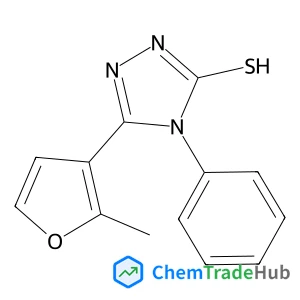
5-(2-Methyl-3-furyl)-4-phenyl-2,4-dihydro-3H-1,2,4-triazole-3-thione
CAS番号:
346464-59-3
分子式:
C13H11N3OS
![N-[2-(2-Pyridinyl)ethyl]-1-propanamine structure](https://static.chemtradehub.com/structs/554/55496-57-6-22b4.webp "N-[2-(2-Pyridinyl)ethyl]-1-propanamine structure")
![6-(Benzyloxy)-8-(2-bromoacetyl)-2H-benzo[b][1,4]oxazin-3(4H)-one structure](https://static.chemtradehub.com/structs/926/926319-53-1-2287.webp "6-(Benzyloxy)-8-(2-bromoacetyl)-2H-benzo[b][1,4]oxazin-3(4H)-one structure")

おすすめサプライヤー






免責事項
このページに表示される学術雑誌情報は、参考および研究目的のみを目的としています。当社は雑誌出版社とは提携しておらず、投稿の取り扱いも行っておりません。出版に関するお問い合わせは、各雑誌出版社に直接ご連絡ください。
表示されている情報に誤りがある場合は、support@chemtradehub.com までご連絡ください。迅速に確認し、対応いたします。