












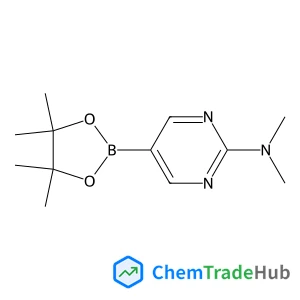
N,N-Dimethyl-5-(4,4,5,5-tetramethyl-1,3,2-dioxaborolan-2-yl)-2-pyrimidinamine
CAS番号:
1032759-30-0
分子式:
C12H20BN3O2
Samuel Aleksanian, Behnoush Khorsand, Rolf Schmidt, Jung Kwon Oh
Degradation of amphiphilic block copolymer (ABP) micelles in response to external stimuli (stimuli-responsive degradation) is a desired property in the design of controlled delivery vehicles. Here, a versatile methodology that combines facile carbodiimide coupling polycondensation with controlled radical polymerization to synthesize thiol-responsive degradable ABP micelles is described. These smart micelles consist of a hydrophobic degradable polyester block with disulfide linkages labeled repeatedly along the main chain; more importantly, in response to thiols they exhibit rapid and controlled degradation, thereby leading to enhanced release of encapsulated model drugs. Moreover, the proposed method allows for a facile bioconjugation of hydrophilic coronas using cell-targeting biomolecules during polymerization.
Yingda Huang, Jianyun He, Zhanxiong Liu, Guilong Cai, Shaowen Zhang, Xiaofang Li
DOI: 10.1039/C6PY01859A
Huafeng Chen, Weijing Pan, Kuo-Wei Huang, Xuequan Zhang, Dirong Gong
DOI: 10.1039/C7PY00252A
Ana Cenacchi Perreira, Samuel Pearson, Franck D'Agosto, Muriel Lansalot, Elodie Bourgeat-Lami
DOI: 10.1039/C6PY01742H
Marcos Fernandez-Villamarin, Ana Sousa-Herves, Silvia Porto, Noelia Guldris, José Martínez-Costas, Ricardo Riguera, Eduardo Fernandez-Megia
DOI: 10.1039/C7PY00304H
Juxin He, Luyang Du, Cong Wang, Mingjian Jiang, Linlin Liu, Yueqi Mo, Zengqi Xie, Bing Yang, Yuguang Ma
DOI: 10.1039/C6PY01995A
Shinji Yamada, Akinori Takasu, Sadatsugu Takayama, Kazuhiko Kawamura
DOI: 10.1039/C4PY00639A
David Alaimo, Alexandre Beigbeder, Philippe Dubois, Guy Broze, Christine Jérôme, Bruno Grignard
DOI: 10.1039/C4PY00366G
Manuela Bader, Gabriel Theurkauff, Katty Den Dauw, Christian Lamotte, Olivier Lhost, Evgueni Kirillov, Jean-François Carpentier
DOI: 10.1039/C4PY00612G
Sue Watson, Anna M. Grabowska
DOI: 10.1039/C4PY00369A
Jinying Peng, Chun Tian, Lifen Zhang, Zhenping Cheng, Xiulin Zhu
DOI: 10.1039/C6PY02133F
6- bromo-1-cyclopropyl-1H-benzimidazoleは、抗炎症、抗ウイルス作用を持つことが報告されており、新薬開発の研究対象として注目...
取り扱う際には、防護眼鏡と手袋を使用し、ドラフトチャンバー内で操作することを推奨します。漏洩時には適切な手順で処理し、安全データシートを常に参照してください。
2,2’-ジメチル-3,3’-ビピリジンは、ピリジンと2-メチルアクリルアミドを有機合成反応で合成します。この反応では、ピリジンと2-メチルアクリルアミドを含有...
6-甲基ピリジン-2-ボリック酸は、合成化学、医薬品合成、以及研究用途などに広く使用され、特に組換えDNA技術や分子生物学の研究において重要な役割を果たします。
(R)-3-(1-甲基-2-氧環己基)プロpano酸メチルは一定の安全性がありますが、直接的な皮膚接触や吸入は避けるべきです。使用する際は適切な個々の安全データ...
ketorolacは、密封して遮光容器に保管し、直射日光や高温を避けて保存してください。温度は常温で保存し、湿度をなるべく低く保つことが推奨されます。
L-2,3-二氨基丙酸二盐酸盐は腐食性が強く、皮膚や粘膜に刺激を与える可能性があります。取り扱う際は、防塵マスク、ゴーグル、手袋を使用し、適切な排気設備を使用し...
2-(4-溴ピリジン-2-基)乙腈のCAS番号は312325-73-8です。主に結晶形態で存在し、分子量は159.01 g/molです。この化合物は水に溶けやす...
この化合物は毒性は低いですが、直接的な接触や吸入に注意が必要です。PPE(個人防護具)を着用し、ドラフトチャンバーを使用して操作することを推奨します。また、漏洩...
3-(1-氧代-1,3-二氢-2H-2-异吲哚)丙酸は、薬理学研究や医薬品製造において広く用いられる化合物です。また、工業的な用途でも一部の化学反応の触媒や助剤...

Polymer Chemistry welcomes submissions in all areas of polymer science that have a strong focus on macromolecular chemistry. Manuscripts may cover a broad range of fields, yet no direct application focus is required.
![4-[(3-Chloro-2-fluorophenyl)amino]-7-methoxy-6-quinazolinyl acetate structure](https://static.chemtradehub.com/structs/740/740081-22-5-f58f.webp "4-[(3-Chloro-2-fluorophenyl)amino]-7-methoxy-6-quinazolinyl acetate structure")




