


Controlled polymerization of isoprene promoted by a type of hemilabile XPN3 (X = O, S) ligand supported cobalt(ii) complexes: the role of a hemilabile donor on the level of control
文献情報
出版日
2017-02-20
DOI
10.1039/C7PY00252A
インパクトファクター
5.582
著者
Huafeng Chen, Weijing Pan, Kuo-Wei Huang, Xuequan Zhang, Dirong Gong
原文を見る
要旨
Cobalt dichloride complexes (Co1–Co9) carrying a novel type of hemilabile donor PN3 (L1–L3) or XPN3 (L4–L6, X = O; L7–L9, X = S) are reported as precursors for controlled polymerization of isoprene. The nature of the hemilabile donor (P, O and S) determines the coordination chemistry of the complexes. X-ray analysis reveals that the P-ligated complex Co3 has two nuclear centres, with one being bis-chelated by L3 and the other with four chlorides. The complex Co4 is formed through N,N,O(P) tridentate coordination, and the S donor for complex Co7, however, lies out of the coordination sphere. Activated by AlEt2Cl, all complexes are highly active with nearly full monomer conversion within 2 h and have a controlled cis-1,4 selectivity at 77.5–99.0% for isoprene polymerization. The P-ligated complexes (Co1–Co3) have higher cis-1,4 selectivities up to 99.0%, albeit a typical molecular weight controlled characteristic is not found. The generated polymers for Co4–Co9 all exhibit well-controlled molecular weights up to 29.1 × 10⁴ and narrow molecular weight distributions (PDI < 1.25). The kinetic studies reveal that the catalyst systems follow a typical living mechanism. Correlating the hemilabile donor with the catalytic performances shows that the presence of the PO (Co4–Co6) or PS (Co7–Co9) moiety in the auxiliary ligand is essential for the living nature; by trapping the Al species, the moiety –HN–PX (X = O, S) makes propagating chain transfer to Al impossible, which was responsible for irreversible reaction in most dienes polymerization. The possible reversible coordination of the allylic end of the propagating chain to Al is proposed for the dual cis-1,4 and 3,4 selectivities for Co4–Co9. This study represents the first example of cobalt catalyzed molecular weight and microstructure controlled polymerization of isoprene ever known.
おすすめジャーナル

Russian Journal of Bioorganic Chemistry

Russian Journal of General Chemistry

Journal of Saudi Chemical Society

Russian Journal of Coordination Chemistry

Saudi Pharmaceutical Journal

Organic Process Research & Development

Drug Discovery Today

Russian Chemical Bulletin

Crystallography Reports

Russian Journal of Organic Chemistry
関連文献
Micro-kinetic model of electrochemical carbon dioxide reduction over platinum in non-aqueous solvents
Brian A. Rohr, Aayush R. Singh, Joseph A. Gauthier, Michael J. Statt, Jens K. Nørskov
2020-02-10
Paper
DOI: 10.1039/C9CP05751J
A detailed description of the CO molecule adsorbed in InOF-1
Bruno Landeros-Rivera, Ilich A. Ibarra, Mariana L. Díaz-Ramírez, Rubicelia Vargas, Hugo A. Lara-García, Jorge Garza, Ana Martínez
2020-03-16
Paper
DOI: 10.1039/D0CP00579G
Metallic FeSe monolayer as an anode material for Li and non-Li ion batteries: a DFT study
Xiaodong Lv, Fengyu Li, Jian Gong, Jinxing Gu, Shiru Lin, Zhongfang Chen
2020-03-20
Paper
DOI: 10.1039/D0CP00967A
Revealing the thermodynamics of individual catalytic steps based on temperature-dependent single-particle nanocatalysis
Tao Chen
2019-09-24
Paper
DOI: 10.1039/C9CP04538D
The total dose effect of γ-ray induced domain evolution on α-In2Se3 nanoflakes
Jinbin Wang, Xiangli Zhong, Xiaoping Ouyang
2020-03-30
Communication
DOI: 10.1039/D0CP00512F
Effect of graphene between photoanode and sensitizer on the intramolecular and intermolecular electron transfer process
Xiaofei Wang, Yuanzuo Li, Peng Song, Fengcai Ma, Yanhui Yang
2020-02-28
Paper
DOI: 10.1039/C9CP06543A
First-principles simulation of monolayer hydrogen passivated Bi2O2S2–metal interfaces
Linqiang Xu, Shiqi Liu, Han Zhang, Xiuying Zhang, Jingzhen Li, Jiahuan Yan, Bowen Shi, Jie Yang, Lianqiang Xu, Xiaotian Sun
2020-03-12
Paper
DOI: 10.1039/D0CP00058B
Thermal decomposition of mixed calcium oxalate hydrates – kinetic deconvolution of complex heterogeneous processes
Roman Svoboda, Zuzana Olmrová Zmrhalová, Dušan Galusek, Daniela Brandová, Jozef Chovanec
2020-03-23
Paper
DOI: 10.1039/C9CP06867H
Efficient thermal- and photocatalysts made of Au nanoparticles on MgAl-layered double hydroxides for energy and environmental applications
2019-09-16
Paper
DOI: 10.1039/C9CP04445K
Dissociative chemisorption of O2 on Agn and Agn−1Ir (n = 3–26) clusters: a first-principle study
Chuangchuang Wang, Yongpeng Yang, Xiaojing Liu, Yuanjie Li, Dandan Song, Yun Tian, Zhaojun Zhang
2020-04-06
Paper
DOI: 10.1039/D0CP01005G
こちらもおすすめ
28770-01-62-(2-Isopropyl-1,3-o...
化合物よくある質問
「邻羟基阿托伐他汀内酯标准品」に適用される法規ガイドelinesは何ですか?
CAS番号163217-74-1の「邻羟基阿托伐他汀内酯标准品」は、GHS分類では危険物に分類されず、主にREACH規則とFDA/EPAの管理対象となります。R...
163217-74-1ortho-Hydroxy Atorva...
化合物よくある質問
メチル(3R)-3-アミノ-2,3-ジヒドロ-1-ベンゾファンラニン-5-カルボイル酸塩塩酸塩の主な用途は何ですか?
メチル(3R)-3-アミノ-2,3-ジヒドロ-1-ベンゾファンラニン-5-カルボイル酸塩塩酸塩は、医薬品や合成化学の研究に広く用いられます。また、特定の薬物の前...
2241594-15-8Methyl (3R)-3-amino-...
化合物よくある質問
トランス-4-メチルピロリジン-3-オール塩酸塩はどのように合成されますか?
トランス-4-メチルピロリジン-3-オール塩酸塩は、4-メチルピロリジンの塩酸塩化によって合成されます。一般的な合成方法では、4-メチルピロリジンを塩酸に加えて...
265108-42-7trans-4-Methylpyrrol...
化合物よくある質問
硫雜環丁烷-1,1-二氧化物は安全ですか?
硫雜環丁烷-1,1-二氧化物は安全ではありません。毒性は報告されていませんが、高温下で分解し、可燃性があるため、高圧ガスは注意が必要です。密閉した容器で保管し、...
5687-92-3Thietane 1,1-dioxide
6054-10-02H, 8H-Benzo[1,2-b
化合物よくある質問
9-ヒドロキシエリプチシネ塩酸塩はどのように合成されますか?
9-ヒドロキシエリプチシネ塩酸塩は、エリプチシネから塩酸を添加することで合成されます。選択性は高いですが、収率は約70%です。
52238-35-49-Hydroxyellipticine...
化合物よくある質問
5-塩素-2-(メチルアミノ)フェニル-(2-塩素フェニル)メタン酮の物理化学的性質は何ですか?
5-塩素-2-(メチルアミノ)フェニル-(2-塩素フェニル)メタン酮のCAS番号は5621-86-3です。この化合物は白色の結晶性粉末で、分子量は415.03で...
5621-86-3[5-Chloro-2-(methyla...
化合物よくある質問
1-[2-(4-甲氧基-苯氧基)-乙基]-哌嗪はどのように保存すればよいですか?
1-[2-(4-甲氧基-苯氧基)-乙基]-哌嗪は、直射日光を避けて暗所に、室温(15-25℃)で保管し、密閉容器に入れることで安定性を保つことができます。
117132-44-21-[2-(4-Methoxy-phen...
化合物よくある質問
2-[3-(4-甲氧基フェニル)プロピル]-4,4,5,5-四メチル-1,3,2-ドイボロロールアンの主な用途は何ですか?
2-[3-(4-甲氧基フェニル)プロピル]-4,4,5,5-四メチル-1,3,2-ドイボロロールアンは、医薬品の合成、有機合成化学、および新材料の研究で使用され...
1073371-72-82-[3-(4-Methoxypheny...
掲載誌
Polymer Chemistry

CiteScore:
8.6
自己引用率:
7.3%
年間論文数:
457
Polymer Chemistry welcomes submissions in all areas of polymer science that have a strong focus on macromolecular chemistry. Manuscripts may cover a broad range of fields, yet no direct application focus is required.
おすすめ化合物
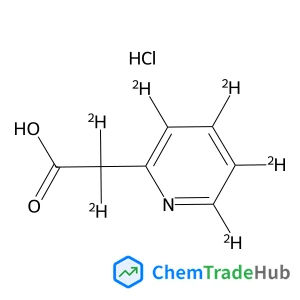
2,2-dideuterio-2-(3,4,5,6-tetradeuterio-2-pyridyl)acetic acid;hydrochloride
CAS番号:
1329799-67-8
分子式:
C7H2ClD6NO2
![[(1S,2S,3R,4S,7R,9S,10S,12R,15S)-4,12-Diacetyloxy-15-[(2R,3S)-3-benzamido-3-phenyl-2-(2,2,2-trichloroethoxycarbonyloxy)propanoyl]oxy-1,9-dihydroxy-10,14,17,17-tetramethyl-11-oxo-6-oxatetracyclo[11.3.1.03,10.04,7]heptadec-13-en-2-yl] benzoate structure](https://static.chemtradehub.com/structs/100/100431-55-8-7104.webp "[(1S,2S,3R,4S,7R,9S,10S,12R,15S)-4,12-Diacetyloxy-15-[(2R,3S)-3-benzamido-3-phenyl-2-(2,2,2-trichloroethoxycarbonyloxy)propanoyl]oxy-1,9-dihydroxy-10,14,17,17-tetramethyl-11-oxo-6-oxatetracyclo[11.3.1.03,10.04,7]heptadec-13-en-2-yl] benzoate structure")
![(3R,5R)-1-[(Benzyloxy)carbonyl]-5-methyl-3-piperidinecarboxylic acid structure](https://static.chemtradehub.com/structs/126/1269757-29-0-c552.webp "(3R,5R)-1-[(Benzyloxy)carbonyl]-5-methyl-3-piperidinecarboxylic acid structure")
(3R,5R)-1-[(Benzyloxy)carbonyl]-5-methyl-3-piperidinecarboxylic acid
CAS番号:
1269757-29-0
分子式:
C15H19NO4
おすすめサプライヤー




免責事項
このページに表示される学術雑誌情報は、参考および研究目的のみを目的としています。当社は雑誌出版社とは提携しておらず、投稿の取り扱いも行っておりません。出版に関するお問い合わせは、各雑誌出版社に直接ご連絡ください。
表示されている情報に誤りがある場合は、support@chemtradehub.com までご連絡ください。迅速に確認し、対応いたします。