












Near infrared labeling of PLGA for in vivo imaging of nanoparticles
文献情報
出版日
2012-01-17
DOI
10.1039/C2PY00520D
インパクトファクター
5.582
著者
原文を見る
要旨
To introduce optical imaging among methods available to follow nanoparticle biodistribution, we have evaluated the concept of covalently labeling poly(lactide-co-glycolide) (PLGA) with a near-infrared (NIR) dye to obtain stable NIR fluorescent nanoparticles. PLGA was coupled with the NIR dye (DY-700, Dyomics) by an amide bond with 38% efficiency. Incorporating 1% of this conjugate into PLGA nanoparticles stabilised by polyvinyl alcohol (PVA) leads to stable nanoparticles (NPs) without affecting their colloidal characteristics (average diameter, polydispersity and zeta potential). In addition, nanoparticles remain strongly fluorescent and display good storage stability for 4 weeks at 4 °C or over one week at 37 °C. Nanoparticle cytotoxicity evaluated using HUVEC, NIH/3T3 and J774.A1 cell lines was similar for unlabeled or labeled NPs. Fluorescent nanoparticles and free dye were injected intravenously into mice and their biodistribution was followed for 24 h by NIR imaging, in vivo and ex vivo. Nanoparticles were found mainly in the liver whereas the free dye was not accumulating preferentially in this organ. The DY-700 NIR conjugate incorporated into PLGA NPs shows good performance both in vitro and in vivo, thus paving the way to finely traceable PLGA nanosystems for in vivo administration.
関連文献
The impact of the molecular weight on the electrochemical properties of poly(TEMPO methacrylate)
Kai Zhang, Jiyu Fan, Michael J. Monteiro, Zhongfan Jia
2017-02-22
Paper
DOI: 10.1039/C7PY00151G
Unprecedented cucurbituril-based ternary host–guest supramolecular polymers mediated through included alkyl chains
Nana Sun, Dongdong Qi, Jianzhuang Jiang
2014-05-30
Communication
DOI: 10.1039/C4PY00512K
The synthesis of microporous polymers using Tröger's base formation
Mariolino Carta, Richard Malpass-Evans, Matthew Croad, Yulia Rogan, Michael Lee, Ian Rose, Neil B. McKeown
2014-06-20
Paper
DOI: 10.1039/C4PY00609G
The in situ formation of nanoparticles via RAFT polymerization-induced self-assembly in a continuous tubular reactor
Jinying Peng, Chun Tian, Lifen Zhang, Zhenping Cheng, Xiulin Zhu
2017-01-26
Paper
DOI: 10.1039/C6PY02133F
Conformation pre-organization in fluorene-based conjugated polymer for simultaneous enhancement of luminescence and charge mobility
Juxin He, Luyang Du, Cong Wang, Mingjian Jiang, Linlin Liu, Yueqi Mo, Zengqi Xie, Bing Yang, Yuguang Ma
2017-01-11
Paper
DOI: 10.1039/C6PY01995A
Naphthobisthiazole diimide-based n-type polymer semiconductors: synthesis, π-stacking, field-effect charge transport, and all-polymer solar cells
Selvam Subramaniyan, Taeshik Earmme, Nishit M. Murari, Samson A. Jenekhe
2014-07-02
Paper
DOI: 10.1039/C4PY00566J
Correction: Amphiphilic and double hydrophilic block copolymers containing a polydehydroalanine block
Peter Bellstedt
2017-01-17
Correction
DOI: 10.1039/C7PY90013A
Differences in electroactive terpolymers based on VDF, TrFE and 2,3,3,3-tetrafluoropropene prepared by batch solution and semi-continuous aqueous suspension polymerizations
Vincent Ladmiral, Thierry Lannuzel, Fabrice Domingues Dos Santos, Bruno Améduri
2016-12-14
Paper
DOI: 10.1039/C6PY01874B
‘Click’-BINOL based chiral ionic polymers for highly enantioselective recognition of tryptophan anions
Guo Wei, Yuliang Jiang, Fei Li, Yiwu Quan, Yixiang Cheng, Chengjian Zhu
2014-06-02
Communication
DOI: 10.1039/C4PY00755G
Catch and release: photocleavable cationic diblock copolymers as a potential platform for nucleic acid delivery
Matthew D. Green, Abbygail A. Foster, Chad T. Greco, Raghunath Roy, Rachel M. Lehr, Thomas H. Epps, III, Millicent O. Sullivan
2014-06-05
Communication
DOI: 10.1039/C4PY00638K
こちらもおすすめ
化合物よくある質問
6- bromo-1-cyclopropyl-1H-benzimidazoleの市場動向や研究トレンドはどうですか?
6- bromo-1-cyclopropyl-1H-benzimidazoleは、抗炎症、抗ウイルス作用を持つことが報告されており、新薬開発の研究対象として注目...
1416713-53-56-Bromo-1-cyclopropy...
化合物よくある質問
環氧プロpanol-d5を取り扱う際の実験室安全事項は何ですか?
取り扱う際には、防護眼鏡と手袋を使用し、ドラフトチャンバー内で操作することを推奨します。漏洩時には適切な手順で処理し、安全データシートを常に参照してください。
1246819-20-4Glycidol-d5
化合物よくある質問
2,2’-ジメチル-3,3’-ビピリジンはどのように合成されますか?
2,2’-ジメチル-3,3’-ビピリジンは、ピリジンと2-メチルアクリルアミドを有機合成反応で合成します。この反応では、ピリジンと2-メチルアクリルアミドを含有...
86156-55-02,2’-Dimethyl-3,3’-b...
化合物よくある質問
6-甲基ピリジン-2-ボリック酸の主な用途は何ですか?
6-甲基ピリジン-2-ボリック酸は、合成化学、医薬品合成、以及研究用途などに広く使用され、特に組換えDNA技術や分子生物学の研究において重要な役割を果たします。
372963-50-3(6-Methyl-2-pyridiny...
化合物よくある質問
(R)-3-(1-甲基-2-氧環己基)プロpano酸メチルは安全ですか?
(R)-3-(1-甲基-2-氧環己基)プロpano酸メチルは一定の安全性がありますが、直接的な皮膚接触や吸入は避けるべきです。使用する際は適切な個々の安全データ...
94089-47-1methyl 3-[(1R)-1-met...
化合物よくある質問
ketorolacはどのように保存すればよいですか?
ketorolacは、密封して遮光容器に保管し、直射日光や高温を避けて保存してください。温度は常温で保存し、湿度をなるべく低く保つことが推奨されます。
74103-06-3rac Ketorolac
化合物よくある質問
L-2,3-二氨基丙酸二盐酸盐を取り扱う際の実験室安全事項は何ですか?
L-2,3-二氨基丙酸二盐酸盐は腐食性が強く、皮膚や粘膜に刺激を与える可能性があります。取り扱う際は、防塵マスク、ゴーグル、手袋を使用し、適切な排気設備を使用し...
19777-68-5(S)-2,3-Diaminopropa...
化合物よくある質問
2-(4-溴ピリジン-2-基)乙腈の物理化学的性質は何ですか?
2-(4-溴ピリジン-2-基)乙腈のCAS番号は312325-73-8です。主に結晶形態で存在し、分子量は159.01 g/molです。この化合物は水に溶けやす...
312325-73-8(4-Bromo-2-pyridinyl...
化合物よくある質問
3-フローロ-[1,1-ベンジレン]-3,4-ジカルボン酸を取り扱う際の実験室安全事項は何ですか?
この化合物は毒性は低いですが、直接的な接触や吸入に注意が必要です。PPE(個人防護具)を着用し、ドラフトチャンバーを使用して操作することを推奨します。また、漏洩...
1261915-32-53'-Fluoro-[1,1'-biph...
化合物よくある質問
3-(1-氧代-1,3-二氢-2H-2-异吲哚)丙酸の主な用途は何ですか?
3-(1-氧代-1,3-二氢-2H-2-异吲哚)丙酸は、薬理学研究や医薬品製造において広く用いられる化合物です。また、工業的な用途でも一部の化学反応の触媒や助剤...
83747-30-23-(1-Oxo-1,3-dihydro...
掲載誌
Polymer Chemistry

CiteScore:
8.6
自己引用率:
7.3%
年間論文数:
457
Polymer Chemistry welcomes submissions in all areas of polymer science that have a strong focus on macromolecular chemistry. Manuscripts may cover a broad range of fields, yet no direct application focus is required.
おすすめ化合物
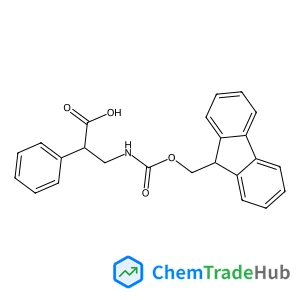
(S)-3-((((9H-Fluoren-9-yl)methoxy)carbonyl)amino)-2-phenylpropanoic acid
CAS番号:
1217663-60-9
分子式:
C24H21NO4
おすすめサプライヤー



免責事項
このページに表示される学術雑誌情報は、参考および研究目的のみを目的としています。当社は雑誌出版社とは提携しておらず、投稿の取り扱いも行っておりません。出版に関するお問い合わせは、各雑誌出版社に直接ご連絡ください。
表示されている情報に誤りがある場合は、support@chemtradehub.com までご連絡ください。迅速に確認し、対応いたします。